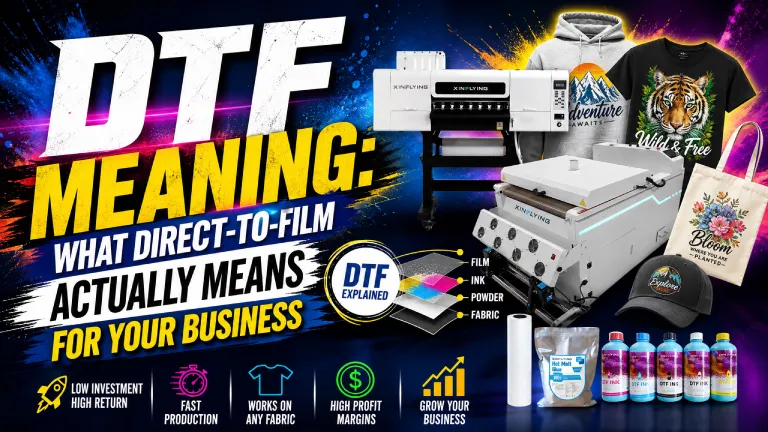
If you’ve seen “DTF printer” or “DTF transfers” while researching custom apparel equipment, you’ve probably wondered what the term actually means. Here’s a plain-English breakdown of DTF meaning, how the process works, and why it’s become one of the most talked-about printing methods in the custom apparel industry.
What Does DTF Mean?
DTF stands for Direct-to-Film. It refers to a digital printing process where a full-color design is printed onto a special PET (polyethylene terephthalate) transfer film, coated with an adhesive powder, and then transferred onto fabric using a heat press. The “direct-to-film” part of the name simply describes where the ink lands first — on film, not directly on the garment — which is what separates DTF from direct-to-garment (DTG) printing.
The DTF meaning has expanded slightly as the technology has grown: today, people use “DTF” to refer to the printing process itself, the printer that does it, and the finished transfer sheet that gets pressed onto a shirt. Context usually makes it clear which one is meant.
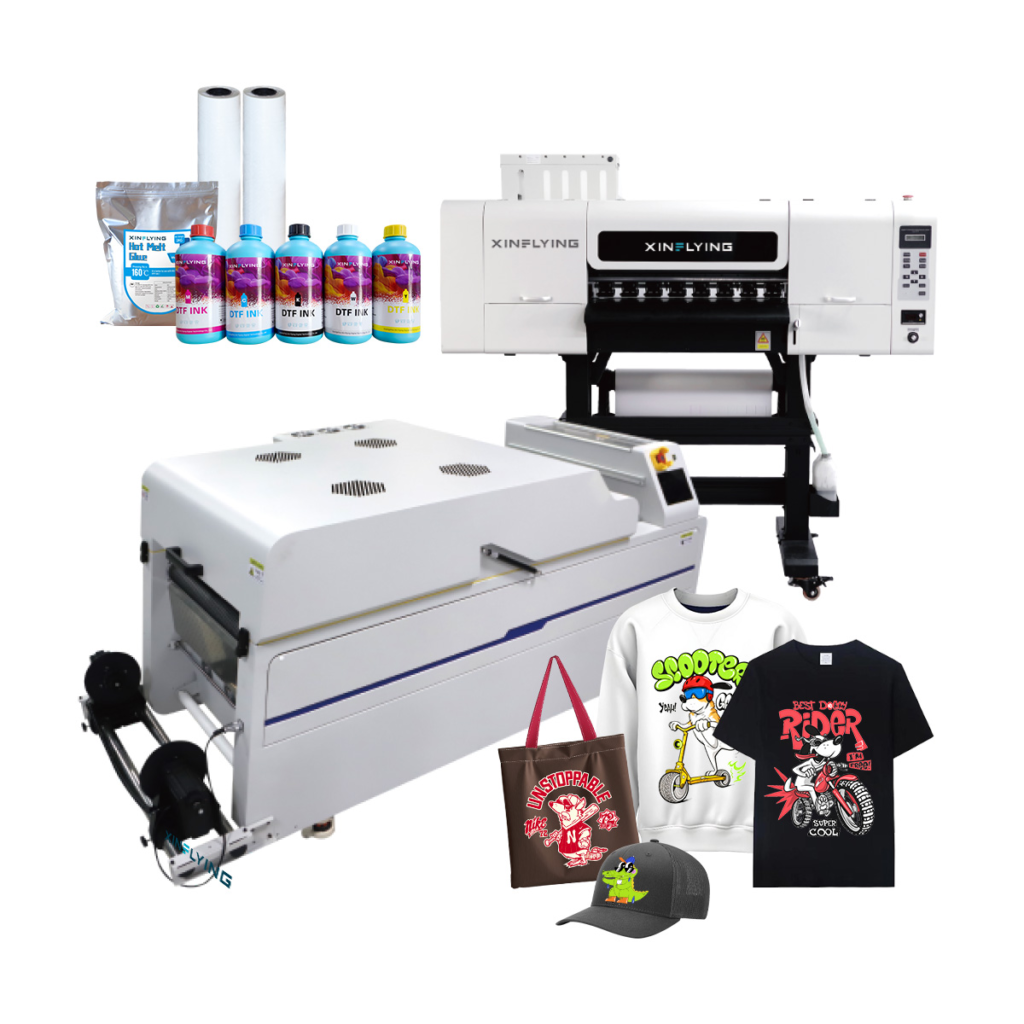
Xinflying DTF Printer Machine-C604
A 4-head DTF printer built with 4x Epson I3200-A1 printheads (CMYK+CMYK+W+W) for stable, high-volume production. Featuring a 24″ print width, it prints large graphics and multi-layout gang sheets in a single pass, maximizing film utilization.
How DTF Printing Works, Briefly
- A design is printed onto PET film using CMYK ink, with a white ink layer printed underneath to keep colors vibrant on any fabric color.
- While the ink is still wet, adhesive powder is applied to the film and any excess is shaken off.
- The powder is cured with heat, turning it into a bonding layer ready for application.
- The finished transfer is placed on the garment and pressed with heat and pressure, bonding the design to the fabric.
- The film backing is peeled away, leaving the printed design permanently transferred onto the fabric.
Why the DTF Meaning Matters for Your Business
Understanding what DTF actually involves — not just the acronym — matters because it explains why the method has specific strengths. Because the design is printed on film rather than fabric, DTF works on nearly any fabric type: cotton, polyester, blends, nylon, and even some non-textile surfaces. There’s no fabric pretreatment step required, which is a major difference from DTG printing.
It also explains the durability: the adhesive powder creates a strong mechanical and chemical bond with the fibers, so properly cured DTF prints can withstand dozens of wash cycles without cracking or peeling.
DTF vs. Screen Printing
- Screen printing requires a separate screen for every color in the design, which adds setup cost and time — DTF prints full-color designs directly from a digital file with no per-color setup.
- Screen printing is more cost-effective at very high volumes of a single design; DTF is more practical for small batches, one-off orders, and designs with gradients or photo-quality detail.
- DTF transfers can be printed ahead of time and stored, then pressed on demand — useful for print-on-demand businesses that don’t want to pre-produce finished garments.
DTF vs. DTG Printing
- DTG (Direct-to-Garment) sprays ink straight onto the fabric and works best on 100% cotton; DTF prints onto film first and works on cotton, polyester, blends, and more.
- DTG requires a pretreatment step before printing; DTF does not require pretreating the garment.
- DTF generally holds up better on dark synthetic fabrics, since the white ink underbase is built into the film rather than absorbed into the fibers.
Beyond Apparel: Where Else DTF Shows Up
While DTF is best known for t-shirts and hoodies, the same transfer process works on bags, hats, aprons, and other soft-good items — anywhere a flat or slightly curved fabric surface can be heat-pressed. This versatility is part of why the DTF meaning has broadened beyond “a t-shirt printing method” to “a general-purpose fabric transfer technology.”
Common Terms You’ll See Alongside DTF
Once you start researching DTF, you’ll run into a handful of related terms that often get used without explanation. Here’s a quick glossary so the rest of your research makes sense:
- PET film — the polyester transfer film the design is printed onto before it’s pressed onto fabric.
- White ink underbase — a layer of white ink printed beneath the CMYK colors so designs stay vibrant on dark or colored garments.
- Hot-peel / cold-peel — refers to when the film backing is removed: immediately while warm (hot-peel) or after cooling (cold-peel), depending on the film and ink used.
- RIP software — Raster Image Processor software that prepares a design file for printing, handling color separation and white ink placement.
- Gang sheet — a single sheet or roll of film loaded with multiple designs printed together to reduce wasted film and speed up production.
- DTF powder / hot-melt adhesive — the powder applied to wet ink that, once cured, bonds the design to fabric during heat pressing.
How Much Does It Cost to Get Started with DTF?
Because the DTF meaning covers everything from a small desktop unit to an industrial wide-format system, the investment required varies widely. A single-printhead A3 desktop printer sits at the lower end of the market and is often paired with a separate powder shaker and a basic heat press — a reasonable starting point for testing the waters. Multi-head, wider-format systems cost more but produce transfers faster and support higher daily order volume, which matters more once repeat business picks up.
Beyond the printer itself, ongoing costs include CMYK and white ink (white ink is consumed faster and is typically the biggest recurring expense), PET film, and adhesive powder — all of which scale with how much you print rather than being a one-time cost.
Frequently Asked Questions
In the custom apparel and printing industry, DTF almost always refers to Direct-to-Film printing. The same three letters occasionally appear in unrelated fields (like finance or gaming), so context matters, but in a printing or apparel conversation, DTF means Direct-to-Film.
No. Sublimation printing uses heat to turn dye into a gas that bonds with polyester fibers, and it only works well on light-colored polyester fabric. DTF prints ink onto a film with a white underbase, so it works on cotton, polyester, blends, and both light and dark garments.
The PET (polyethylene terephthalate) film is the surface the design is printed onto before adhesive powder is applied. It acts as a temporary carrier — once the design is heat-pressed onto the garment, the film is peeled away, leaving only the ink and adhesive bonded to the fabric.
Yes. Because DTF transfers are printed on film and can be pressed onto a garment at any point after printing, many shops print designs in batches and store the finished transfers until an order comes in, which speeds up fulfillment for repeat designs.
A single-printhead desktop model can handle small-batch or startup volume, but multi-head printers (dual, quad, or more) print significantly faster, which matters once you’re fulfilling daily orders rather than occasional ones — the right choice depends on your expected volume, not just budget.
No — regardless of brand, DTF refers to the same underlying process: printing onto film, applying adhesive powder, curing, and heat-pressing onto fabric. What varies between brands and models is print speed, printhead technology, and build quality, not the fundamental meaning of the term.
Related Resources
External reference — Polyethylene Terephthalate (PET) — Wikipedia