
DYE SUBLIMATION PRINTING SOLUTION
Dye Sublimation Printer for Home Textiles
Roll-to-roll sublimation solution for curtains, bedding, and upholstery fabrics.
Curtain manufacturers
Home décor fabric suppliers
Why Choose a Dye Sublimation Printer for Home Textiles?
You Produce
Polyester-Based Fabrics
You Need
More Pattern Flexibility
You Want
Faster Sampling and Approval
You Need
Continuous 1.9 m Roll Production
Challenges in Home Textile Printing
High Setup Cost for Small Orders
Slow Sampling Cycle
Limited Design Flexibility
Inventory Risk from Seasonal Collections
Home Textile Products Suited to Dye Sublimation Printing
Curtains & drapes
The largest single application for wide-format sublimation in home textiles. Continuous roll printing eliminates the panel joins required by narrower printing equipment.
Why sublimation: 1.9 m width covers standard curtain drops in one pass. Repeat pattern registration across long fabric runs is controlled by the RIP system.
Bedding — duvet covers & pillowcases
Large-format panel printing for king, queen, and single bedding sets. Complex botanical, geometric, and photographic prints reproduced at full resolution.
Why sublimation: No surface coating means the printed fabric retains the soft hand-feel required for bedding products that are in direct skin contact.
Cushion covers & throw pillows
High-margin short-run and custom production. E-commerce cushion businesses, interior designers, and furniture brands ordering small batches of unique designs.
Why sublimation: No minimum order quantity — profitable at any run length. Design changes require no additional setup cost.
Upholstery & sofa cover fabrics
Decorative upholstery fabric for furniture manufacturers and interior fit-out projects. Large continuous print runs with precise repeat pattern matching across fabric widths.
Why sublimation: Roll-to-roll production maintains pattern registration across full furniture-length fabric cuts without the colour shift that occurs between separate print batches.
Tablecloths & table runners
Hotel, restaurant, and hospitality custom tablecloths. Geometric and branded repeat patterns across large table dimensions. Wash durability for commercial laundry cycles.
Why sublimation: Sublimation prints withstand commercial laundering at high temperatures — critical for hospitality linen that is washed daily.
Wall art & decorative fabric panels
Printed fabric wall panels, tapestries, and art reproductions for interior decoration. High-resolution photographic and artistic imagery on lightweight polyester canvas.
Why sublimation: 3200 dpi resolution reproduces photographic detail and fine brushwork with accuracy equivalent to fine-art printing on paper — on a washable, frameable fabric substrate.
Build a Complete Home Textile Sublimation Production Line
For continuous roll-to-roll home textile production, the sublimation printer and calendar heat press must operate at matched speeds. XINFLYING provides coordinated 1.9 m printer-plus-calendar configurations from one supplier.
Sublimation Printers
1.9 m · 8-head sublimation printer for mid-volume home textile production
Print heads
8× Epson i3200-A1
Max speed
306 m²/h (1 pass)
Recommended speed
210 m²/h (1 pass)
Print width
75″ / 190 cm
Resolution
3200 dpi
Power
10.2 kW · 210–230 V · 45 A
Drying
Built-in intelligent hot-air dryer
Software
Maintop (std) · PrintFactory · RIN
Recommended for curtain, bedding, and cushion cover production at mid-volume scale. Matched with XF-60190B(H) calendar.
High throughput
1.9 m · 15-head sublimation printer for high-volume home textile production
Print heads
15× Epson i3200-A1
Max speed
524 m²/h (1 pass)
Recommended speed
394 m²/h (1 pass)
Print width
75″ / 190 cm
Resolution
3200 dpi
Power
14.5 kW · 210–230 V · 45 A
Drying
Built-in intelligent hot-air dryer
Software
Maintop (std) · PrintFactory · RIN
Suited to large-scale curtain mills and bedding manufacturers running multi-shift operations. Matched with XF-80190B(H) calendar.
Calendar Heat Press Machines
Calendar heat press · 1.9 m width · 60 cm drum · for mid-volume lines
Roller width
1.9 m
Roller diameter
60 cm (24″)
Transfer speed
300–400 m/h
Working table
3 m length
Roller material
100% aramid (8 mm)
Temperature range
0–260°C
Power
54.3 kW · 3-phase 220 V / 380 V
Current
145 A / 85 A · 50 Hz / 60 Hz
Transfer speed matched to XF-19E8-PRO output. Suitable for curtain and bedding mills producing up to 300–400 linear metres per hour.
High throughput
Calendar heat press · 1.9 m width · 80 cm drum · for high-volume lines
Roller width
1.9 m
Roller diameter
80 cm
Transfer speed
600 m/h
Working table
3 m length
Roller material
100% aramid (6 mm)
Temperature range
0–260°C
Power
62 kW · 3-phase 220 V / 380 V
Current
165 A / 96 A · 50 Hz / 60 Hz
600 m/h transfer speed leads the XF-19E15-PRO printer output — the calendar is never the bottleneck in a high-volume home textile line.
Recommended Home Textile Production Line Configurations
Mid-volume home textile line: XF-19E8-PRO + XF-60190B(H) — suited to curtain and bedding manufacturers producing 1,500–2,500 m² per shift. Both units operate within matched speed ranges for continuous uninterrupted production.
High-volume home textile line: XF-19E15-PRO + XF-80190B(H) — designed for large-scale mills running multiple shifts. The calendar’s 600 m/h transfer capacity exceeds the printer’s recommended output, ensuring the press is never the production constraint.
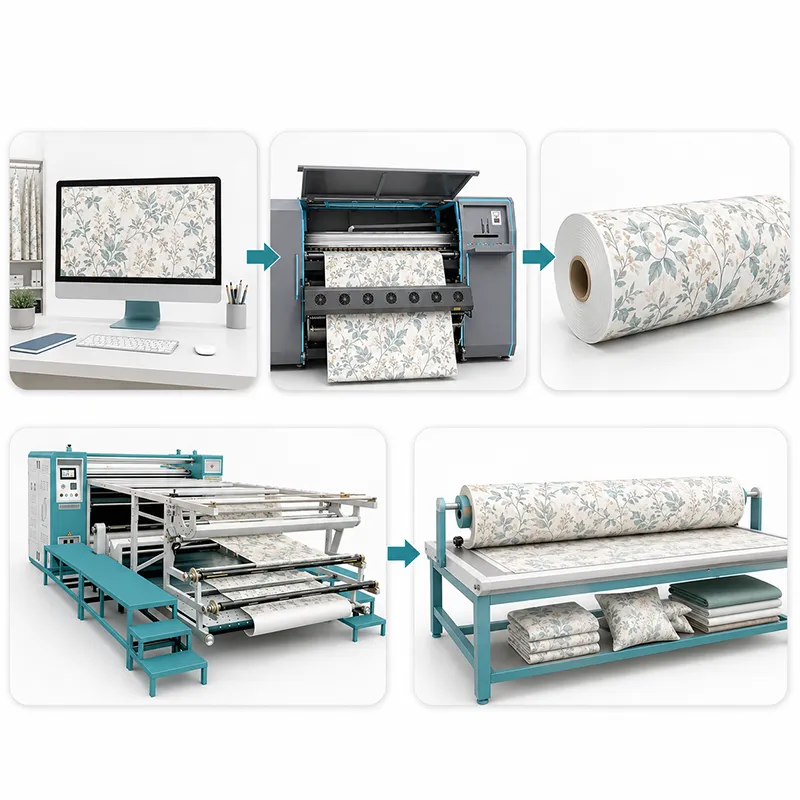
Roll-to-Roll Sublimation Workflow for Home Textiles
Patterns are created or imported into RIP software (Maintop, PrintFactory, or RIN). For home textiles, repeat unit dimensions are defined precisely in the RIP — this controls how the pattern tiles across the fabric width and along the length of the roll. A substrate-specific ICC profile is applied for the target polyester fabric. Resolution for home textile production is typically set at 100–150 dpi at final output size, balancing detail quality with print speed. Large files representing continuous roll content are processed in sections to manage memory efficiently.
Transfer paper is loaded onto the printer feed system in roll form. The sublimation printer outputs CMYK ink continuously across the full 1.9 m print width. The XF-19E8-PRO delivers recommended speeds of 210 m²/h; the XF-19E15-PRO reaches 394 m²/h. The built-in intelligent hot-air dryer ensures ink is fully cured before the paper rolls for transfer, preventing smearing or blocking during paper storage or immediate press feeding. Automatic tension control maintains consistent paper advance and prevents pattern shift across long rolls.
Printed transfer paper and polyester fabric are fed simultaneously onto the calendar heat press feed system, paper face-down onto the fabric surface. Both rolls advance together through the heated drum at matched speed. The XF-60190B(H) operates at 300–400 m/h; the XF-80190B(H) at 600 m/h. Temperature is set between 190–210°C depending on fabric weight and polyester content. At this temperature, sublimation ink converts to gas and diffuses permanently into the polyester fibre. No pressure film, adhesive, or laminate is used — the process is entirely thermal.
Printed fabric exits the calendar press and is inspected for colour consistency, sharpness, and pattern registration before re-rolling. Colour consistency is assessed visually and, in production environments, with a spectrophotometer against approved colour standards. Pattern repeat accuracy is checked at regular intervals across the roll. Any deviation in tension, temperature, or ink delivery that causes colour drift or pattern shift is identified at this stage before the roll is committed to cutting. Passed fabric is rolled onto collection cores for storage or immediate cutting.
Inspected fabric rolls are unwound and cut to finished product dimensions. Curtain fabric is cut to the required drop length, accounting for hem allowances. Bedding fabric is cut to panel sizes for duvet covers, pillowcases, and flat sheets. Cushion cover fabric is cut to template dimensions. Because the fabric is printed in a continuous roll, pattern placement is consistent across all cut pieces from the same roll — eliminating the panel-to-panel colour variation that occurs when pieces are printed individually or sourced from separate production batches.
How Sublimation Printing Can Grow Your Home Textile Business
Four key outcomes home textile manufacturers typically achieve after adopting sublimation printing.
Small Batch Profitability
Near-zero Design Cost
Win Hospitality Contracts
Faster Trend Response
Dye Sublimation Printing for Home Textiles — Frequently Asked Questions
Polyester and high-polyester-blend fabrics are required for dye sublimation printing. For curtains, 100% polyester voile, blackout polyester, and polyester-linen blends (with polyester content above 65%) are the most commonly used substrates. For bedding, 100% polyester microfibre and polyester-cotton blends (minimum 65% polyester) are standard. Pure cotton and linen fabrics are not compatible with sublimation inks and will not produce a durable result. The higher the polyester content, the more vibrant and wash-resistant the finished print.
Xinflying's XF-19E8-PRO and XF-19E15-PRO both offer a maximum print width of 1.9 m (75"). This width accommodates standard curtain panel widths, king-size bedding dimensions, and most upholstery fabric requirements in a single pass. Wide-format production at 1.9 m eliminates the need for panel joining that would be required with narrower printers, resulting in seamless full-width fabric with no colour discontinuity at joins.
Yes. Repeat pattern accuracy is managed at two levels in a sublimation production line. First, the RIP software defines repeat unit dimensions precisely and controls the printer feed system to advance the paper by exactly the correct amount for each repeat. Second, the calendar heat press tension control system ensures the fabric advances at a consistent rate matched to the paper feed, preventing pattern stretch or compression during transfer. For home textile production, where a pattern may repeat hundreds of times across a single order, this dual-level control is essential for professional results.
Rotary printing is optimised for very large production volumes — typically 5,000 metres or more per pattern — where the tooling cost is amortised across a large run. It produces consistent results at high speed for standard colour palettes. Sublimation printing has no tooling cost, no minimum run length, and no colour count limitation — it is economically viable from a single metre and reproduces photographic and gradient designs that rotary printing cannot match. For manufacturers serving custom, seasonal, and small-batch markets, sublimation offers capabilities that rotary printing cannot provide at any scale.
Yes, provided the fabric is polyester or a high-polyester blend. Sublimation is widely used for decorative upholstery fabric, sofa cover fabric, and furniture textile panels. The key considerations for upholstery are fabric weight (heavier fabrics require longer dwell time in the calendar press for complete ink penetration) and rub fastness (sublimation prints on tightly woven polyester perform well in standard rub-fastness tests for upholstery use). For upholstery fabrics with a textured or pile surface, testing on a sample prior to full production is recommended to verify the transfer quality.
There is no minimum order quantity for sublimation printing. Because the process requires no tooling, plates, or screens, the cost structure per metre is the same whether you produce 5 metres or 5,000 metres. This makes sublimation the only economically viable technology for custom home textile orders, interior designer commissions, hospitality sector contracts, and new pattern market testing — all applications where the quantities required are below the minimums of traditional printing methods.
Ready to Modernise Your Home Textile Printing?
Tell us your production requirements — fabric type, weekly output volume, print width, and whether you need a printer only or a complete printer-plus-calendar line — and we will recommend the right configuration for your home textile operation.