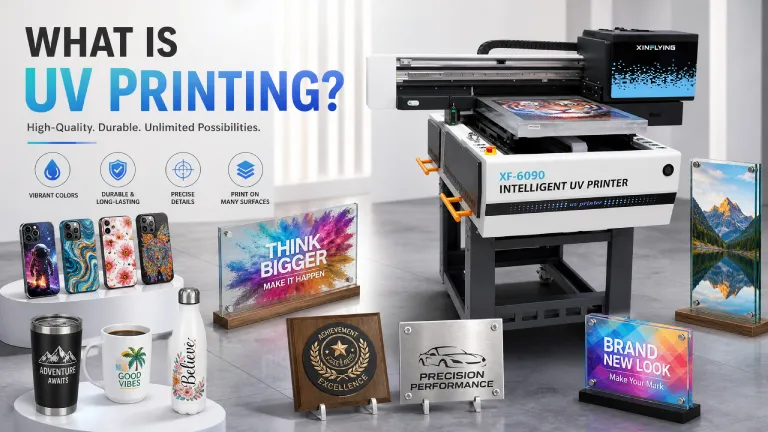
If you’ve come across the term “UV printing” while researching ways to print on materials like acrylic, wood, or metal, here’s the full picture — what it actually is, how the curing process works, and what it can (and can’t) do compared to other printing methods.
What Is UV Printing?
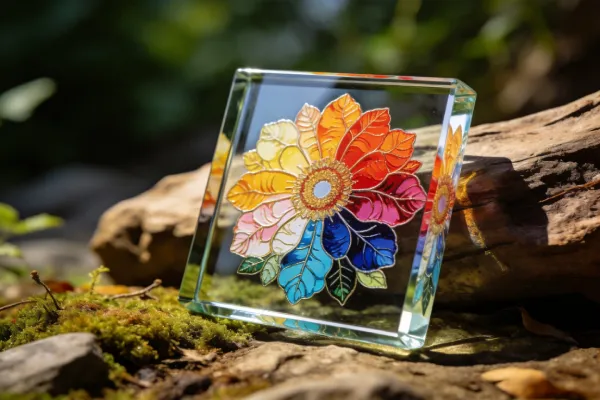
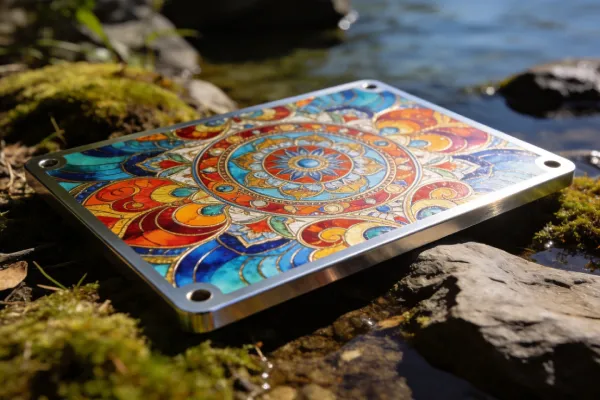
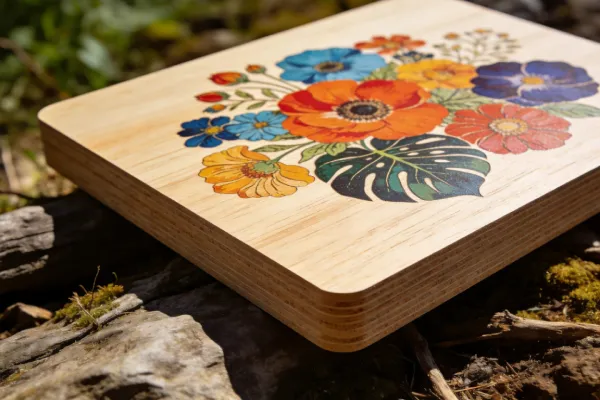
UV printing is a digital printing process that uses ultraviolet light to instantly cure, or harden, specially formulated ink as it’s applied to a surface. Instead of drying through evaporation or absorption like standard inkjet or solvent ink, UV-curable ink hardens the moment it’s exposed to UV light from lamps built into the printer. This instant curing is what allows UV printing to work on materials that other printing methods can’t handle well — non-porous, rigid surfaces like glass, metal, acrylic, and wood, where there’s nothing for liquid ink to soak into.
The technology itself isn’t brand new — UV curing was first used commercially for things like gel nail polish and industrial coatings before the printing industry adopted it. What changed is that as UV lamps, inks, and printheads became more refined and affordable, UV printing moved from a niche industrial process into something small print shops, sign makers, and product customization businesses could realistically invest in. Today it sits alongside DTF, DTG, and sublimation as one of the core digital printing technologies businesses choose between depending on what they’re decorating.
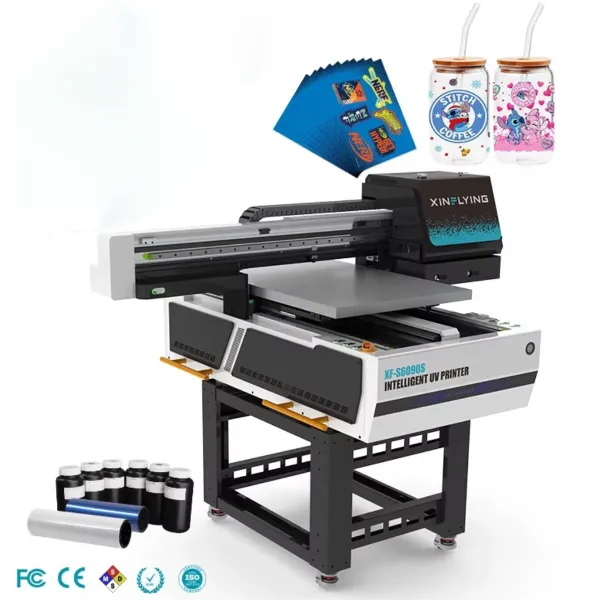
Xinflying UV Printer Machine-S6090S
UV Flatbed Printer Machine XF-S6090S delivers high-precision flatbed printing on rigid materials such as glass, metal, acrylic, wood, and plastic. It supports CMYK, white ink, and varnish printing with vibrant colors and durable finishes.
How UV Printing Works, Step by Step
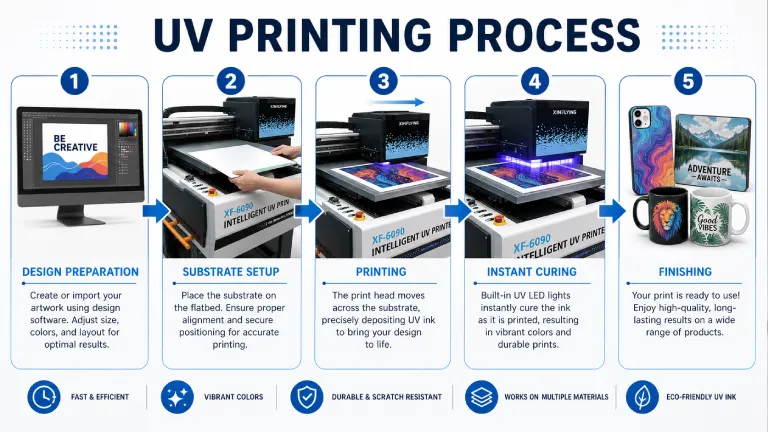
- 1. Design preparation: artwork is prepared in design software and sized to fit the target object or print area, with color modes and resolution adjusted to match the printer’s requirements.
- 2. Substrate setup: the material is cleaned and positioned on the printer’s flatbed or in a jig, since dust, oil, or debris can affect how well the ink cures and adheres to the surface.
- 3. Printing: the printhead deposits UV-curable ink onto the surface layer by layer, often including a white ink base first for color accuracy on dark, colored, or transparent materials.
- 4. Instant curing: UV lamps mounted near the printhead cure the ink almost immediately as it’s applied, hardening it into a solid layer before the next pass — this is the step that fundamentally separates UV printing from every ink-drying-based method.
- 5. Finishing: once printing is complete, the object is ready for immediate handling — there’s no separate drying rack, no waiting period, and no risk of smudging a fresh print, since curing happens in real time as the printer runs.
Why UV Printing Stands Out from Other Methods
- No drying time: because ink cures instantly under UV light, printed items can be handled, packaged, or shipped right away instead of waiting for ink to air-dry, which can take hours with solvent-based printing.
- Works on non-porous materials: UV ink adheres to surfaces like glass, metal, and plastic that liquid inks would simply sit on top of, bead up on, or fail to bond with entirely.
- Sharp detail and vibrant color: because there’s no ink spreading or bleeding during a drying phase, UV printing produces crisp edges, fine text, and accurate color reproduction even at small sizes.
- Raised, textured effects: layering multiple passes of white ink or clear varnish can create a tactile, dimensional finish, used for embossed-look designs, spot-gloss branding, and Braille or ADA-compliant signage.
- Lower VOC emissions: UV-curable inks generally release fewer volatile organic compounds than solvent-based inks, since there’s no evaporation stage releasing chemicals into the air during drying.
- Efficient use of shop space: without a drying rack or curing oven taking up floor space, a UV printing setup can have a smaller production footprint than some heat-based alternatives.
What Can You Print With UV Printing?
Because UV ink bonds to almost any clean, non-porous surface, UV printing shows up across a wide range of product categories rather than being limited to one industry:
- Promotional products: pens, phone cases, drinkware, keychains, and awards with full-color, durable designs that hold up to daily handling.
- Signage and displays: acrylic signs, POP displays, and wayfinding signage that need to hold up to handling, indoor lighting, and repeated customer contact.
- Packaging and labels: rigid packaging, sample boxes, and labels applied directly to tins, tubes, and bottles for short-run or prototype packaging work.
- Home décor: printed tile, glass panels, and wood art with custom designs, patterns, or photography reproduced directly onto the material.
- Industrial and functional parts: nameplates, control panel overlays, and instrument labels needing durable, precise printing that survives regular handling and cleaning.
- Curved and dimensional items: with a rotary attachment, UV printers can decorate tumblers, bottles, and other cylindrical items by rotating the object as it prints.
UV Printing vs. DTF Printing
These two methods are often confused because both can produce vibrant, full-color results, but they work in fundamentally different ways. UV printing cures ink directly onto the final object using UV light — no heat press involved, and no separate transfer step. DTF (Direct-to-Film) printing prints onto a film first, then transfers the design onto fabric using heat and pressure, with an adhesive powder layer bonding the ink to the fibers.
- Substrate: UV printing is generally the better fit for rigid or specialty hard-surface materials — acrylic, glass, wood, metal. DTF is built specifically for fabric and soft, flexible substrates like cotton, polyester, and blends.
- Process: UV printing is a single-pass, direct process. DTF involves multiple stages — printing, powdering, curing, and pressing — before the design reaches its final surface.
- Flexibility of finish: UV ink sits on top of the surface and can crack if the material flexes significantly, while DTF transfers are designed to stretch and move with fabric.
- Typical use case: a business decorating both hard goods (signage, drinkware) and soft goods (t-shirts, apparel) often ends up needing both technologies rather than choosing one over the other.
UV Printing vs. UV DTF Printing
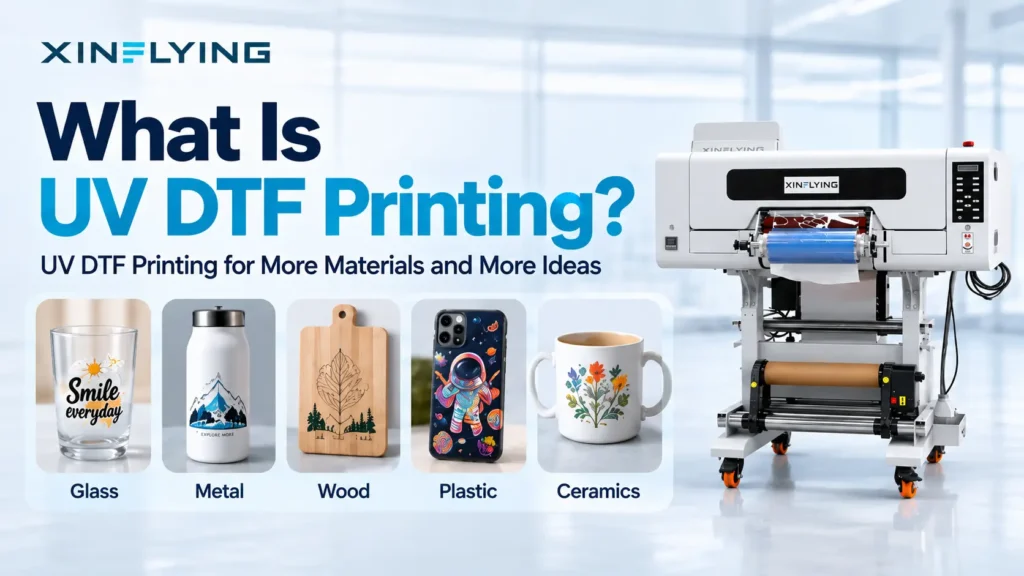
UV DTF printing is a related but distinct process, and the naming overlap trips a lot of people up. Standard UV printing applies ink directly to the object being decorated — a flatbed printer, an object jig, or a rotary attachment for curved items. UV DTF printing instead prints the design onto a transfer film first, then that film is applied to the object afterward, similar to a high-quality sticker.
- UV DTF is useful for smaller items, curved surfaces, or production setups where loading each object directly into a flatbed printer isn’t practical.
- Because UV DTF transfers are printed ahead of time, they can be produced in batches and applied later, similar to how DTF apparel transfers work — useful for businesses that want to decouple printing time from application time.
- Standard UV (direct-to-object) printing tends to produce a marginally more durable, integrated finish since there’s no adhesive layer between the ink and the object, while UV DTF trades a small amount of that durability for flexibility in what it can decorate.
Things to Consider Before Choosing UV Printing
- Equipment cost: UV printers, particularly flatbed models with a larger print area, generally represent a higher upfront investment than entry-level DTF or DTG equipment.
- Flat or gently curved surfaces work best: without a rotary attachment, UV printing is best suited to flat or slightly curved objects rather than deeply irregular shapes.
- Not a fabric solution: for t-shirts, hoodies, and other soft garments meant to be worn and washed repeatedly, DTF or DTG printing remains the more practical choice.
- Maintenance matters: like any inkjet-based system, UV printers need routine nozzle checks and printhead maintenance, with white ink channels in particular needing regular circulation to avoid clogging.
Frequently Asked Questions
No. Regular inkjet ink dries through evaporation or absorption into the material, which takes time and only works well on absorbent surfaces like paper. UV printing uses ink that cures instantly under ultraviolet light, so it works on non-porous materials like glass, metal, and acrylic that standard inkjet ink can’t dry on at all.
UV printing struggles with highly flexible or stretchy materials, since the cured ink forms a somewhat rigid layer on the surface that can crack if the material bends or stretches significantly. It also doesn’t work well on fabric meant to be worn, which is why UV printing is generally used on rigid or semi-rigid substrates rather than clothing.
UV-curable inks generally have lower VOC (volatile organic compound) emissions than solvent-based inks, since there’s no evaporation stage releasing chemicals into the air. Some odor can still occur during curing, so reasonable ventilation is still a good practice.
Once cured, UV ink is generally resistant to scratching, fading, and water exposure, making it suitable for both indoor items and many outdoor applications like signage, though a protective laminate is sometimes added for prints facing prolonged sun and weather exposure.
Standard UV printing applies ink directly onto the final object (direct-to-object). UV DTF printing instead prints onto a transfer film first, then applies the finished design to the object afterward — useful for curved surfaces or objects that are difficult to load directly into a flatbed printer.
UV printing requires a printer specifically built with UV lamps and compatible with UV-curable ink — it’s not something you can add to a standard inkjet or solvent printer. Dedicated UV flatbed or UV DTF printers are purpose-built for this curing process.