Starting a direct-to-garment (DTG) printing business doesn’t have to mean draining your savings on a full industrial setup from day one. Plenty of successful print shops started with a single entry-level machine, a spare room, and a handful of blank shirts. This guide breaks down what you actually need to get started on a limited budget, where it’s safe to cut corners, and where it isn’t.
Why DTG Is a Smart Low-Budget Entry Point
Compared to screen printing, DTG has a much lower barrier to entry. There are no screens to burn, no plates to register, and no minimum order quantities to hit before a job becomes profitable. You can print one shirt or fifty with the same setup, which makes it ideal for testing designs, running a print-on-demand shop, or serving local customers who want small custom orders.
If you’re trying to decide between the two methods for your budget and order volume, this breakdown of DTG vs. screen printing is a useful place to start — it compares setup cost, color complexity, and order size side by side.
What “Low Budget” Actually Means in DTG
Before getting into numbers, it helps to separate the costs into three categories:
- Non-negotiable equipment — the machine, curing method, and pretreatment. You cannot produce a durable, sellable print without these.
- Consumables — ink, pretreatment liquid, and blank garments. These are ongoing costs, not one-time purchases.
- Nice-to-haves — automated dryers, industrial pretreatment sprayers, and design software upgrades. These improve speed and consistency but aren’t required to print your first hundred shirts.
A realistic low-budget setup focuses entirely on category one, buys just enough of category two to start selling, and delays category three until revenue justifies it.
Core Equipment You Actually Need
1. An Entry-Level DTG Printer
This is where most of your budget will go, and it’s not the place to cut corners — a cheap or poorly built printer will cost you more in downtime, clogged heads, and wasted ink than it saves upfront. Look for a compact desktop-style DTG printer designed for small businesses rather than an industrial production model. These machines are built for lower daily volume, take up less space, and are priced accordingly.
Xinflying’s DTG Garment Printer lineup, for example, includes a compact 2-head model built specifically for small business production, alongside larger 4-head machines for shops planning to scale into higher volume later.
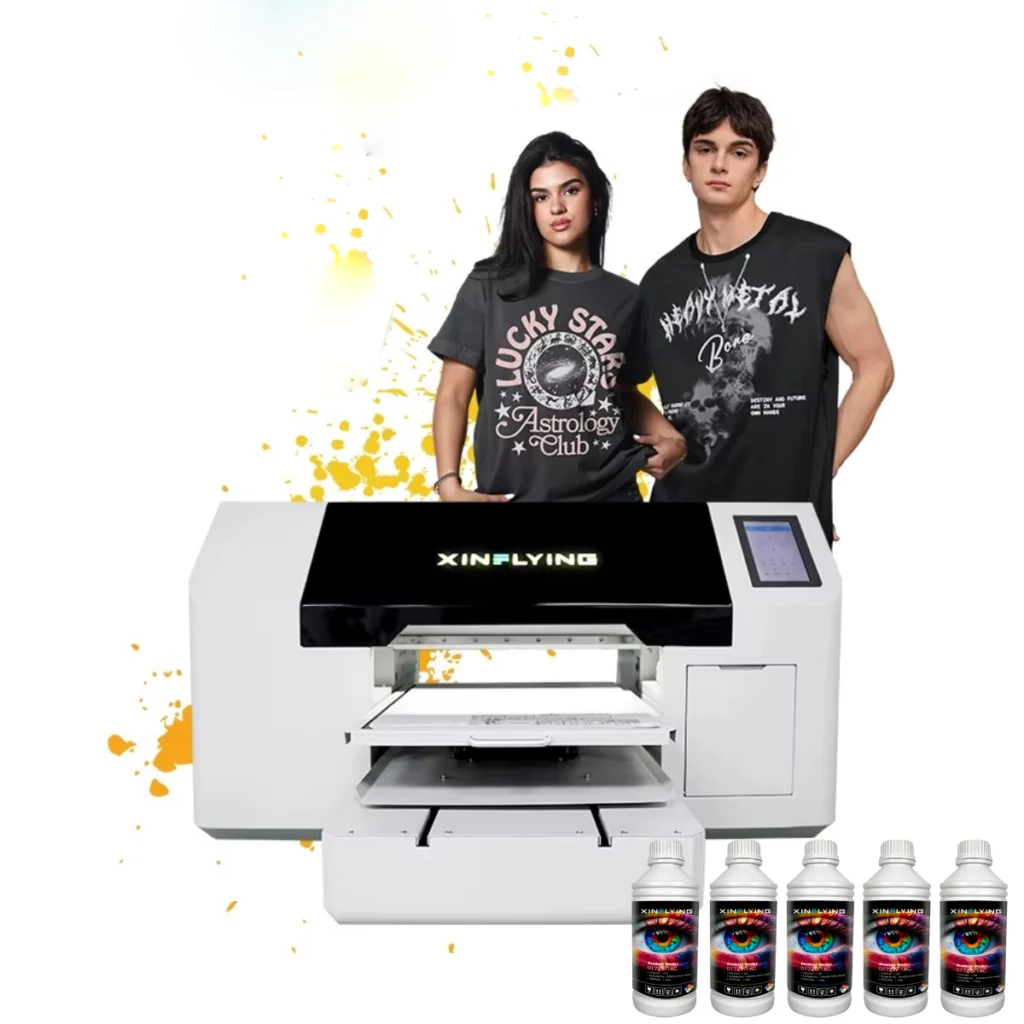
Xinflying DTG Garment Printer-10
The Xinflying DTG Garment Printer-10 is a compact direct-to-garment printer designed for small businesses and custom apparel production. It delivers vibrant, high-resolution prints on cotton garments with stable performance, easy operation, and efficient automated printing for fast, professional results.
2. A Heat Press (Not a Conveyor Dryer, Yet)
A basic heat press can handle both pretreatment drying and final ink curing, so you don’t need a conveyor tunnel dryer on day one. A single flat heat press costs a fraction of a conveyor dryer and is more than capable of curing prints at low volume. Upgrade to a tunnel dryer only once your order volume makes manual pressing a bottleneck.
3. A Manual Pretreatment Sprayer
Automated pretreatment machines speed up production, but a hand-pump sprayer applies pretreatment solution just as effectively at low volume — it just takes a little longer per garment. This is one of the easiest places to save money early on without hurting print quality.
4. Starter Ink and Pretreatment Liquid
Buy ink and pretreatment liquid in smaller starter quantities rather than committing to bulk pricing right away. Once you know your actual weekly usage, bulk buying becomes a real cost saver — but overbuying ink before you have consistent order volume just ties up cash and risks ink expiring before you use it.
For a full breakdown of what a complete workflow includes, from ink to dryers, the DTG garment printer supplies page lays out each component and how they work together.
A Realistic Starter Budget Breakdown
While exact pricing varies by supplier and region, a lean startup setup generally breaks down into these categories:
- Printer: the largest single expense, but entry-level small-business models cost significantly less than industrial multi-head machines.
- Heat press: a mid-range flat press is a one-time cost that will last for years with basic maintenance.
- Pretreatment sprayer: inexpensive compared to automated machines.
- Starter consumables (ink, pretreatment liquid, blanks): your main recurring cost, and the one most directly tied to how many shirts you’re actually printing and selling.
The key budgeting principle: spend on the printer and curing method, since those determine print quality and durability, and stay lean on consumables and automation until you have consistent order volume to justify the upgrade.
Step-by-Step: Getting Your First Orders Without Overspending
Step 1: Start with one core product. Don’t try to offer hoodies, tote bags, and shirts on day one. Pick a single garment type — plain cotton t-shirts are the easiest to print well — and master it before expanding your catalog.
Step 2: Buy blanks in small batches. Order enough garments for your first few sales, not a warehouse’s worth. This keeps cash flow flexible while you’re still learning your printer’s quirks.
Step 3: Price for your real costs. Factor in ink, pretreatment, blank garment cost, and your time. New DTG sellers often underprice their first designs and end up covering electricity and equipment wear out of pocket.
Step 4: Reinvest early profit into consumables, not new equipment. It’s tempting to buy a second printer or a fancy dryer as soon as you have some cash flow. Resist it until your current setup is actually the bottleneck.
Step 5: Track your cost per print. Knowing your actual ink and pretreatment cost per shirt lets you price confidently and spot waste early, whether it’s an over-saturated print setting or a pretreatment machine running too much solution per garment.
If you need help thinking through outside financing options as you scale beyond your own savings, the U.S. Small Business Administration’s guide to funding a small business is a solid, neutral starting point for comparing loans, crowdfunding, and self-funding.
Common Budget Mistakes to Avoid
Buying an industrial machine before you have industrial demand. A high-volume, multi-head printer is a great investment once you’re consistently printing hundreds of shirts a week — but it’s overkill, and a significant sunk cost, for a shop still building its first customer base.
Skipping pretreatment to save money. Pretreatment liquid is cheap compared to the cost of a shirt that cracks or fades after one wash. Skipping it to save a few cents per print is one of the fastest ways to lose repeat customers.
Underestimating maintenance time. DTG printers need regular head cleaning and ink circulation, especially the white ink line. Budget your own time for this — a clogged head you could have prevented is far more expensive to fix than the five minutes routine maintenance takes.
Ignoring garment quality to cut costs. A slightly cheaper blank that’s thin or loosely woven often prints unevenly, which means wasted ink and reprints. The savings on the blank rarely make up for the reprint cost.
Scaling Up When You’re Ready
Once you have consistent orders and a clear sense of your bottlenecks, it’s usually worth upgrading in this order: a second print head or higher-capacity printer first, then an automated pretreatment machine, then a conveyor dryer. This mirrors the complete DTG workflow that most established shops eventually run — printer, pretreatment machine, and tunnel dryer working together for consistent, higher-volume output.
If you’re also considering related decoration methods as your product line grows — for instance, comparing DTG against other options for lower-cost bulk transfers — it’s worth browsing the full printing blog for method-specific comparisons before you invest.
Final Thoughts
A low-budget DTG startup isn’t about buying the cheapest version of everything — it’s about spending where it actually protects your print quality (the printer and curing process) and staying lean everywhere else (consumables, automation, and product range) until your order volume justifies the next investment. Start small, master one product, track your real costs, and scale equipment only when it solves an actual bottleneck rather than a hypothetical one.
If you’re weighing specific printer models against your budget and expected order volume, reach out to our team for a configuration recommendation based on what you’re actually planning to print.