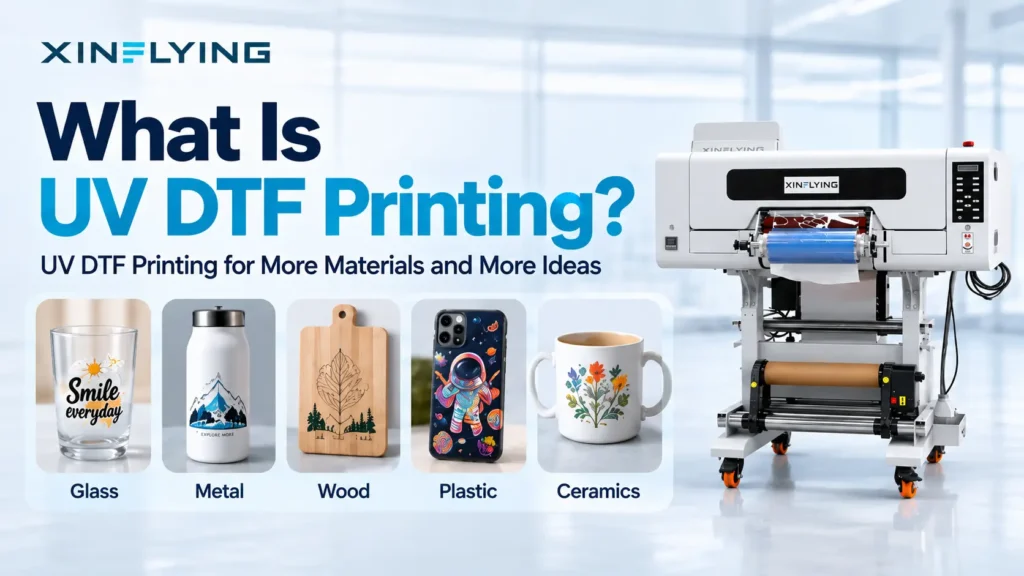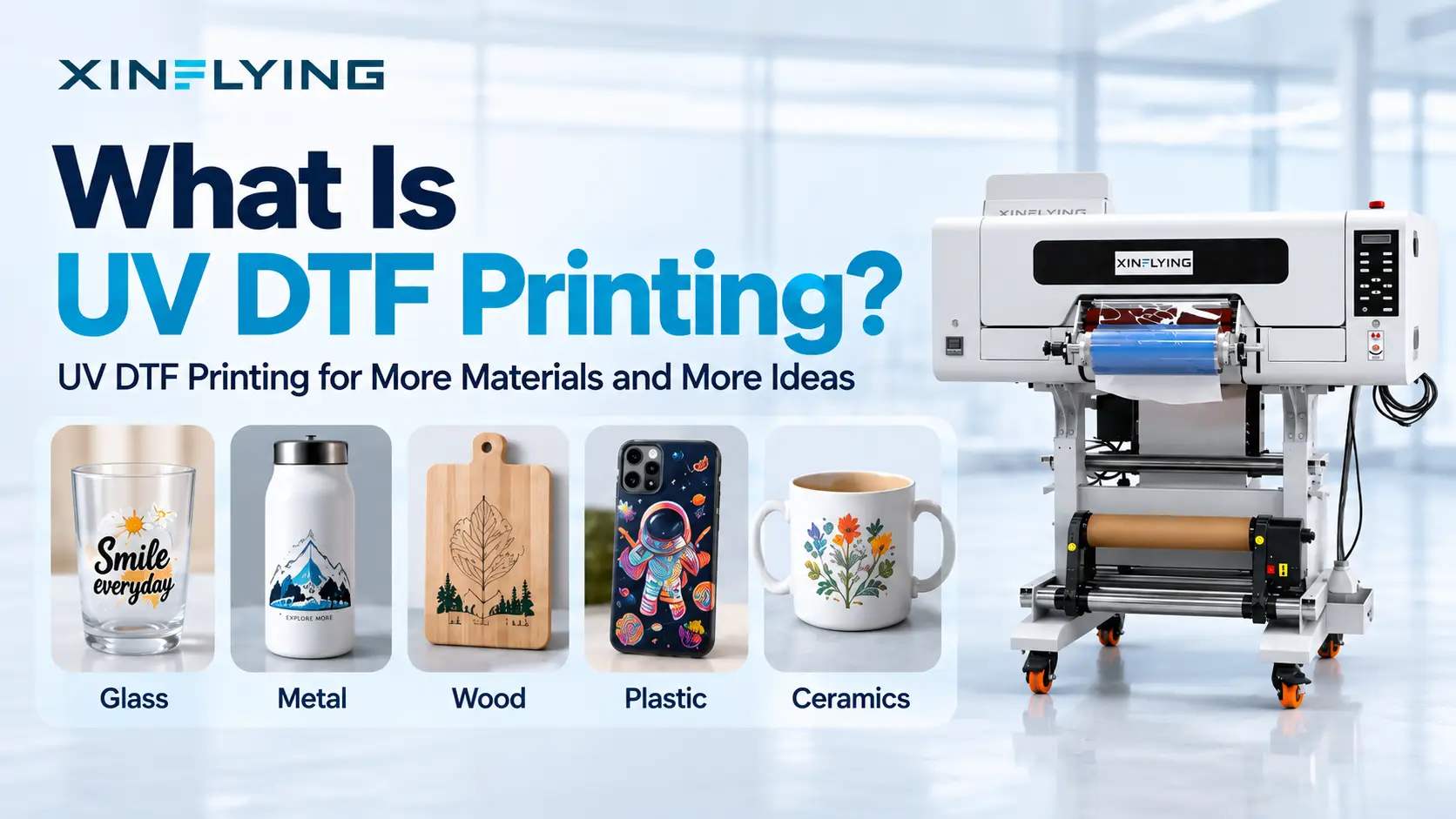
UV DTF printing is a digital decoration process that prints a full-color design onto a special transfer film before applying it to a hard object. The UV ink cures during printing, and the finished graphic can then be transferred to glass, metal, wood, plastic, and other flat or curved surfaces without a heat press. The target surface must still be properly cleaned and dried before application.
In practical terms, the workflow is simple: print the design, prepare the transfer, peel the film, press the graphic onto the product, and remove the carrier. This makes UV DTF a flexible option for personalized gifts, branded merchandise, signage, and small-batch custom products.
UV DTF Printing at a Glance
| Question | Short answer |
|---|---|
| What does UV DTF stand for? | Ultraviolet Direct to Film |
| How is the design applied? | It is printed onto film and then transferred to the product like a decal |
| Is a heat press required? | No |
| Is a special primer or coating required? | Not in the cited application workflow, but the surface must be cleaned and dried |
| What surfaces can it decorate? | Hard surfaces such as glass, metal, wood, plastic, and coated ceramics |
| Can it work on curved objects? | Yes, it can be used on products such as cups and bottles |
| What visual effects are possible? | Full color, fine detail, white-ink opacity, gloss, and a slightly raised texture |
What Does UV DTF Mean?
UV DTF stands for Ultraviolet Direct to Film. The process uses UV-curable ink to print a design onto a dedicated transfer film. Instead of placing the final product inside a printer, the design is produced on film first and transferred to the object afterward.
This separation between printing and application is the key idea behind UV DTF. A product that is awkward to load into a printer, or that has a curved surface, can still receive a detailed graphic through the transfer process. The printed design behaves much like a ready-to-apply decal, but it can include full-color artwork, a white ink layer, and a gloss layer.
How Does UV DTF Printing Work?
The UV DTF printing process builds the graphic in layers on one film, covers it with a second transfer film, and then moves the finished design onto the product. A typical workflow follows six stages.
1. Print the Design on A Film
The printer places the artwork onto a transparent print sheet or glued film, often called A film by suppliers. It uses UV-curable ink, which cures under ultraviolet light. RadTech explains that photoinitiators convert UV energy into reactive species that initiate polymerization, producing a cured ink or coating.
2. Add the White Ink Layer
A white ink layer is added behind the color image. Its purpose is to improve opacity and reduce interference from the color of the object underneath. Xinflying’s UV printing guide explains that a white ink base supports color accuracy on dark, colored, or transparent materials.
3. Apply the Gloss Layer
The printer can also add a gloss or clear-ink layer to the design. This layer creates a shinier finish and can give the transferred graphic a raised look and feel. Xinflying’s UV printing guide explains that multiple passes of clear varnish can create tactile, dimensional effects such as embossed-look designs and spot gloss.
4. Add the Transfer Film
After printing, a transfer film is applied over the design. Some suppliers call this B film, but film names and layer construction vary by manufacturer. Once the two components are combined, the printed graphic is ready for application.
5. Clean and Dry the Product Surface
Before applying the graphic, thoroughly clean and dry the product surface. Xinflying’s cup-wrap application guide recommends removing fingerprints, oil, dust, residue, and moisture before applying the transfer.
6. Peel, Press, and Remove the Carrier
To apply the transfer, peel away the backing, position the design on the product, and press it firmly against the surface. Then remove the top carrier film. The printed graphic stays on the object.
No heat press is required. The transfer is normally applied with controlled manual pressure. Xinflying’s application guide recommends even contact and repeated passes on curved objects rather than excessive force.
What Are A Film and B Film in UV DTF?
Many suppliers use A film and B film as convenient labels, but the terminology is not standardized. Roland DGA uses “UV DTF Print Sheet” and “UV DTF Transfer Film,” while Xinflying’s sticker-production workflow identifies A film as a release film and B film as the transfer film.
Across these naming systems, the two components perform the same broad jobs:
- Print component: carries the adhesive and printed image layers.
- Transfer component: supports the completed graphic during pressure application and is removed afterward.
- Final result: only the image and adhesive layers remain on the object.
A published image-transfer-sheet patent describes the same underlying sequence: print an image layer on a glue layer, apply a transfer film, pressure-bond the image to the object, and peel away the transfer film. Always follow the terminology and instructions supplied with the selected film system.
What Materials Can UV DTF Be Applied To?
UV DTF transfers are designed for a broad range of hard materials. Compatible applications include:
- Glass
- Metal
- Wood
- Plastic
- Coated ceramic cups and mugs
- Tumblers and drinkware
- Phone cases
- Glassware
- Other flat or curved hard products
The ability to decorate both flat and curved items gives businesses room to offer multiple product categories through one transfer workflow. Xinflying’s UV DTF sticker solution covers glass, acrylic, metal, plastic, wood, cups, bottles, phone cases, packaging, and promotional gifts. Adhesion should still be tested on the exact product before production.
Why Is UV DTF Printing Becoming Popular?
U.S. search behavior provides a clear signal of growing interest. Google Trends data for the United States shows that relative search interest in “UV DTF” was near zero in 2021–2022, began rising in 2023, and reached a five-year peak in 2026. Google Trends is a normalized interest index, not an estimate of search volume, sales, or market size.
Industry activity points in the same direction. Mimaki announced its first dedicated UV-DTF printer for FESPA 2025, and PRINTING United Alliance reported an enhanced Roland DGA UV DTF system in February 2026. These launches do not quantify sales, but they show major manufacturers investing in dedicated UV DTF product lines.
The reasons are practical: UV DTF combines a simplified application process with broad material compatibility and detailed output. These advantages are especially relevant to businesses that handle varied products, multiple designs, or small custom batches.
Fast, Straightforward Application
The printed transfer is applied with controlled manual pressure rather than a heat press. The surface must be thoroughly cleaned and dried, but Xinflying’s published application workflow does not include a separate primer or coating step. This keeps the path from printed artwork to finished product relatively straightforward.
Broad Product Compatibility
One transfer method can cover several hard-material product categories. A shop can move between glassware, metal items, wooden products, plastic accessories, and curved drinkware without developing a separate printing process for every object.
Vivid, Detailed Graphics
UV DTF supports full-color, high-resolution designs. The white ink layer improves coverage, while the gloss layer adds shine and a raised tactile effect. Together, these layers help the finished graphic remain clear and visually distinct on dark, transparent, or colored products.
Durable Finished Decoration
Durability varies by system. Xinflying lists its U004 UV DTF transfer film as waterproof, scratch-resistant, and UV-durable, while the Ink-026 product page specifies scratch, water, and wear resistance after UV curing. These are product specifications rather than published standardized test results, so performance should be verified with the exact ink, film, substrate, and application conditions.
UV DTF Transfer vs. Direct Printing on an Object
The main difference is where the image is printed. Direct object printing requires the product to be positioned in the printing equipment. UV DTF prints the artwork onto transfer film first, so the finished image can be applied later.
| Consideration | UV DTF transfer | Direct printing on an object |
|---|---|---|
| Where the image is printed | On dedicated transfer film | On the final object |
| How the image reaches the product | The finished graphic is transferred and pressed onto the surface | The printer applies ink directly to the surface |
| Awkward or curved items | The film can be positioned on suitable curved surfaces | The object must be compatible with the printing setup |
| Application equipment | No heat press is required | Depends on the direct-printing setup |
For products that are inconvenient to load into a printer, the transfer-first workflow offers a practical alternative. It separates image production from product handling and allows the same printed transfer concept to serve different hard goods.
Common UV DTF Applications
UV DTF is useful wherever a business needs detailed graphics on hard products. Common applications include:
Personalized Gifts
Names, illustrations, decorative artwork, and custom graphics can be transferred to gift items in small quantities. The simple application process is well suited to businesses that produce many designs rather than one long, identical run.
Custom Cups and Glassware
Mugs, tumblers, bottles, and other drinkware have curved surfaces that may be inconvenient for direct printing. A UV DTF transfer can be aligned and pressed onto the surface after the design has already been printed.
Phone Cases and Digital Accessories
Full-color artwork, logos, and small details can be applied to phone cases and other hard accessories. The white layer supports visibility on colored or transparent products.
Brand Logos and Product Identification
Businesses can use UV DTF transfers for logos, branded graphics, and decorative product identification. This makes the process relevant to promotional items, packaging components, and small branded product runs.
Creative and Handmade Products
Wood, glass, metal, and plastic craft products can all be decorated through the same basic method. Makers can expand their catalog without adopting a separate application workflow for every material.
Which Businesses Are a Good Fit for UV DTF?
UV DTF is particularly suitable for custom businesses that need to handle multiple hard-product types and short production runs. Potential users include:
- Personalized gift businesses
- Cup and glassware customization shops
- Phone case and accessory decorators
- Signage and branding providers
- Craft and creative-product sellers
- Businesses producing small batches with many design variations
The strongest fit is a workflow where flexibility matters. Because the design is printed first and applied later, a business can prepare transfers and use them across a range of compatible products. Businesses evaluating production equipment can also explore Xinflying’s UV printer machine solutions for related hard-surface printing applications.
What Should You Know Before Using UV DTF?
UV DTF works best when the product, transfer materials, and intended use are evaluated together. This process is primarily intended for hard surfaces such as glass, metal, wood, plastic, and coated ceramics. Before production, confirm that the selected product accepts the transfer and that the finished appearance meets the order requirements.
Do not assume that every UV DTF transfer carries the same durability or compliance ratings. Outdoor lifespan, dishwasher resistance, food-contact suitability, and adhesion can vary by film, ink, substrate, and application. For drinkware, do not claim food-contact suitability or place the graphic on surfaces that directly contact food, beverages, or the mouth unless the exact system has appropriate certification. Check supplier technical data and test the finished product under its intended conditions before making a specific performance claim.
Frequently Asked Questions About UV DTF Printing
No. UV DTF transfers are normally applied with controlled manual pressure rather than a heat press. Xinflying’s cup-wrap application guide recommends even pressure and careful carrier-film removal, especially on curved products.
A separate primer or coating step is not included in Xinflying’s published cup-wrap application workflow. However, the product surface must still be thoroughly cleaned and dried before the transfer is applied.
Yes. UV DTF can be applied to suitable curved hard objects such as cups, bottles, and tumblers. Because the design is transferred from film, the object does not have to be placed directly inside the printing equipment.
Yes. A white ink layer is added behind the color design to improve opacity. It helps the artwork stay vivid and legible when applied to dark, colored, or transparent objects.
The gloss layer adds shine and can create a slightly raised visual and tactile effect. It gives the finished graphic more dimension while complementing the full-color and white ink layers.
Manufacturers describe UV DTF graphics as resistant to moisture and scratching, but public standardized test data remains limited. Performance depends on the ink, film, substrate, application quality, and conditions of use. Verify requirements such as dishwasher resistance, abrasion, or outdoor exposure for the exact system before production.
UV DTF can decorate a range of hard products, including mugs, tumblers, bottles, phone cases, glassware, signs, gifts, and craft items made from glass, metal, wood, plastic, or coated ceramics.
Final Takeaway
UV DTF printing is a transfer-based digital decoration method that combines UV-curable color ink, white ink, optional gloss, and a two-component film system. It produces detailed, full-color graphics that can be transferred to many hard surfaces without a heat press. The target surface must still be cleaned, dried, and tested for compatibility.
For custom-product businesses, its value lies in flexibility: the artwork is produced separately, then applied to flat or curved products as needed. That makes UV DTF a practical option for personalized gifts, branded goods, drinkware, phone cases, signage, and small-batch product lines with frequent design changes.