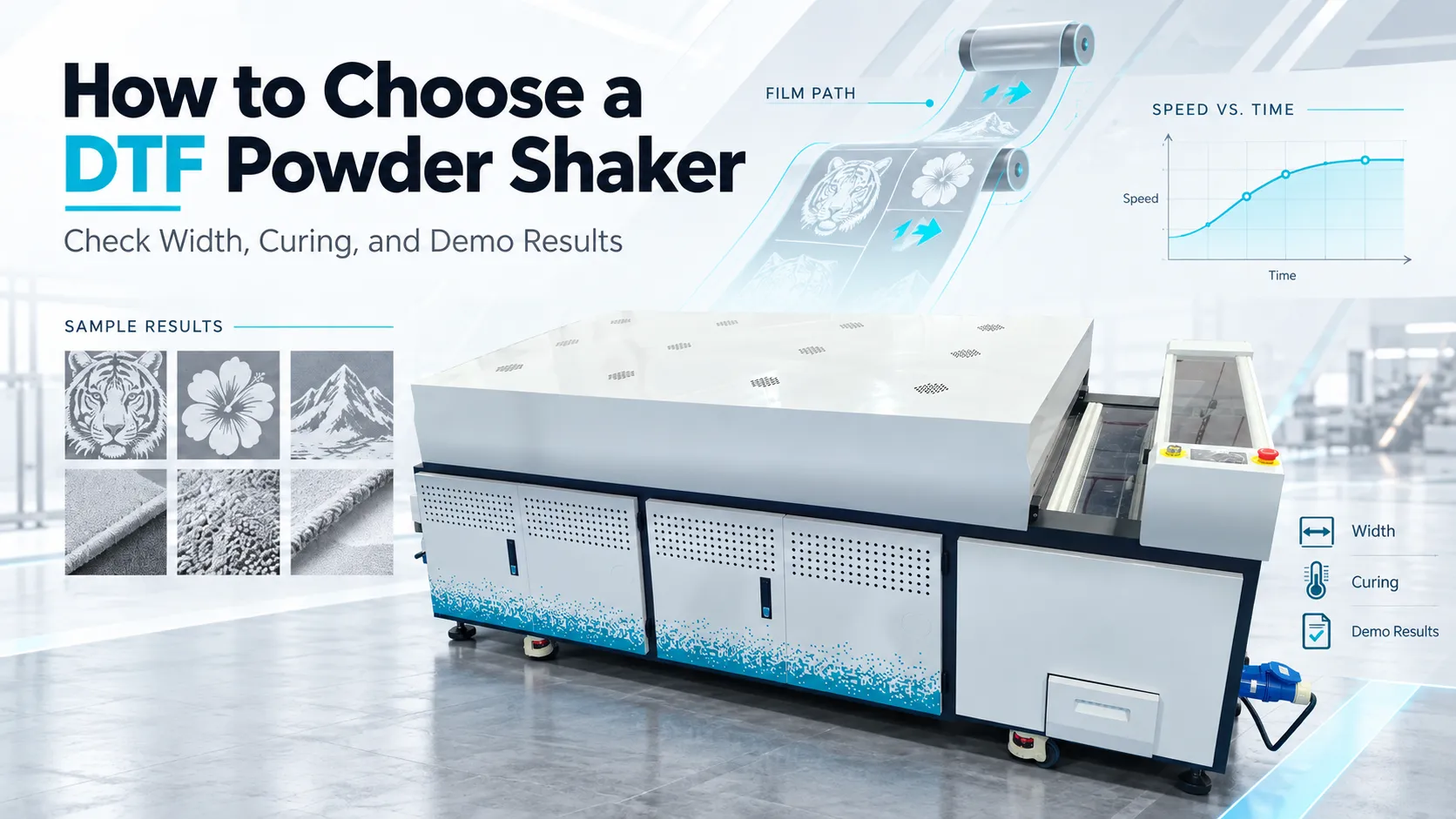
A DTF powder shaker should match the film, print mode, and order pattern the business actually uses. Width is the first check; consistent powdering, curing, and film handling decide whether the equipment can finish that work. Before buying, compare a normal production run with a short run that includes an approved pause and restart.
The useful target is accepted transfers per complete job, including setup and cleanup. A fast demonstration of one design cannot show how much handling a day of mixed orders will require.
Start With the Work the Shaker Will Replace
A powder shaker applies adhesive powder to freshly printed textile DTF film and removes the excess. A combined shaker and dryer also heats the coated film before collection; individual machines may perform only part of that process. Garment application still requires a separate heat-press step.
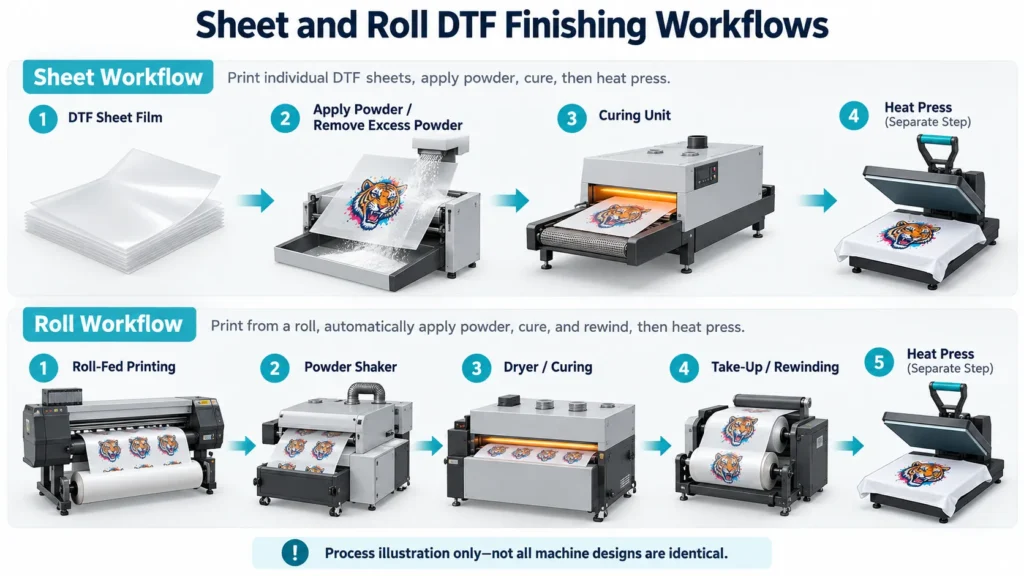
Begin with a regular order and a recurring difficult order. Record film format, layout, print mode, batch length, and the time spent powdering, curing, and cleaning. Those details show which tasks automation needs to remove.
| Current workload | Equipment worth considering | Tradeoff to check |
|---|---|---|
| Occasional individual sheets | Manual powdering or a sheet powdering device, with a separate curing unit | Hands-on work may remain manageable; compare complete batch time |
| Repeated roll jobs | A roll-fed powder shaker and dryer with compatible take-up | Reduces repeated handling, but adds loading, warm-up, and cleaning tasks |
| Long production runs | A continuous finishing unit demonstrated with the intended printer and materials | Must sustain acceptable output, with practical refill and service access |
There is no universal daily shirt count that makes automation worthwhile. Large back prints and small chest logos use different amounts of film, and five short jobs can require more setup than one long job.
If pressing or packing already limits deliveries, a larger shaker may do little for finished-shirt output. First identify whether powdering and curing are the stages holding orders back.
Match the Entire Film Path
Use the actual film width, supported media range, and guide clearances when choosing a DTF powder shaker machine. A nominal size describes a product class; it does not confirm that film will pass through every stage correctly. Check powder coverage, the heated path, cooling where fitted, and take-up as well as the entrance.
For example, 24 inches equals 609.6 mm, while equipment marketed as “24-inch” may specify 600 mm media. That distinction matters when ordering rolls. Confirm the supported width in millimeters instead of treating the two labels as interchangeable.
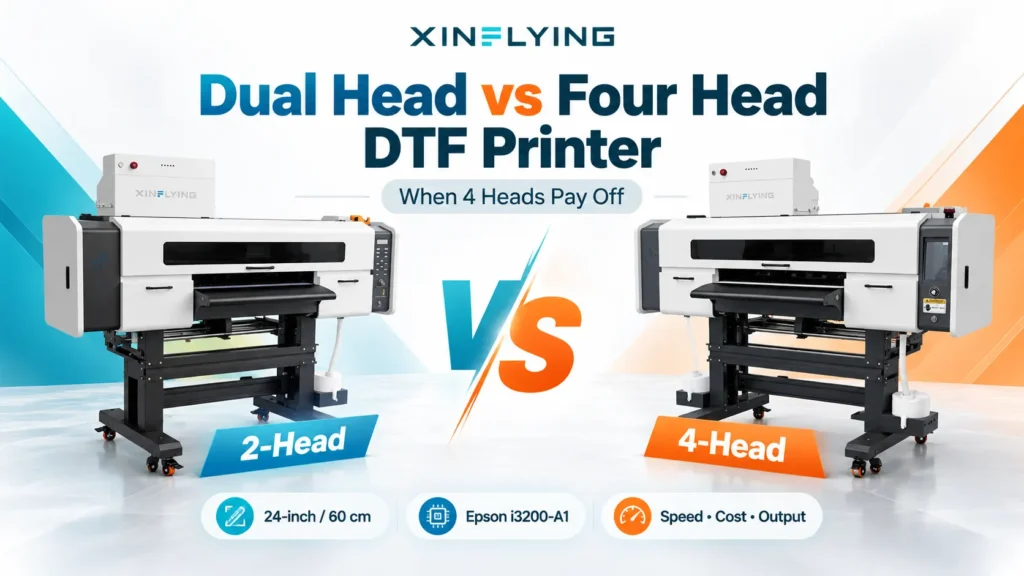
Two Xinflying configurations illustrate why matching the size label is only a starting point:
| Published configuration | Media width label | Transport or take-up detail | Shaker dimensions, L × W × H |
|---|---|---|---|
| XF-702E printer + XF-Z650-2 shaker | 24-inch class; listed as 60 cm | Net-belt conveyor; sensor-controlled automatic take-up | 1,750 × 1,000 × 1,050 mm |
| XF-C602 printer + XF-A650 shaker | 24-inch class; listed as 60 cm | Mesh belt / roller suction; constant-tension automatic sensing | 1,940 × 920 × 1,010 mm |
These are manufacturer-listed configurations, not measured production results. The different transport arrangements make film control part of the comparison, while the dimensions affect layout and access. Neither row establishes compatibility with every other printer of the same width.
Explore the available Xinflying powder shakers and DTF supplies alongside the proposed printer configuration. A purchasing comparison should identify the exact shaker model, rather than describe the bundle simply as “printer plus dryer.”
Check What Happens Between the Printer and Dryer
A typical scanning-head DTF printer advances film between passes, while the finishing equipment must manage the arriving material without pulling it out of position. The combination may use a film buffer, sensors, or coordinated transport. Confirm the supported arrangement and watch it operate with the intended print mode.
During the demonstration, look for film tracking, wrinkles, unwanted tension, and repeated operator corrections. Then have the operator show the manufacturer’s approved pause and restart. Film that moves cleanly during steady printing can behave differently when upstream output stops.
Automatic take-up does not establish automatic coordination of the whole line. It also does not mean the equipment can run unattended.
Compare Curing Capacity in the Same Units
Printer throughput, conveyor speed, and curing time describe different things. Comparing m²/h with m/min without accounting for width can make an unsuitable pairing look adequate.
For a hypothetical continuous run using the full width of a 0.60 m roll, 9 m²/h of film throughput corresponds to:
9 m²/h ÷ 0.60 m = 15 m/h = 0.25 m/min.
This conversion works only when the area figure represents full-width film advanced. If a specification measures printed image area instead, or excludes job gaps, it cannot be substituted directly. An average feed calculation also does not describe every movement of an intermittently feeding printer.
Use Residence Time as a Check, Not a Cure Recipe
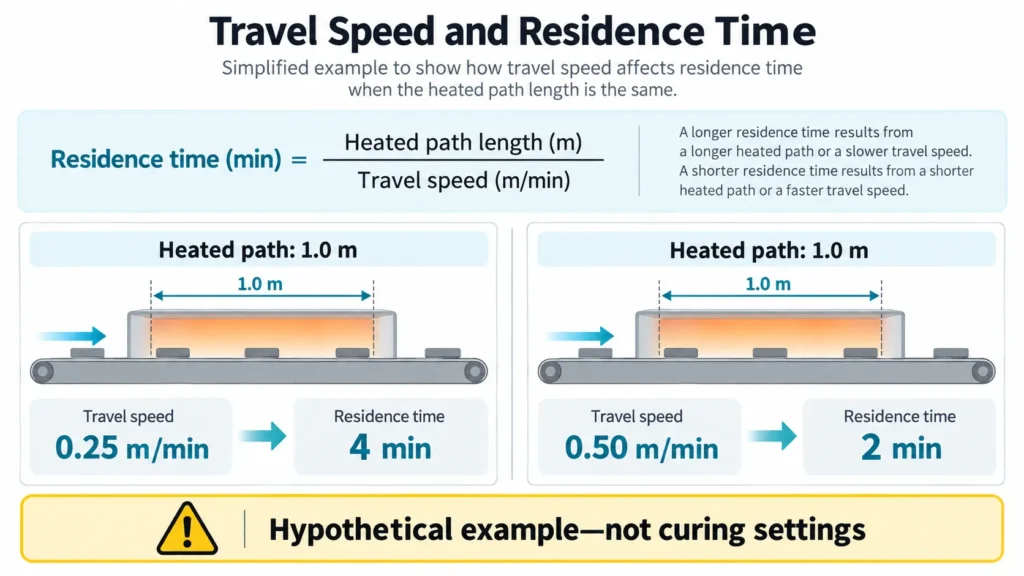
At constant film speed, time in a heated path equals its effective length divided by travel speed. With a hypothetical 1.0 m heated path and the 0.25 m/min feed above, that time is 4 minutes. Doubling feed speed halves it to 2 minutes.
These invented values explain the relationship; they are not recommended DTF curing settings or specifications for either Xinflying model above. A longer path can provide more exposure time, but the calculation alone cannot show that the adhesive has reached the required condition.
Look Beyond Heater Count and Wattage
Infrared lamps, heated plates, and hot-air arrangements transfer heat differently. More zones can provide additional control, but neither more heaters nor higher electrical power proves better curing. Compare the supported powder-and-film process, heat distribution, and resulting samples at the intended production speed.
The controller’s displayed temperature is not automatically the adhesive-layer temperature. Likewise, a belt’s maximum travel speed is not a validated curing rate. The supplier should demonstrate the selected materials under documented operating conditions, including any cooling required before winding.
For buyers comparing a DTF powder shaker and dryer, the key question is whether it can process the printer’s normal output while meeting the agreed transfer-quality checks. Increasing heat to compensate for insufficient processing time is not a general solution.
Check Powder Handling and Routine Maintenance
Automation is useful when it removes repetitive work without creating a harder cleanup task. Inspect access to the powder tray, dispensing area, film path, and collection points. Have the supplier demonstrate routine cleaning using the prescribed shutdown, cooling, and isolation procedure.
Powder recovery and powder reuse are separate decisions. A machine may collect excess powder automatically, but that does not establish that contaminated, damp, or partly heated material is suitable to return. Follow the powder supplier’s reuse rules and the equipment instructions; a screen alone cannot restore unsuitable powder.
Watch how the machine handles a refill and how easily an operator can remove residue. Clear access matters because a hard-to-reach tray or filter turns a small maintenance job into repeated lost production time. Confirm which tasks belong to the operator and which require technical support.
Before ordering, identify the replacement parts and service information available for the quoted model. Heater elements, belts, sensors, and filters are examples to discuss, not a universal replacement schedule. Obtain the actual maintenance intervals and warranty exclusions in writing.
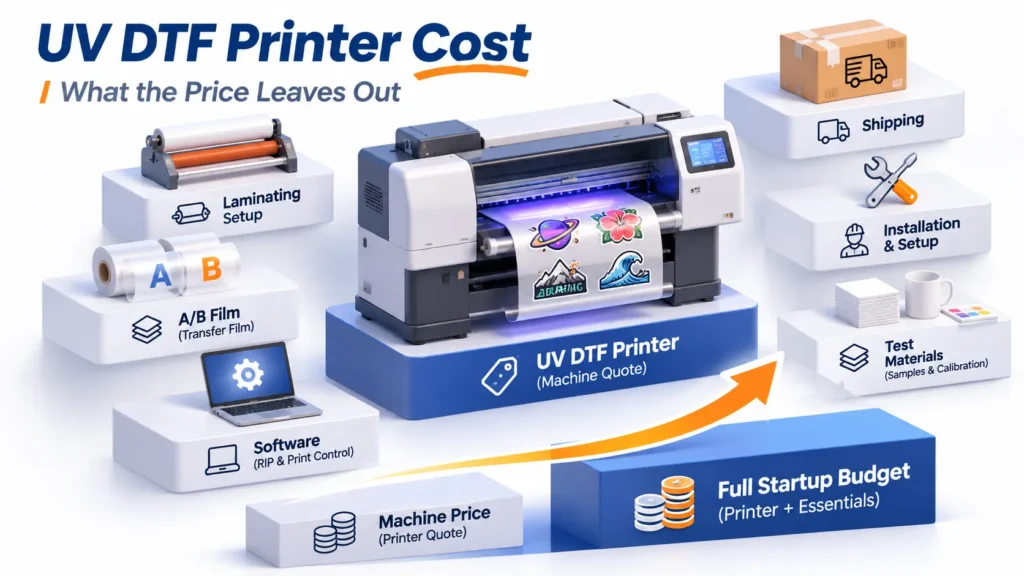
Price the Installed Equipment, Not Just the Machine
A suitable shaker must also fit the building and the operating budget. Measure the delivery route and the working layout with the printer, film buffer, access panels, powder loading, and exhaust connections included. The machine’s external dimensions are not its required operating space.
Confirm the U.S. Electrical and Extraction Requirements
Have a qualified electrician check the exact unit’s voltage, phase, frequency, current, grounding, and circuit requirements. A listing that offers 110 V and 220 V versions does not mean every shipped unit supports both. A plug adapter does not establish electrical compatibility.
Powder handling and heated processing also need the appropriate exposure controls. Obtain the specific consumables’ safety data sheets and the equipment’s extraction instructions. OSHA’s guide to safety data sheets explains where to find handling information in Section 7 and exposure controls in Section 8.
A closed housing or built-in purifier is a feature to evaluate, not proof that no ventilation is needed. Confirm the intended exhaust route, filter requirements, and replacement access for the installation. Do not use odor or the absence of visible smoke as an exposure assessment.
Separate Purchase Costs From Running Costs
Compare quotes with the same scope: shaker, curing equipment, extraction, required accessories, delivery, installation, and training. Then compare electricity, filter and maintenance costs, powder loss, rejected film, and hands-on labor. Nameplate power alone does not establish energy use per finished order.
For a simple operating comparison, divide the defined powdering-and-curing costs for a job by its accepted transfer count. Include setup, cleanup, and rejected material within that boundary. This gives a finishing cost per accepted transfer, not the full cost of a garment or a profit forecast.
Fewer operator minutes matter only when that time becomes usable. If the operator must return every few minutes to adjust the line, nominally automatic operation may not free a reliable block of time for other work.
Test Across the Film and Across the Job
A useful buying demonstration checks both where a transfer sat on the film and when it passed through the equipment. I recommend recording samples in a small matrix: left, center, and right across the usable print width, at startup, steady running, and restart. This is a suggested purchasing check, not a certification test.
Use the same representative artwork across those positions and keep the powder, film, ink configuration, and print mode consistent. Include fine detail and larger inked areas relevant to actual orders. The supplier should perform only the equipment’s approved pause and restart sequence.
| Run stage | Left-side sample | Center sample | Right-side sample | Record alongside samples |
|---|---|---|---|---|
| Startup after the prescribed preparation | Retain and label | Retain and label | Retain and label | Preparation time and initial adjustments |
| Stable production | Retain and label | Retain and label | Retain and label | Print mode, feed conditions, and powder refill events |
| Restart after an approved pause | Retain and label | Retain and label | Retain and label | Pause procedure, duration, and restart waste |
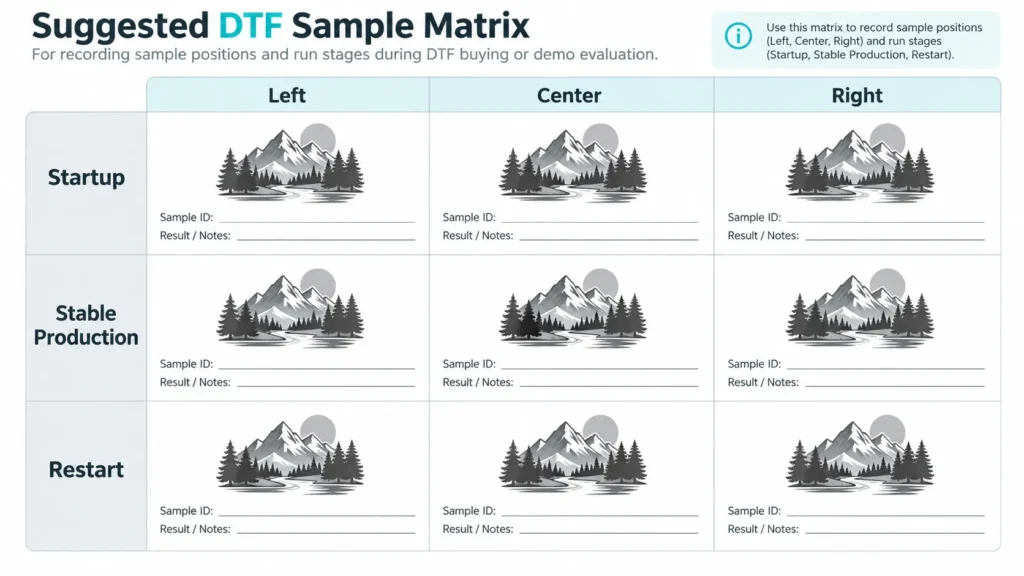
Check powder coverage, loose residue in unprinted areas, and film condition. Apply the retained transfers using the matched heat-press procedure, then compare the garment results. Agree on relevant adhesion and wash checks before the trial; a good appearance immediately after pressing does not establish long-term durability.
Keep the sample’s position and run stage attached to every result. A defect on one side calls for a different investigation from a defect appearing only after restart, although the matrix cannot identify the cause by itself.
Next, repeat the comparison with a short job and a longer job. Time each from the agreed starting condition through the last collected transfer and required cleanup, with warm-up and hands-on work recorded separately. This shows whether startup and cleaning costs dominate small batches or whether sustained finishing capacity limits longer runs.
Count accepted transfers, rejects, and rework under the same criteria for each candidate. Keep later wash-test results separate from production timing and update the acceptance decision if they fail. A strong steady-run sample should not hide losses at the beginning or end of the order.
Frequently Asked Questions
Not necessarily. Manual or sheet-based processing may suit occasional batches if it meets quality and handling requirements. Automation becomes easier to justify when repeated powdering work consumes usable labor time or cannot keep pace with orders.
Possibly, if its supported media range, guides, powdering area, and transport arrangement accommodate that film and printer. Maximum width alone does not establish a minimum supported width. Confirm the combination before paying for extra capacity.
Possibly, but a shared width is insufficient. Check film feeding, operating speed, curing conditions, and who will support the combined installation. A demonstration of the exact pair is more useful than separate videos of the two machines.
Not automatically. Rated power does not prove heat distribution, accepted output, or energy cost per transfer. Compare results with the same materials and operating conditions before choosing on wattage.
Send the printer model, film width, normal print mode, powder and film products, typical batch layout, and target output. Include available electrical service and a simple workspace sketch. These details help define the equipment and installation scope.
Choose a Shaker Around the Orders It Must Finish
Shortlist equipment that supports the actual film and printing workflow, then compare quality, operator time, and installation cost on representative jobs. Keep the normal batch and the difficult recurring batch in that comparison. They reveal different reasons to choose a machine.
For a Xinflying proposal, request a matched printer and powder-shaker configuration using those order details. Pricing is prepared for the selected configuration and delivery requirements, so the quote should identify the equipment, accessories, and service scope being supplied.