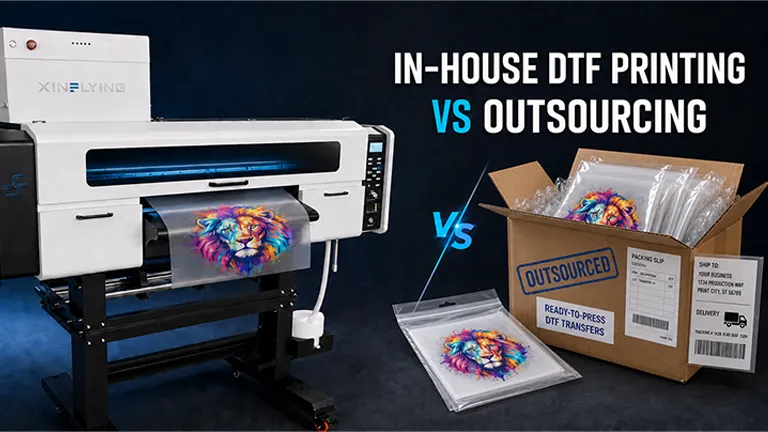
Ordering ready-to-press DTF transfers lets an apparel shop offer full-color products without operating a printer. Bringing production in-house provides more control over scheduling, samples, reprints, and costs, but it also adds equipment, labor, maintenance, and workflow responsibility.
Outsourcing is usually the safer choice while DTF demand is low, irregular, or unproven. In-house DTF printing Machine becomes worth evaluating when demand is consistent, supplier lead times are limiting sales, and the expected savings can support a complete production system, trained labor, maintenance, space, and downtime risk. Many growing shops benefit from using both methods during the transition.
There is no universal order quantity at which every business should buy a DTF printer. Use your actual demand, landed transfer cost, turnaround requirements, and operating capacity to make the decision.
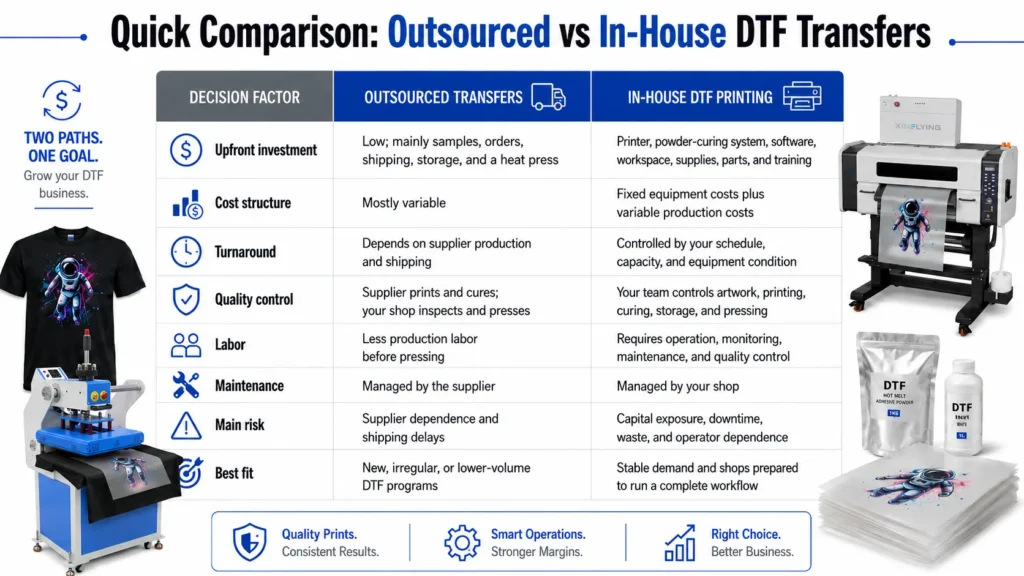
Quick Comparison: Outsourced vs In-House DTF Transfers
| Decision factor | Outsourced transfers | In-house DTF printing |
|---|---|---|
| Upfront investment | Low; mainly samples, orders, shipping, storage, and a heat press | Printer, powder-curing system, software, workspace, supplies, parts, and training |
| Cost structure | Mostly variable | Fixed equipment costs plus variable production costs |
| Turnaround | Depends on supplier production and shipping | Controlled by your schedule, capacity, and equipment condition |
| Quality control | Supplier prints and cures; your shop inspects and presses | Your team controls artwork, printing, curing, storage, and pressing |
| Labor | Less production labor before pressing | Requires operation, monitoring, maintenance, and quality control |
| Maintenance | Managed by the supplier | Managed by your shop |
| Main risk | Supplier dependence and shipping delays | Capital exposure, downtime, waste, and operator dependence |
| Best fit | New, irregular, or lower-volume DTF programs | Stable demand and shops prepared to run a complete workflow |
Printavo’s comparison similarly centers the decision on investment, demand, quality control, rush work, and growth. Your own numbers should determine the outcome.
What Do the Two Production Models Involve?
When you outsource, a supplier prints, powders, and cures your transfers. You receive individual designs or DTF gang sheets, inspect them, and apply them with a heat press. You avoid printer maintenance and production complexity, but the supplier’s cutoff times, quality consistency, remake policy, and shipping performance become part of your customer promise.
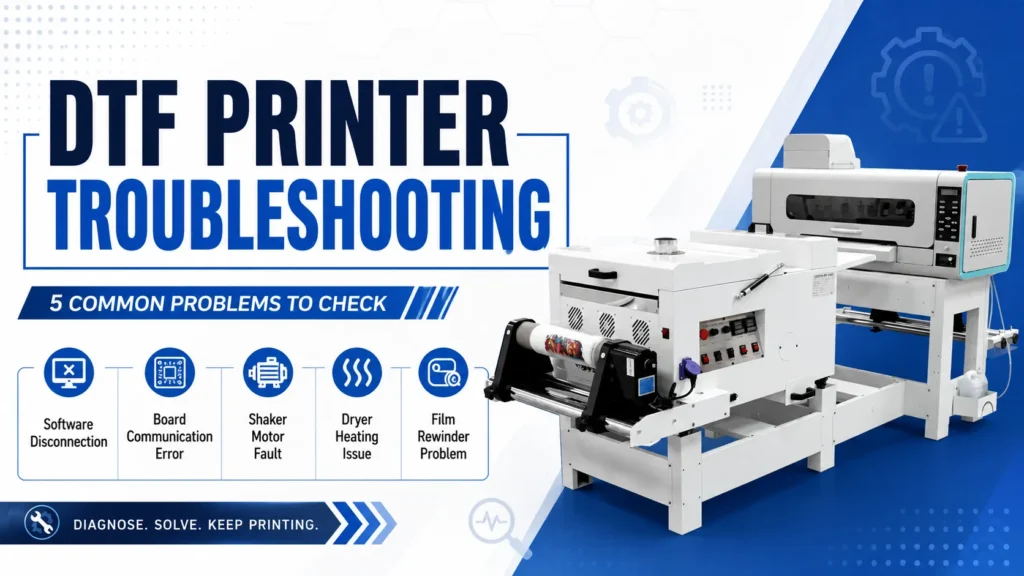
In-house production means operating a complete transfer-making system, not simply purchasing a printer. A production-ready setup normally includes:
- A DTF printer matched to your design sizes and output.
- Powder-application and curing equipment.
- A commercial heat press.
- RIP software and a suitable computer.
- Compatible ink, PET film, hot-melt powder, and cleaning materials.
- Air management and a controlled print room.
- Trained operators, maintenance parts, and technical support.
White ink requires active management. Settling, dried ink, air, contamination, poor capping, or unsuitable room conditions can disrupt ink delivery. Kao Collins recommends attention to white-ink agitation, approved cleaning, environmental control, and maintenance areas such as the cap and wiper. Roland DGA also explains that temperature and humidity affect nozzle performance.
When Outsourcing DTF Transfers Makes More Sense
Outsourcing is often the better current decision when:
- Demand is unproven or inconsistent. You pay for transfers when orders exist instead of supporting equipment during slow periods.
- DTF is a small part of the business. An embroidery, screen-printing, or promotional-products shop can add full-color decoration without another production department.
- You need to preserve cash. Equipment, supplies, parts, facility preparation, and training may compete with inventory, marketing, or more established services.
- You lack an operator or suitable room. DTF production needs artwork preparation, monitoring, maintenance, ventilation, environmental control, and material storage.
- Supplier turnaround fits your offer. If transfers arrive consistently within the schedule customers expect, outsourcing may not be creating a meaningful constraint.
- Operational simplicity is valuable. Performing every process internally does not automatically improve a business.
需求的稳定性比一次性高峰更重要。稳定可预测的周量比偶发的大订单更容易规划。
When It May Be Time to Print DTF Transfers In-House
In-house production becomes more reasonable when several signals appear together.
Demand Is Stable and Measurable
Review several months of transfer orders. Track usable square footage, normal and peak weekly demand, typical design dimensions, repeat artwork, production days, and the share of rush work. This information helps determine printing width and workflow capacity more accurately than a garment count alone.
Supplier Lead Time Is Costing You Business
Track rush jobs declined, orders delayed, expedited shipping, remake time, and customer deadlines affected by transfer delivery. In-house printing can support quicker samples and replacements, but that advantage matters only if delays are frequent enough to have a measurable cost.
You Need More Scheduling and Quality Control
Internal production shortens the feedback loop for one-off personalization, local events, samples, repeat designs, and quick replenishment. Control does not automatically mean better quality; it means your team owns the artwork, ink, film, powder, curing, maintenance, and operator decisions.
Your Shop Is Operationally Ready
Before buying equipment, confirm that you have a trained operator and backup coverage, maintenance time, a controlled room, adequate power and ventilation, supply and parts management, documented quality checks, technical support, and enough cash flow for training and downtime.
Compare Outsourcing and In-House Costs Correctly
Use the same unit on both sides: cost per usable transfer, gang sheet, square foot, or completed garment. “Usable” prevents defects, test prints, and setup waste from disappearing from the calculation.
Landed Outsourced Cost
Outsourced cost per usable transfer = (transfer price + minimum charges + shipping + rush fees + reorder or defect cost) ÷ usable transfers received
Include standard and expedited freight, artwork or setup charges, discarded transfers, and documented correction costs.
In-House Variable Cost
In-house variable cost per usable transfer = (ink + film + powder + direct labor + utilities + variable maintenance + waste) ÷ usable transfers produced
Measure a representative production period. Include nozzle checks, test prints, startup film, cleaning ink, failed transfers, and operator time.
Fixed Monthly Cost and Planning Break-Even
Fixed or semi-fixed costs can include equipment financing, RIP licensing, facility costs, environmental control, training, scheduled maintenance, and critical spare parts.
Total monthly in-house cost = fixed monthly cost + variable production cost + downtime impact
When the landed outsourced unit cost is higher than the in-house variable unit cost:
Planning break-even volume = monthly fixed in-house cost ÷ (landed outsourced unit cost − in-house variable unit cost)
Use your invoices, labor rate, equipment terms, waste records, and realistic output assumptions. The result is a planning estimate, not a guaranteed payback point.
Consider a Hybrid Transition
The decision does not have to be permanent or absolute. A hybrid model lets a shop print repeat, local, sample, replacement, and rush work internally while outsourcing:
- Overflow beyond safe internal capacity.
- Seasonal peaks.
- Unusual sizes or specifications.
- Jobs requiring capabilities the internal system does not provide.
- Orders needed while the printer is being serviced.
Before purchasing, collect 8–12 weeks of transfer spend, square footage, shipping fees, supplier turnaround, remakes, rush jobs, typical design sizes, and normal versus peak volume. After bringing selected work inside, compare cost per usable transfer, labor, waste, uptime, turnaround, and outsourced overflow before expanding.
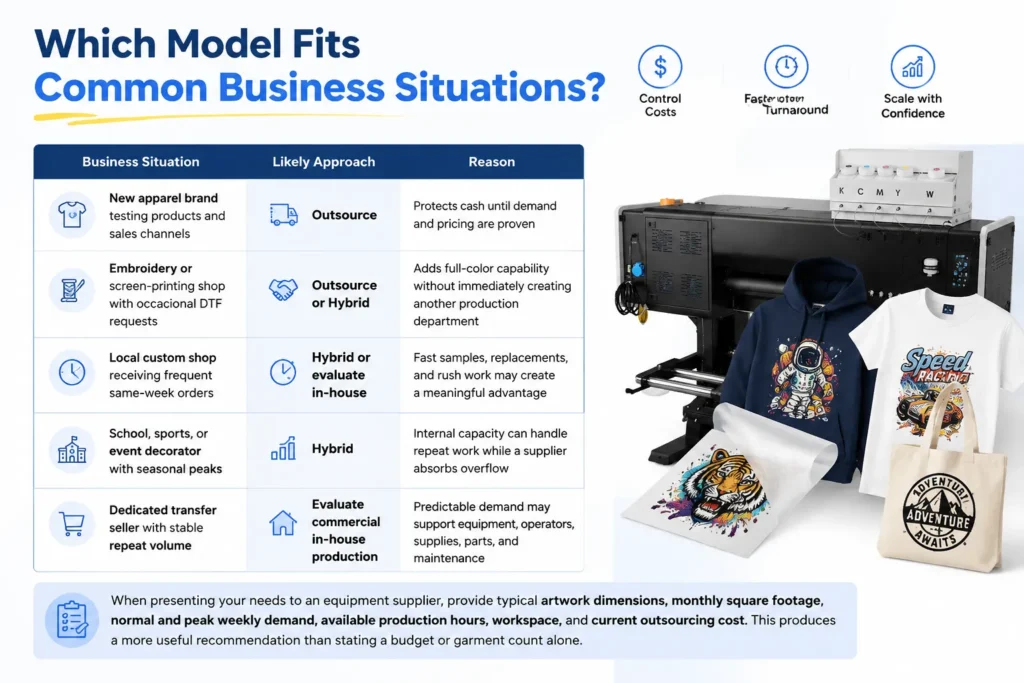
Which Model Fits Common Business Situations?
The following scenarios are starting points rather than fixed rules:
| Business situation | Likely approach | Reason |
|---|---|---|
| New apparel brand testing products and sales channels | Outsource | Protects cash until demand and pricing are proven |
| Embroidery or screen-printing shop with occasional DTF requests | Outsource or hybrid | Adds full-color capability without immediately creating another production department |
| Local custom shop receiving frequent same-week orders | Hybrid or evaluate in-house | Fast samples, replacements, and rush work may create a meaningful advantage |
| School, sports, or event decorator with seasonal peaks | Hybrid | Internal capacity can handle repeat work while a supplier absorbs overflow |
| Dedicated transfer seller with stable repeat volume | Evaluate commercial in-house production | Predictable demand may support equipment, operators, supplies, parts, and maintenance |
A seasonal business with reliable advance planning may continue outsourcing successfully. A smaller local shop may justify in-house printing sooner when rapid turnaround is central to its offer. The deciding factor is whether internal production solves a recurring, measurable constraint.
When presenting your needs to an equipment supplier, provide typical artwork dimensions, monthly square footage, normal and peak weekly demand, available production hours, workspace, and current outsourcing cost. This produces a more useful recommendation than stating a budget or garment count alone.
What Equipment and Capacity Will You Need?
Match the complete workflow to your normal jobs. Printing width should suit your common artwork and gang-sheet layouts. The powder applicator and curing system must keep pace with the printer, while the heat press must support your garment sizes and application volume.
Evaluate white-ink circulation, filtration, capping, nozzle protection, service access, RIP licensing, consumable availability, maintenance parts, training, and warranty terms. Automated protection can reduce common risks, but it does not replace the operator routine described in the DTF printer maintenance guide.
Xinflying supplies DTF Printer Machine Supplies, including ink, film, powder, powder shakers, heat presses, and air-purification equipment. For Xinflying DTF printers, the confirmed operating environment is 20–30°C (68–86°F) and 45%–65% relative humidity. Confirm model-specific power, ventilation, access, and complete-line space before ordering.
The current Xinflying DTF printer range includes:
| Model | Published configuration | Listed 6-pass speed |
|---|---|---|
| XF-450 Pro | Up to 420 mm; 2 × Epson i1600-A1 printheads | 9 m²/h |
| XF-702E | Up to 600 mm; 2 × Epson i3200-A1 printheads | 10 m²/h |
| XF-F808 | Up to 800 mm; 8 × Epson i3200-A1 printheads | 28 m²/h |
Actual output depends on artwork, pass setting, RIP configuration, consumables, environment, maintenance, operator workflow, and powder-curing capacity. Use the broader DTF printer buying guide when comparing configurations.
Frequently Asked Questions
Outsourcing is often financially safer when demand is low or irregular because it avoids equipment, maintenance, space, and dedicated production labor. In-house printing may reduce unit cost at steady volume, but only after including equipment, labor, utilities, waste, maintenance, software, supplies, and downtime.
There is no universal transfer or garment count. Calculate landed outsourced cost, in-house variable cost, and monthly fixed cost, then estimate break-even volume. Confirm that demand is consistent and that your team can operate and maintain the complete system.
A production-ready setup normally includes a DTF printer, powder and curing equipment, heat press, RIP software, computer, ink, film, powder, cleaning materials, air management, a controlled room, maintenance parts, trained labor, and technical support.
Yes. A hybrid model lets a shop print repeat and time-sensitive jobs internally while outsourcing overflow, seasonal peaks, unusual sizes, or jobs requiring other capabilities.
Payback depends on landed outsourcing cost, in-house cost per usable transfer, equipment and facility investment, volume, labor, waste, uptime, and contribution margin. A supplier cannot responsibly guarantee a payback period without those inputs.
Make the Decision with Production Data
Outsourcing is usually the practical starting point for irregular demand. In-house DTF printing becomes more attractive when demand is stable, external lead time is constraining the business, and your shop can manage the complete workflow. For many growing shops, a controlled hybrid transition is the lowest-risk route.
Request a DTF printer configuration recommendation using your artwork sizes, monthly transfer volume, peak demand, workspace, destination, and current outsourcing cost.