Whether you’re launching a custom merchandise business or scaling an existing print operation, choosing the right dye sublimation printing equipment is one of the most critical decisions you’ll make. The wrong machine can mean wasted ink, inconsistent color, and unhappy customers. The right setup? Flawless, vibrant prints at speeds that keep your business profitable.
In this guide, we break down every piece of equipment you need — from sublimation printers to heat presses — and help you build the ideal production workflow.
What Is Dye Sublimation Printing?
Dye sublimation is a digital printing process that uses heat to bond dye directly into polyester fabric or polymer-coated substrates. Unlike traditional inkjet printing, the ink is converted from a solid to a gas (sublimating) and permanently embeds into the material — producing vivid, wash-resistant colors that won’t crack, peel, or fade.
This makes sublimation the go-to technology for sportswear, custom apparel, promotional products, home décor, and soft signage.
Core Equipment Overview
A complete dye sublimation setup consists of four main components:
- Sublimation Printer — the heart of your operation
- Sublimation Ink — specially formulated dye-based inks
- Heat Press — transfers the printed image to substrate
- Transfer Paper — the carrier medium between printer and product
1. Sublimation Printers
Sublimation printers are modified inkjet printers configured to use sublimation ink. They range from desktop units for startups to wide-format industrial machines for high-volume production.
Desktop Sublimation Printers (Up to 13″ wide)
Best for: small businesses, beginners, on-demand printing
- Epson EcoTank ET-2803 / ET-2850 — highly popular entry-level conversion printers
- Sawgrass Virtuoso SG500 / SG1000 — purpose-built sublimation systems with premium color accuracy
- Epson SureColor F170 — compact, purpose-built, great for mugs and small items
Desktop models typically print up to 8.5″ × 14″ (A4/Letter), making them ideal for mugs, phone cases, and small garments.
Wide-Format Sublimation Printers (24″– 64″+)
Best for: apparel, banners, soft signage, high-volume production
- Epson SureColor F6470 (44″) — industry workhorse, excellent ink efficiency
- Epson SureColor F9470 (64″) — production-grade, high-volume all-over printing
- Mimaki TS100-1600 (64″) — advanced color gamut, used in fashion and textile industries
- Roland Texart RT-640 (64″) — superior color management for sports and activewear
- Xinflying Dye Sublimation Printer-19E8(75″)— superior color management for T-shirt and home decor
Wide-format printers are essential for all-over print apparel, large banners, and cut-and-sew production.
2. Sublimation Ink
Not all sublimation inks are created equal. Key factors to evaluate:
- wider gamut = more vibrant output
- must match your printer’s print head type (Epson Micro Piezo, etc.)
- critical for apparel applications
- using third-party inks may void printer warranties
Top brands: Sawgrass SubliJet-HD, Epson UltraChrome DS, Mimaki Sb210, J-Teck3, Kiian Digital.
Pro Tip: Always perform a color profile calibration when switching ink brands. ICC profiles are essential for consistent, accurate color reproduction.
3. Heat Presses
The heat press is what activates the dye sublimation reaction, applying controlled heat (typically 380–400°F / 193–204°C) and pressure over a set dwell time.
Flatbed Heat Presses
Most versatile type — handles flat substrates including transfer paper, mouse pads, tiles, and fabric panels. Available in sizes from 9″×12″ to 16″×24″ and larger.
- Hotronix Fusion IQ — digital control, even pressure distribution, widely used in professional shops
- Stahls’ Hotronix Air Fusion — pneumatic press, reduces operator fatigue in high-volume settings
- HIX HeatWave — reliable mid-range option for growing businesses
Sublimation Heat Presses Machine
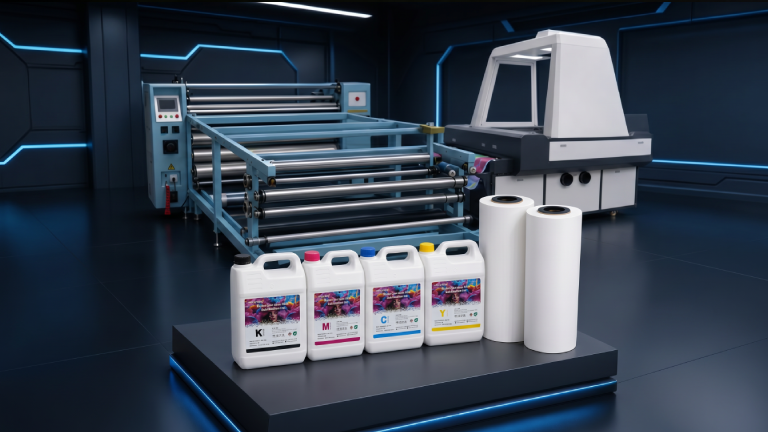
Ideal for continuous roll-to-roll production of fabric. Processes materials at high speed with consistent pressure across the entire width.
- Monti Antonio 76 Series — trusted in industrial apparel production
- Klieverik — widely used in European textile manufacturing
- Xinflying—widely used in t-shirt and home textile manufacturing
Required for sportswear, jersey production, and large-scale cut-and-sew operations.
Specialty Heat Presses
- cylindrical design for sublimating mugs (11oz, 15oz, travel mugs)
- curved platen designed for structured hats
- articulated platen for sneakers and footwear
- sublimation of curved/rigid items like phone cases, awards
4. Transfer Paper
Sublimation transfer paper acts as the intermediate carrier — it holds the printed ink until heat activates the transfer. Paper quality directly affects output quality.
- — affects ink hold and release characteristics
- — heavier paper is more stable but slower to dry
- — important for fine detail and sharp edges
Recommended brands: TexPrint (DT/XP/R), Beaver Paper, A-SUB, Coldenhove Jetcal EVO.
5. Supporting Equipment & Accessories
A complete sublimation production line also requires:
- for contour cutting substrates and heat transfer materials
- Wasatch, CADlink, or Ergosoft for professional color management and nesting
- X-Rite i1 or Barbieri for ICC profile creation and quality control
- used above and below transfer in the heat press to prevent ghost images and contamination
- holds transfer paper in position during pressing
- polyester garments (min. 65% poly for vibrant results), polymer-coated hard goods
How to Choose the Right Setup
When building your sublimation equipment stack, consider these factors:
Production Volume
- Sawgrass SG500 + Hotronix 16×20 flatbed press
- Epson F6470 44″ + dual flatbed presses
- Epson F9470 64″ + Monti Antonio calendering press
- Xinflying 19E8 75″+ Sublimation heat press machine
Product Mix
- wide-format printer + calendering press
- desktop printer + 3D vacuum press + mug press
- wide-format printer + flatbed press + mug/cap attachments
Budget Considerations
Entry-level complete setups start around $1,500–$3,000 (desktop printer + swing-away press). Professional wide-format setups range from $12,000–$50,000+ depending on print width and press type.
ROI Tip: Wide-format printers have higher upfront cost but significantly lower cost-per-piece at volume. Calculate your break-even point based on your expected monthly print volume.
Maintenance Best Practices
- Run daily print head cleaning cycles to prevent clogging
- Store ink cartridges in a cool, dark environment
- Calibrate heat press temperature with a digital thermometer monthly
- Replace heat press silicone pads annually or when surface becomes uneven
- Use printer manufacturer’s recommended ICC profiles and update them regularly
Final Thoughts
Investing in the right dye sublimation printing equipment sets the foundation for a profitable, scalable printing business. Start with equipment that matches your current volume — and choose brands with strong dealer support and parts availability to minimize downtime.
Whether you’re printing custom jerseys, personalized gifts, or large-format soft signage, the right sublimation setup will deliver the vibrant, durable results your customers expect.
You Might Also Like: