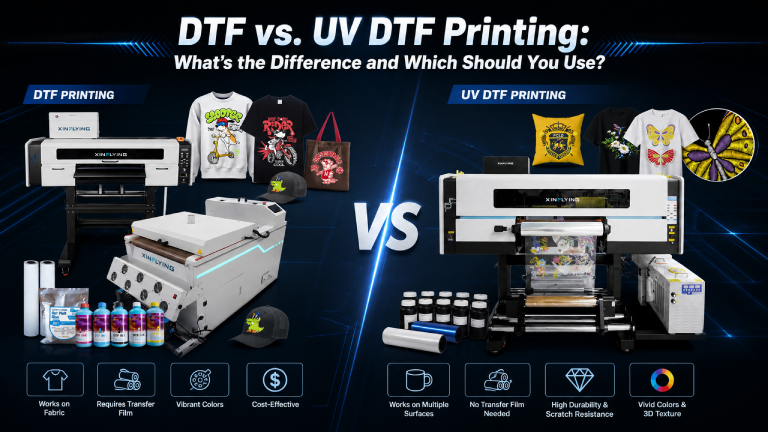
Two of the most talked-about printing technologies in the custom product space are DTF (Direct-to-Film) and UV DTF (UV Direct-to-Film). While they share a name, they work very differently and are suited to entirely different applications.
This guide breaks down both methods clearly so you can make the right choice for your business or project.
What Is DTF Printing?
DTF (Direct-to-Film) printing involves printing a design onto a special PET film using water-based textile inks, then applying a hot-melt adhesive powder before curing. The resulting transfer is heat-pressed onto fabric to create a permanent, flexible print.
- Best for: Apparel, fabric products, T-shirts, hoodies, hats
- Ink type: Water-based textile inks + adhesive powder
- Application method: Heat press at 275–320°F
- Substrate: Primarily fabric (cotton, polyester, blends, nylon)
What Is UV DTF Printing?
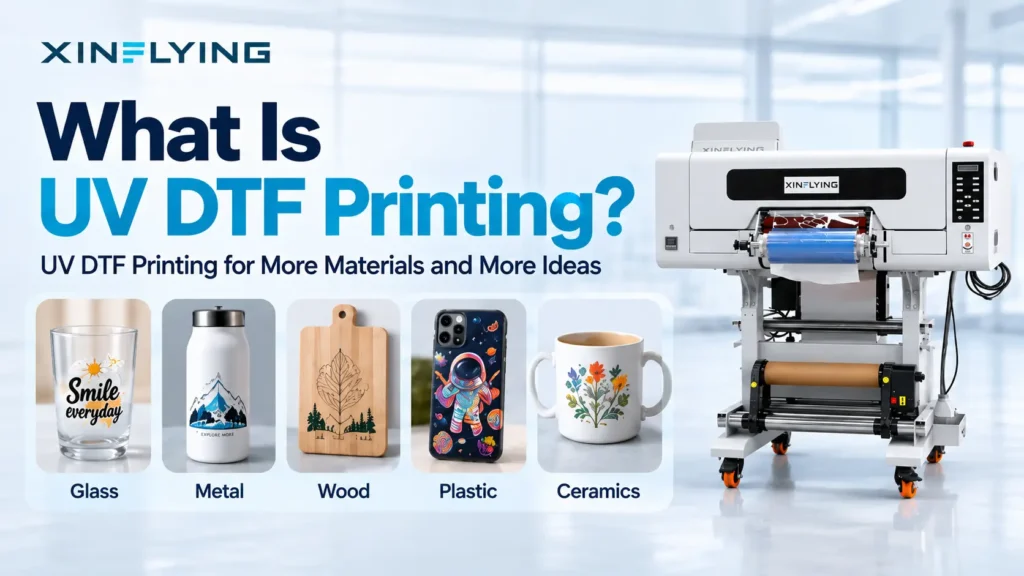
UV DTF printing uses UV-curable inks printed onto a special UV transfer film. The print is cured instantly under UV light, then transferred to the final substrate using hand pressure — no heat press required.
- Best for: Hard surfaces — mugs, bottles, phone cases, wood, glass, metal, acrylic
- Ink type: UV-curable inks
- Application method: Peel-and-stick (hand pressure only)
- Substrate: Rigid, hard, and non-fabric surfaces
DTF vs UV DTF: Side-by-Side Comparison
| Factor | DTF Printing | UV DTF Printing |
| Primary Substrate | Fabric / Apparel | Hard surfaces (mugs, cases, wood, glass) |
| Application Method | Heat press required | Peel and stick — no heat needed |
| Color Vibrancy | Excellent on fabric | Excellent on hard surfaces |
| Durability | 50+ wash cycles on apparel | Excellent on rigid substrates |
| Equipment Needed | DTF printer + curing oven + heat press | UV DTF printer only |
| Cost per Print | Low to moderate | Moderate (UV inks are pricier) |
| Setup Complexity | Moderate | Low — easy to apply |
| Dark Substrate Support | Yes (no white underbase on film needed) | Yes |
| Flexibility of Output | Soft, flexible print | Rigid, glossy finish |
| Minimum Order | None | None |
When to Choose DTF Printing
DTF is your go-to when the final product is fabric-based. It excels at producing vibrant, wash-durable prints on virtually any apparel item regardless of fabric color or content.
- You’re printing on T-shirts, hoodies, hats, bags, or other garments
- You need prints that survive repeated machine washing
- You want to print on dark or multi-colored fabrics
- You’re running a print-on-demand or custom apparel business
When to Choose UV DTF Printing
UV DTF is the right choice when you’re decorating rigid, non-fabric products. The peel-and-stick application is fast, easy, and requires no heat equipment — making it ideal for adding branding to hard goods.
- You’re decorating mugs, tumblers, water bottles, or drinkware
- You’re creating phone case skins, laptop decals, or product labels
- You need to add custom prints to wood, glass, acrylic, or metal
- You want a quick-apply method with no heat press involved
| Can I Use Both? Yes — many print shops run DTF for apparel orders and UV DTF for hard-goods orders. Together they cover nearly every custom product category, making your shop significantly more versatile. |
Durability: How Do They Compare?
DTF Durability on Fabric
With proper heat press application and care instructions (cold wash, gentle cycle, inside out), DTF prints typically last 50–80 wash cycles before showing visible wear. The print flexibility prevents cracking even on stretchy fabrics.
UV DTF Durability on Hard Surfaces
UV DTF prints cure to a hard, scratch-resistant finish. On smooth, non-porous surfaces like coated tumblers and phone cases, they perform excellently. On rough or textured surfaces, edge adhesion can be a consideration.
Cost Comparison
DTF tends to be more cost-efficient at volume for apparel printing. UV DTF has slightly higher ink costs but eliminates the need for a heat press and curing oven — reducing upfront equipment investment for hard-goods decorators.
Frequently Asked Questions
Can UV DTF be used on fabric?
UV DTF is not designed for fabric applications. The rigid UV-cured ink layer would crack when the fabric flexes. Use standard DTF printing for all fabric and apparel products.
Which has better color quality — DTF or UV DTF?
Both produce excellent color quality on their intended substrates. DTF delivers rich, photo-realistic color on fabric. UV DTF produces vibrant, high-gloss color on hard surfaces. The comparison only applies when both are being used on the same type of substrate, which isn’t their intended use.
Is UV DTF waterproof?
UV-cured inks are generally water-resistant on non-porous surfaces. Products like tumblers or drinkware with UV DTF prints should be hand-washed rather than machine washed to extend the life of the print.
Which is easier to get started with?
UV DTF has a lower barrier to entry — no heat press or curing oven required, and application is simply peel-and-stick. DTF requires more equipment (printer, powder shaker, curing oven, heat press) but opens up the large and lucrative apparel market.
Final Thoughts
DTF and UV DTF are complementary technologies, not competitors. DTF dominates the apparel and fabric space; UV DTF owns the hard-goods and promotional products market. Understanding the distinction helps you invest in the right equipment and serve your customers better.
You Might Also Like: