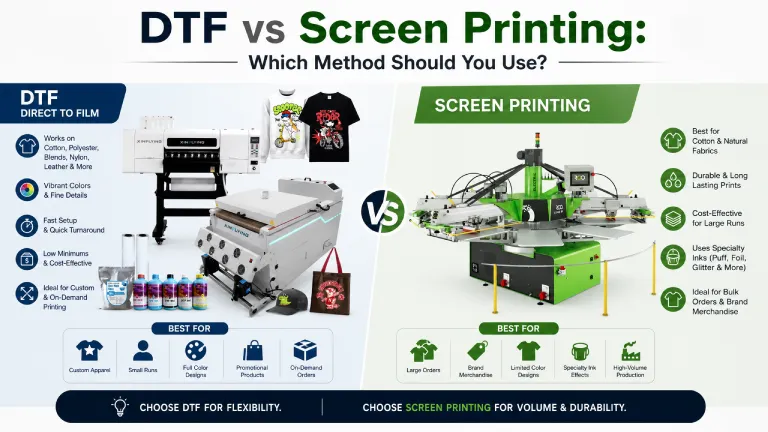
DTF vs Screen Printing: Which Method Should You Use?
If you are running a custom apparel business or thinking about starting one, choosing between DTF printing and screen printing is one of the most important decisions you will make early on. Both methods produce high-quality, durable prints on fabric, but they work in fundamentally different ways, suit different order types, and have very different cost structures. The right answer depends entirely on what you are printing, how many pieces you need, and what kind of business model you are building.
This guide breaks down exactly how each method works, compares them head to head across every factor that matters for a print business, and gives you a clear framework for deciding which one belongs in your shop — or whether you need both.
How DTF Printing Works
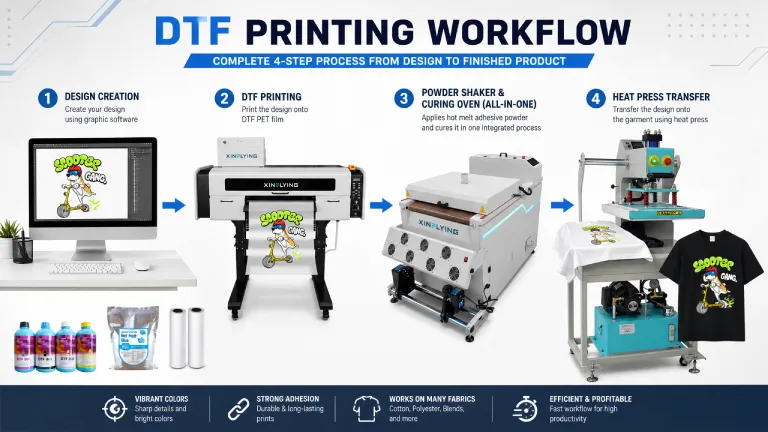
DTF stands for direct to film printing. A DTF printer prints your design onto a special PET film using CMYK inks plus a white ink base layer. Hot melt adhesive powder is then applied to the wet ink and cured in an oven or with a heat source, creating a finished transfer sheet that is ready to press. When you are ready to apply the design, a heat press bonds the transfer permanently to the fabric surface.
The entire process from file to finished transfer takes just a few minutes per design. Because there is no screen to create and no setup cost per design, you can print one piece just as efficiently as you print fifty. DTF works on virtually any fabric type — cotton, polyester, nylon, denim, and blends — without any pretreatment and without adjusting the process for different fabric colors.
DTF printing has grown rapidly over the past few years as the technology has matured and equipment costs have come down. As Printful’s overview of custom printing methods notes, DTF is now one of the most versatile options available for custom apparel production, particularly for businesses that need to handle short runs and complex full-color designs efficiently.
How Screen Printing Works
Screen printing is one of the oldest and most established methods in the apparel printing industry. The process works by creating a separate mesh screen for each color in a design, then pushing ink through each screen onto the fabric one color at a time. The ink is cured with heat after printing to create a durable, permanent bond with the fabric fibers.
Screen printing is especially strong for bold, high-contrast designs with a limited number of solid colors. A classic two-color logo on a t-shirt, for example, is exactly what screen printing does best: the setup cost for two screens is manageable, and once the screens are set up, you can run hundreds or thousands of identical shirts quickly and at a low cost per piece.
Screen printing has been the dominant method for large-run apparel production for decades. The Specialty Graphic Imaging Association (SGIA) recognizes screen printing as a core printing discipline with well-established industry standards for ink durability, washability, and production consistency — one reason it remains the go-to method for major branded merchandise and uniform programs.
DTF vs Screen Printing: Side-by-Side Comparison
| Feature | DTF Printing | Screen Printing |
| Fabric compatibility | Any fabric — cotton, polyester, nylon, blends | Any fabric |
| Minimum order quantity | 1 piece, no setup cost | Usually 12–24+ pieces due to setup cost |
| Setup time | None — print and press directly | Screen creation needed per color/design |
| Color complexity | Unlimited colors, gradients, photos | Each color = separate screen (cost increases) |
| Print feel | Slightly raised texture | Soft, flat feel on fabric |
| Durability | Excellent, wash-resistant | Excellent, industry standard |
| Best for | Short runs, complex designs, mixed orders | Large runs, simple bold designs |
| Cost at low volume | Lower — no setup fee | Higher — setup cost spread over few pieces |
| Cost at high volume | Competitive | Lower per piece at 100+ units |
| Dark fabric printing | Excellent — no pretreatment needed | Excellent with opaque inks |
| White ink | Built into DTF process | Requires separate underbase screen |
| Turnaround time | Fast — same day possible | Slower due to screen prep and drying |
Cost Comparison: Where Each Method Wins
Cost is where the difference between DTF and screen printing becomes most significant, and it is also where businesses most commonly make the wrong choice by not thinking carefully about their actual order mix.
DTF cost structure:
DTF has no setup cost per design. Your cost per print is relatively flat regardless of whether you are making one shirt or one hundred, since you are paying for ink, film, powder, and press time on every piece rather than amortizing a one-time setup charge. This makes DTF extremely cost-effective for small orders and one-off custom pieces, and it makes it easy to offer one-at-a-time custom printing profitably.
Screen printing cost structure:
Screen printing has a meaningful setup cost for each design because a new screen must be created for every color. A two-color design needs two screens, a five-color design needs five screens, and so on. This setup cost is usually charged as a flat fee per screen, which needs to be spread across the order quantity. As Printbest explains in its comparison of printing methods, screen printing becomes cost-competitive and then progressively cheaper per piece as order quantities increase, typically reaching its cost advantage at around 24 to 48 pieces and becoming significantly cheaper than DTF at 100 or more identical pieces.
The practical implication: if most of your orders are under 24 pieces, DTF will almost always be cheaper to produce. If most of your orders are over 100 identical pieces of the same design, screen printing will usually give you a lower cost per shirt.
Print Quality: How Do They Actually Look?
Both DTF and screen printing produce vibrant, durable prints, but they look and feel different in ways that matter for certain products and customers.
DTF prints have a slightly raised texture because the transfer sits on top of the fabric rather than bonding into the fibers. The texture is subtle and most customers do not notice it on casual wear, but it is more noticeable on lightweight or thin fabrics. DTF handles gradients, photographic images, and complex multi-color designs exceptionally well, since it is essentially a full-color digital print process with no limit on colors.
Screen printing produces a flatter, softer feel on the fabric because the ink is pushed directly into and onto the fibers rather than transferred as a separate layer. For simple bold designs, screen-printed colors tend to look very saturated and clean. For complex designs with many colors or gradients, screen printing requires significantly more screens and cost, and may not reproduce fine photographic detail as well as DTF.
For most customers, both methods produce prints that look great and last well through repeated washing when applied correctly. The difference in feel becomes more relevant at the premium end of the market, where customers paying more for garments may notice and prefer the softer feel of a screen-printed design.
Durability: Which Lasts Longer?
Both DTF and screen printing produce durable, long-lasting prints when applied correctly, and both are wash-resistant through dozens of machine wash cycles. According to Printful’s durability testing on print methods, DTF transfers maintain color vibrancy and adhesion through repeated washing when heat-pressed at the correct temperature and pressure. Screen printing, as an older and more established technology, also has a very strong track record for wash durability, particularly with plastisol inks which are highly resistant to fading and cracking.
The main durability difference to be aware of with DTF is edge cracking on very large prints, particularly designs that cover the full front or back of a shirt. Large DTF transfers can develop slight cracking at the edges after many wash cycles, especially if the shirt is washed at high temperatures or tumble dried on high heat. Screen printing does not have this issue since there is no transfer edge to crack. For large, full-coverage designs that need to last many years of heavy washing, this is worth factoring into your method choice.
Which Is Better for Small Businesses Starting Out?
For most small custom apparel businesses starting out today, DTF is the more practical starting point for several reasons.
- No minimum order quantity — you can take single-piece custom orders profitably from day one
- No screen setup cost — you can offer any design, any color, without a setup fee
- Lower initial equipment investment compared to a full screen printing setup with exposure unit, press, and dryer
- Faster turnaround — same-day printing is realistic for small orders
- Works on any fabric type without adjusting the process
Screen printing makes more sense as a starting method if your business model from the beginning involves large, repeat orders — for example, supplying branded merchandise to corporate clients, producing team uniforms in bulk, or printing the same design for a large event. In those cases, the setup cost of screen printing gets spread across enough pieces that the per-unit cost advantage kicks in.
Many print businesses start with DTF for its flexibility, then add screen printing capability later as they build larger volume accounts that justify the setup cost.
When to Use DTF vs Screen Printing
Choose DTF when:
- Order quantities are under 24 pieces
- Designs are complex with many colors, gradients, or photographic detail
- You need to print on multiple different fabric types from the same order
- Turnaround time is tight and you cannot wait for screen preparation
- You are running a print-on-demand business with one-off custom orders
- You want to offer all-over print or large-format designs cost-effectively
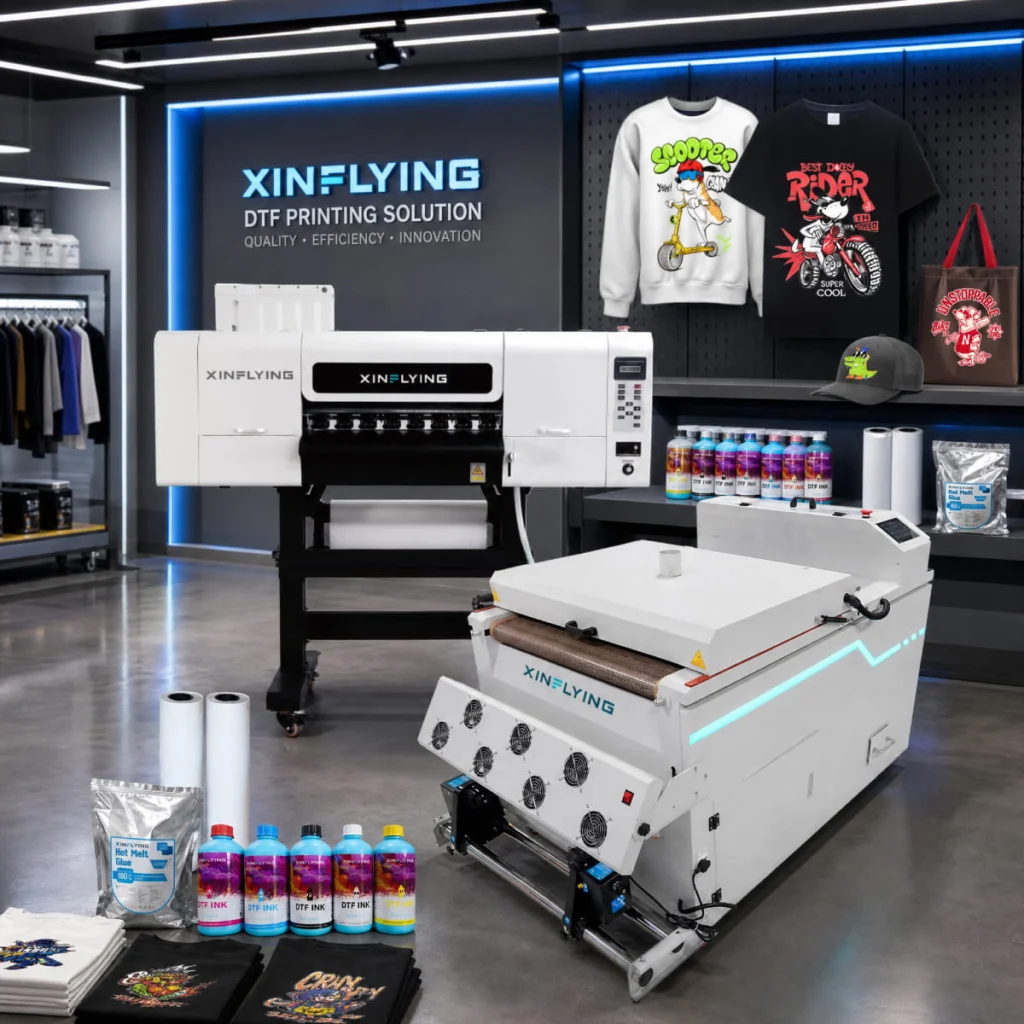
Xinflying DTF Printer Machine-702E
Boost your garment printing business with the Xinflying DTF Printer Machine-702E. Enjoy fast production, vivid color reproduction, reliable performance, and high-quality DTF transfers for a wide range of fabrics.
Choose screen printing when:
- Order quantities are 48 pieces or more of the same design
- Designs are simple and bold with a limited number of solid colors
- You are producing branded merchandise, team uniforms, or event shirts in bulk
- Customers specifically want the soft, flat hand feel of a screen-printed finish
- You are printing large volumes of the same design repeatedly over time
Can You Run Both DTF and Screen Printing in the Same Shop?
Absolutely, and many established print shops do exactly this. DTF and screen printing are complementary rather than competing methods. A shop that offers both can take any order regardless of size, design complexity, or fabric type, and route each job to the most cost-effective method automatically.
A common workflow in mixed shops: one-off custom orders and short runs under 24 pieces go to DTF, while bulk orders over 48 pieces of simple designs go to screen printing. This gives the shop a competitive cost structure at both ends of the market without turning away any order type.
Xinflying DTF printer machines built for custom apparel businesses of all sizes. If you are comparing DTF equipment options or want to understand which setup fits your expected order mix, visit us at https://www.xin-flying.com.
Frequently Asked Questions
For small orders, yes — DTF has no setup fees, so a single shirt costs roughly the same per unit as an order of 20. For large orders (100+), screen printing is usually cheaper per piece.
Both are highly durable and can last 50+ washes with proper curing. Screen printing ink sits as a thick, opaque layer, while DTF forms a bonded film — durability mainly depends on quality materials and correct application, not the method itself.
Not well. Screen printing is built for solid-color, simple designs since each color requires a separate screen. For photo-quality or gradient designs, DTF is the better choice.
Most shops see screen printing become cost-effective starting around 24–50+ pieces, though this varies by number of colors and shop pricing.
Yes. DTF works well on cotton, polyester, and blends alike, making it more versatile across fabric types than screen printing in some setups.
Sources
- Custom Screen Printing Industry Report — IBISWorld
- Direct to Film Printing Market Report — Grand View Research
- Industrial Screen Printing Market — Persistence Market Research
You Might Also Like: