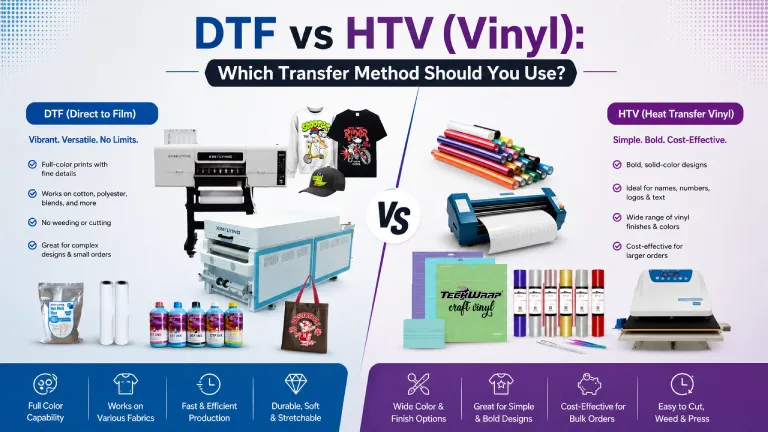
If you’re running a custom apparel business — or comparing equipment before you start one — DTF and HTV (heat transfer vinyl) are two of the most common ways to put a design on a shirt without screen printing. Both use a heat press to apply the design, and both skip the pre-treatment and drying steps that DTG and sublimation require. But the way each method is made, and what kind of designs it’s suited for, are completely different.
This guide compares DTF and HTV printing head-to-head — cost, durability, design complexity, and fabric compatibility — so you can decide which one belongs in your shop, or whether you need both.
How DTF Printing Works
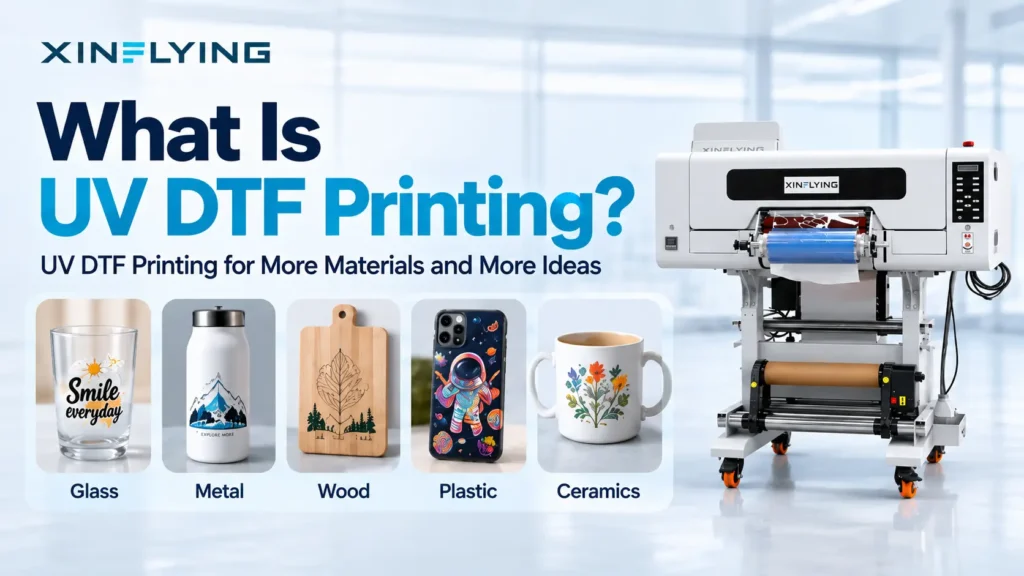
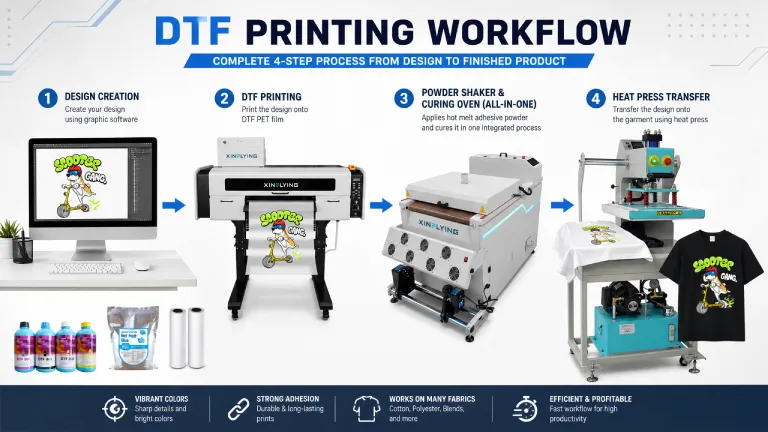
DTF (Direct-to-Film) prints your design onto PET film using CMYK inks plus a white ink base layer, then a hot-melt adhesive powder is applied to the wet ink and cured. The result is a ready-to-press transfer sheet that can be applied to the garment with a heat press. Because DTF is a digital print process, it handles unlimited colors, gradients, and full-color photographic designs with no extra cost or setup per color.
How HTV (Heat Transfer Vinyl) Works
HTV starts as a roll of colored vinyl film. A cutting plotter cuts the design outline into the vinyl, and then the excess vinyl around the design — called the weed — is manually peeled away, leaving only the design shape on the backing sheet. That shape is then heat-pressed onto the garment. Each color in a design needs its own sheet of vinyl, cut and weeded separately, then layered and pressed in sequence.
HTV excels at bold, solid-color designs — team names, jersey numbers, simple logos, and lettering. Specialty vinyl types (glitter, holographic, flock, reflective) let HTV do things DTF can’t easily replicate, like a genuine metallic or glitter finish. But because each color requires a separate cut-and-weed step, HTV becomes slow and labor-intensive for complex, multi-color, or photo-realistic designs.
DTF vs HTV: Side-by-Side Comparison
| Feature | DTF Printing | HTV (Vinyl) |
| Fabric compatibility | Any fabric — cotton, polyester, nylon, blends | Any fabric, though thin/stretchy fabrics need care |
| Design complexity | Unlimited colors, gradients, photos | Best for solid colors, simple shapes, text |
| Setup per design | None — print and press directly | Cutting + weeding per color, layered by hand |
| Minimum order quantity | 1 piece, no setup cost | 1 piece, but labor cost scales with complexity |
| Production speed | Fast — a few minutes per design | Slower for multi-color or detailed designs |
| Feel on fabric | Slightly raised, thin film layer | Noticeably thicker, especially with multiple layers |
| Special effects | Not built-in (matte/gloss varnish only) | Glitter, holographic, flock, reflective, metallic |
| Durability | Excellent, wash-resistant | Excellent, though multi-layer designs can lift at edges |
| Best for | Full-color, detailed, or photo designs | Bold logos, numbers, names, single/few-color art |
| Cost at low complexity | Similar to HTV for simple 1–2 color designs | Similar to DTF for simple 1–2 color designs |
| Cost at high complexity | Flat — cost doesn’t rise with color count | Rises with each added color/layer |
Cost Comparison: Where Each Method Wins
For simple designs — a single-color logo or a jersey number — DTF and HTV cost roughly the same per piece, so the choice usually comes down to feel and finish rather than price.
The gap opens up as design complexity increases. DTF’s cost is driven mainly by ink, film, and powder, so a five-color design costs about the same to print as a one-color design. HTV’s cost is driven by labor: each additional color means another sheet of vinyl to cut, weed, and layer by hand, so a five-color design takes meaningfully more time and material than a one-color design. For shops doing detailed or full-color artwork, DTF is almost always the cheaper and faster option at scale.
HTV can still be cost-effective for shops that mostly produce simple, bold designs — especially when a specialty vinyl finish (glitter, holographic, reflective) is part of what the customer is paying for, since DTF can’t replicate those textures directly.
Print Quality and Feel: How Do They Compare?
DTF handles gradients, fine detail, and photographic images well, since it’s a full-color digital print with no limit on colors. The finished transfer has a slight, even texture regardless of design complexity.
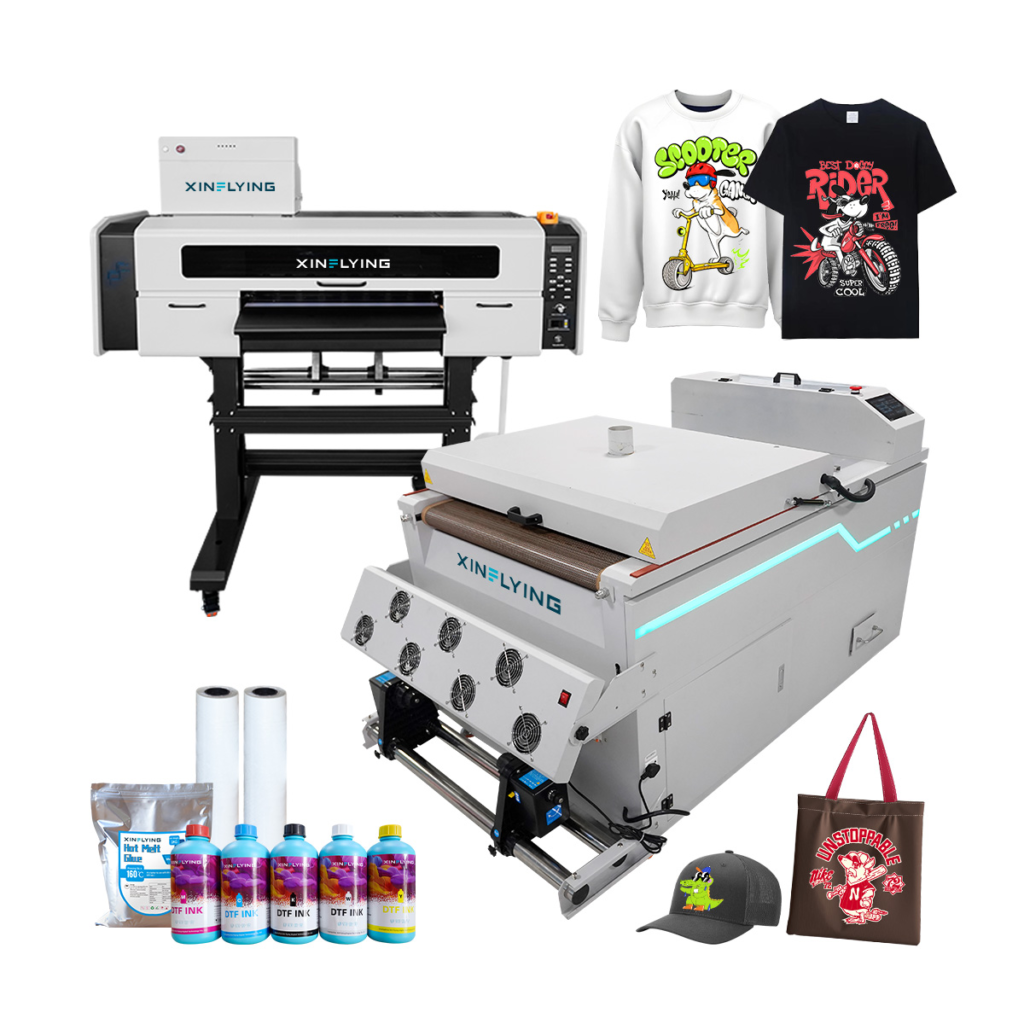
Xinflying DTF Printer Machine-702E
Enhance your DTF printing workflow with the 702E, equipped with 2 Epson i3200-A1 printheads for precise and high-speed 24-inch wide printing. Perfect for T-shirts, canvas bags, and other textiles, this DTF printer delivers consistent ink output and ultra-clear details.
Technical Specifications:
Print Width: 24”
Print Speed: 6Pass:10m²/h 8Pass:8m²/h 12Pass:5m²/h
Printhead: 2pcs Epson i3200-A1
Dimension: L1700*W850*H1350mm
HTV produces very clean, saturated solid colors and crisp edges — ideal for bold lettering and logos. But feel changes with layering: a single-layer HTV design sits close to the fabric, while multi-color designs stack several layers of vinyl on top of each other, which noticeably increases thickness and stiffness at the print location.
Durability: Which Lasts Longer?
Both DTF and HTV are wash-durable when applied at the correct temperature, pressure, and time, and both can last 50+ washes with proper care. The failure points differ, though: DTF transfers can develop slight edge cracking on very large, full-coverage prints after many high-heat wash cycles. HTV’s main risk is at layer edges and corners on multi-color designs — the more layers stacked, the more edges there are that can start to lift or peel over time, especially if the shop skips a step in weeding or pressing.
Which Is Better for Small Businesses Starting Out?
For shops planning to offer a wide range of custom, full-color, or photo-based designs, DTF is the more scalable starting point — pricing stays flat regardless of color count, and there’s no cutting or weeding labor to manage.
HTV makes more sense as a primary method for shops focused on team and school apparel — names, numbers, and simple logos — where design complexity is naturally low and the labor cost of weeding stays manageable. It’s also the better choice for orders that specifically call for a specialty finish like glitter or holographic vinyl.
- Choose DTF for: full-color designs, photo-realistic art, gradients, mixed fabric orders, fast turnaround
- Choose HTV for: team names/numbers, simple 1–3 color logos, specialty finishes (glitter, holographic, reflective), low per-design labor when order volume of simple designs is high
Can You Run Both DTF and HTV in the Same Shop?
Yes, and many shops do. DTF and HTV cover different strengths rather than competing directly — DTF for anything full-color or detailed, HTV for bold single-color designs and specialty finishes that DTF can’t produce. A shop offering both can route each order to whichever method fits the design and the customer’s budget.
Xinflying DTF printer machines are built for custom apparel businesses of all sizes. If you’re comparing DTF equipment or want help matching a setup to your typical design mix, visit us at xin-flying.com.
Frequently Asked Questions
Is DTF cheaper than HTV?
For simple 1–2 color designs, cost is similar. For multi-color or detailed designs, DTF is usually cheaper since its cost doesn’t rise with color count, while HTV requires a separate cut-and-weed step per color.
Which lasts longer, DTF or HTV?
Both can last 50+ washes with proper application. DTF is more prone to edge cracking on very large designs; HTV is more prone to lifting at layer edges on multi-color designs.
Can HTV do photo-realistic designs?
Not practically. HTV is cut from solid-color vinyl sheets, so each color needs a separate layer — gradients and photographic detail are essentially out of reach. DTF is the better choice for that kind of design.
Does DTF offer glitter or holographic effects like HTV?
Not directly. DTF can add gloss or matte varnish finishes, but true glitter, holographic, flock, or reflective textures currently require specialty HTV vinyl.
What’s the minimum order for HTV to make sense?
There’s no strict minimum — HTV works for single pieces — but it’s most cost-effective for simple, low-color designs. As color count rises, DTF becomes the more efficient choice regardless of order size.
Sources
Direct to Film Printing Market Report — Grand View Research
Custom Screen Printing Industry Report — IBISWorld
You Might Also Like
DTF vs Screen Printing: Which Method Should You Use?