The custom print industry offers more technology choices than ever — but picking the wrong one for your product mix or business model is an expensive mistake. This guide cuts through the confusion.
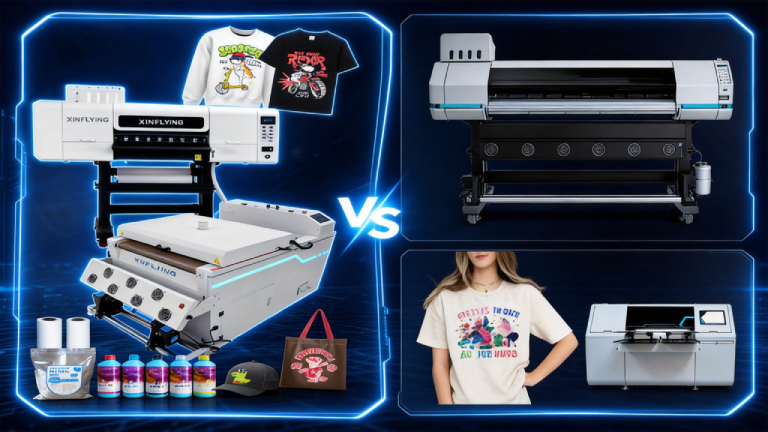
If you’ve been weighing up a DTF printer machine against DTG, sublimation, or screen printing, you’re not alone. Each technology has a distinct set of strengths, limitations, and ideal use cases — and understanding those differences is what separates a smart investment from wasted capital.
This article gives you a head-to-head comparison across every factor that matters: fabric compatibility, performance on dark garments, suitability for small orders, color capability, production speed, setup complexity, durability, maintenance burden, and cost efficiency.
The Four Technologies at a Glance
DTF (Direct-to-Film) Printing
DTF prints designs onto a special PET film using CMYK + white inkjet inks, applies a hot-melt adhesive powder, cures the film, then transfers it onto a substrate using a heat press. The result is a full-color, soft-feel transfer that bonds to virtually any fabric — no pretreatment required.
DTG (Direct-to-Garment) Printing
DTG inkjet printers apply water-based inks directly onto the fabric surface, similar to how a desktop printer works on paper. It excels on 100% cotton and works well for on-demand single-piece production. Dark garments require a liquid pretreatment before printing.
Dye Sublimation Printing
Sublimation uses heat to convert solid dye into gas, which bonds chemically with polyester fibers or polymer-coated hard goods. The result is an incredibly vibrant, permanent print — but it only works on white or light-colored polyester and polymer-coated substrates.
Screen Printing
Screen printing forces ink through a mesh stencil onto the substrate — one layer (and one screen setup) per color. It is the dominant method for high-volume runs because of its very high production speed and low per-unit cost once set up. It struggles with small orders, complex multicolor gradients, and rapid design turnarounds.
Feature-by-Feature Comparison
The table below compares all four technologies across nine key performance dimensions, based on real-world production data:
| Feature | DTF Printing | DTG Printing | Sublimation | Screen Printing |
| Fabric Compatibility | Cotton, Polyester, Blends, Nylon | Mainly Cotton | Polyester Only | Most Fabrics |
| Dark Garments | ✓ Excellent | ✓ Good | ✗ Not Suitable | ✓ Excellent |
| Small Orders | ✓ Ideal | ✓ Ideal | ✓ Ideal | ✗ High Setup Cost |
| Full-Color Designs | ✓ Excellent | ✓ Excellent | ✓ Excellent | Limited |
| Production Speed | ✓ Fast | Medium | Fast | ✓ Very Fast for Bulk |
| Setup Requirements | Low | Medium | Low | High |
| Durability | ✓ High | High | High | High |
| Maintenance | Low | High | Low | Medium |
| Cost Efficiency | ✓ Excellent | Medium | Medium | Best for Large Volumes |
Breaking Down Each Category
1. Fabric Compatibility
DTF is the clear winner for flexibility. It bonds to cotton, polyester, blends, nylon, leather, and more — without any pretreatment or substrate coating. This makes it uniquely versatile for shops that print on a wide variety of blank types.
DTG is optimized for cotton and struggles on synthetic fibers. Sublimation is locked to white or light polyester. Screen printing works on most fabrics but requires flat, stable surfaces and doesn’t handle stretchy or technical fabrics as reliably.
For shops handling mixed orders — t-shirts, bags, hats, workwear, sportswear — DTF’s substrate flexibility is a major operational advantage.
2. Dark Garments
Printing on dark fabrics is where technologies diverge most dramatically. DTF and screen printing both perform excellently on black and dark-colored garments because both use an opaque white ink or ink layer as a base.
DTG can handle dark garments with liquid pretreatment (applying white ink underbase before the color layer), but this adds time, chemical handling, and can affect hand feel. Sublimation cannot print on dark garments at all — the dye is transparent, so dark fabric absorbs the color and the design disappears.
3. Small Orders & On-Demand Printing
DTF, DTG, and sublimation are all excellent for on-demand and small-run production. There is no screen setup, no minimum run, and no wasted setup cost. You can economically print one shirt or a dozen.
Screen printing reverses this equation entirely. Each color in a design requires a separate screen, burned and aligned at setup. Setup costs are typically $20–$50 per screen, making it uneconomical for small runs. Screen printing is designed for bulk — usually 24 pieces or more for cost efficiency.
4. Full-Color & Gradient Designs
DTF, DTG, and sublimation all excel at full-color photographic prints and complex gradients. They are inkjet-based and can reproduce virtually unlimited colors simultaneously.
Screen printing is limited by the number of screens. Most shops can run 4–8 colors. Gradients require expensive halftone techniques. Photographic designs are difficult and expensive to reproduce in screen print.
5. Production Speed
DTF produces gang sheets (multiple designs on one film) efficiently, and pressing is fast — typically 15–20 seconds per transfer at production pace. Sublimation presses are similarly fast on fabric.
DTG is the slowest of the four on a per-garment basis because each garment is printed individually in the printer bed, with print times ranging from 1–5 minutes depending on design complexity and ink coverage.
Screen printing’s automatic presses can print hundreds of units per hour once set up, making it the clear speed leader for large runs where the design doesn’t change.
6. Setup Requirements
DTF and sublimation are the simplest to set up: a printer, heat press, and supplies are all you need. No chemicals, no screens, no burn process, no specialized ventilation.
DTG requires regular head cleaning, pretreatment equipment, and fabric testing. Screen printing requires a darkroom, exposure unit, screen coater, and washout station — a significant physical infrastructure investment.
7. Durability
All four technologies are durable when executed correctly. DTF transfers are rated for 50+ wash cycles and resist cracking when pressed with the correct time/temperature/pressure. DTG prints can wash very well on cotton. Sublimation prints are arguably the most wash-durable because the dye is embedded in the fibers at a molecular level. Screen prints are extremely durable and have decades of proven longevity in the industry.
8. Maintenance
DTF printers require regular ink circulation and printhead maintenance, but less intensive daily attention than DTG. DTG printers are notorious for printhead clogging — especially white ink heads — requiring daily cycles and careful humidity control. Sublimation printers are generally low-maintenance. Screen printing presses are mechanically robust but require daily screen cleaning, ink storage management, and periodic emulsion maintenance.
9. Cost Efficiency
DTF offers excellent cost efficiency across small to medium production volumes. There is no setup cost, consumables are predictable, and labor per unit is low once workflows are optimized.
DTG has higher consumables (pretreatment, ink, print time) and higher maintenance costs, making it more expensive per unit than DTF at comparable volumes.
Sublimation is cost-efficient for the right product mix — polyester blanks are affordable, and press time is short. But its substrate restriction limits its applicability.
Screen printing becomes the most cost-efficient option at high volumes (100+ units of the same design). Its per-unit cost drops dramatically at scale, outperforming all other methods when print runs are large enough.
Verdict: Which Technology Is Right for Your Business?
The right technology depends entirely on your product mix, order profile, and growth trajectory. Here is a clear summary:
| Technology | Best For |
| DTF Printer Machine | Best all-rounder — widest fabric compatibility, excellent for dark garments, no setup cost, ideal for small-to-medium runs. |
| DTG Printing | Great for cotton-heavy orders, but limited on dark garments without pretreat and slower output per hour. |
| Sublimation Printing | Unbeatable vibrancy on polyester and hard goods, but incompatible with dark or cotton fabrics — a specialized tool. |
| Screen Printing | Dominant at high-volume runs due to speed and cost, but high setup, limited colors, and not viable for small orders. |
Most growing custom print businesses eventually adopt more than one technology — DTF for apparel versatility, sublimation for hard goods and drinkware, and screen printing if high-volume uniform runs become a core revenue stream.
Who Should Invest in a DTF Printer Machine?
A DTF printer machine is the strongest starting point for most new custom print businesses because:
- It serves the broadest range of substrate types and fabric colors
- It requires no pretreatment chemicals or darkroom infrastructure
- It is cost-efficient from order quantity 1 upward
- Gang sheet printing maximizes ink and material efficiency for small-batch mixed orders
- White ink performance enables dark garment printing without the complexity of DTG pretreat
- It pairs naturally with sublimation (for hard goods) and screen print (for bulk runs) as the business scales
If your customer base is diverse — small businesses, schools, sports teams, events, and individuals — and your order sizes are typically 1–50 pieces, DTF is almost certainly the highest-ROI technology to invest in first.
Final Thoughts
There is no single “best” printing technology — only the best technology for your specific business situation. DTF printing has earned its position as the most versatile and accessible entry point for custom apparel and merchandise production, but the right answer for a high-volume uniform shop or a drinkware-only business may look very different.
Evaluate your top product categories, your typical order size, and your growth plans. Then build your equipment stack around the technology (or technologies) that serve those needs most efficiently.
The good news: with DTF’s low setup requirements and broad compatibility, you can start generating revenue quickly and use that cash flow to expand your capabilities as demand grows.