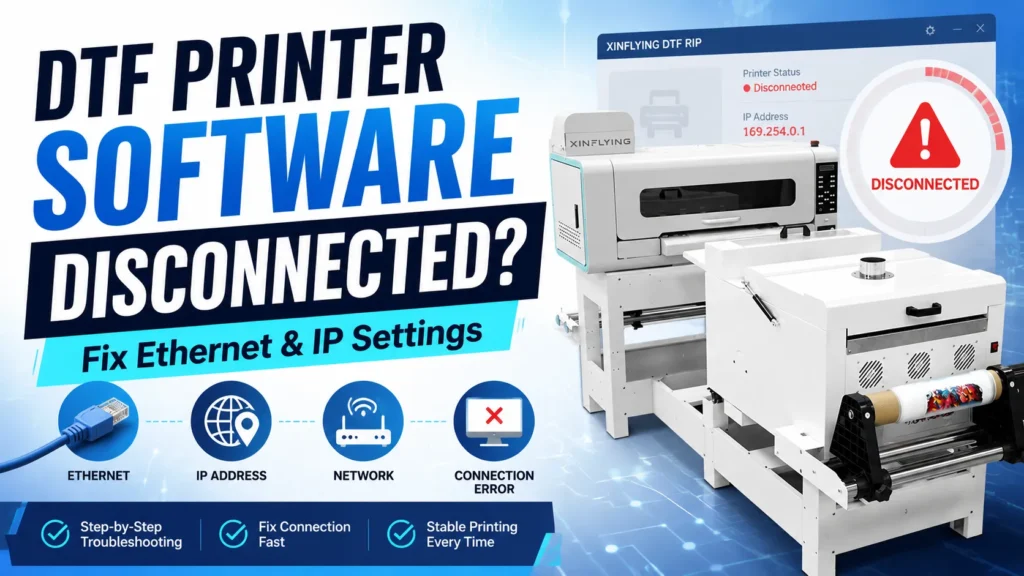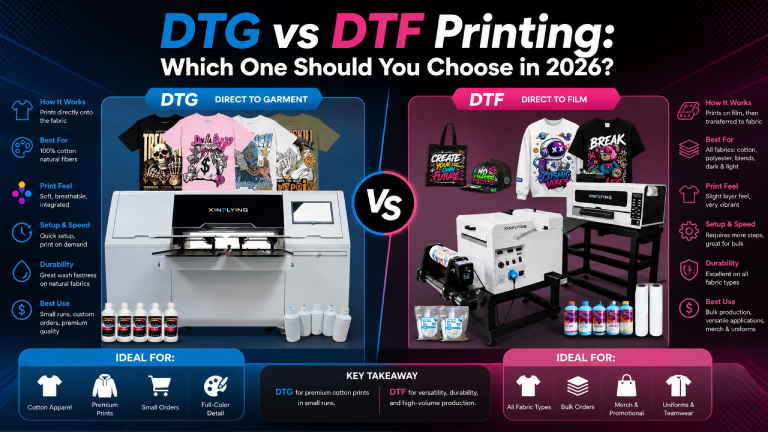
If you’re setting up a print-on-demand shop or comparing equipment for your print business, DTG vs DTF is probably the first decision you’ll face. Both methods produce full-color, photo-quality prints, but they work in completely different ways — and that difference matters a lot depending on what you’re printing and on what fabric.
This guide compares them head-to-head so you can pick the right one (or use both).
What Is DTG Printing?
DTG (Direct-to-Garment) printing works like a giant inkjet printer for clothing. The garment is loaded flat onto a platen, pre-treated (for dark fabrics), and ink is sprayed directly into the fibers.
Strengths of DTG:
- Extremely soft hand-feel — the print becomes part of the fabric
- Great color accuracy for photo-realistic designs
- No minimum order — perfect for single custom shirts
Weaknesses of DTG:
- Works reliably only on cotton or high-cotton blends
- Requires pre-treatment for dark garments, which adds time and cost
- Slower per-unit production speed than transfer methods
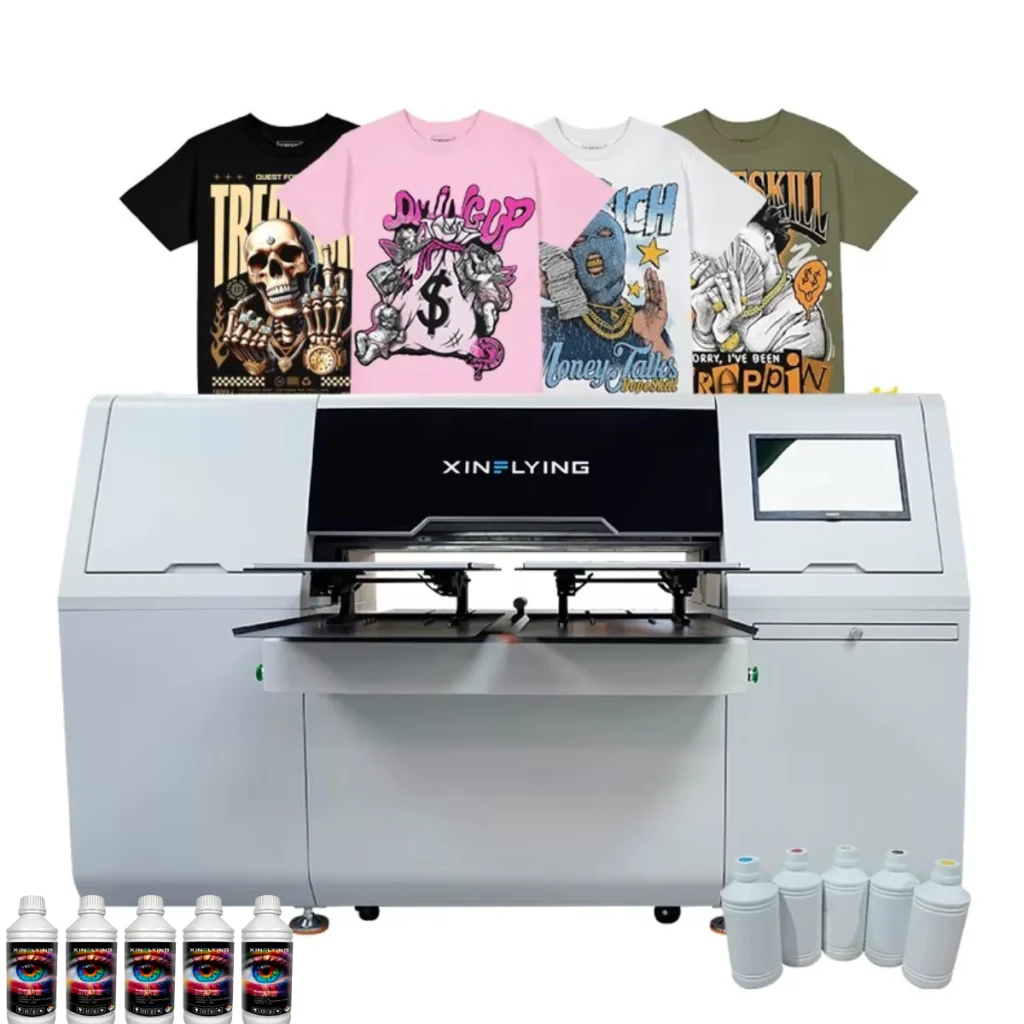
Xinflying DTG Garment Printer-20
The Xinflying DTG Garment Printer-20 is designed for efficient, on-demand garment printing, offering vivid colors, sharp details, and consistent results for custom apparel production.
What Is DTF Printing?
DTF (Direct-to-Film) printing takes a different route. Instead of printing on the garment itself, the design (plus a white ink base layer) is printed onto a special PET film, coated with adhesive powder, cured, and then heat-pressed onto the fabric.
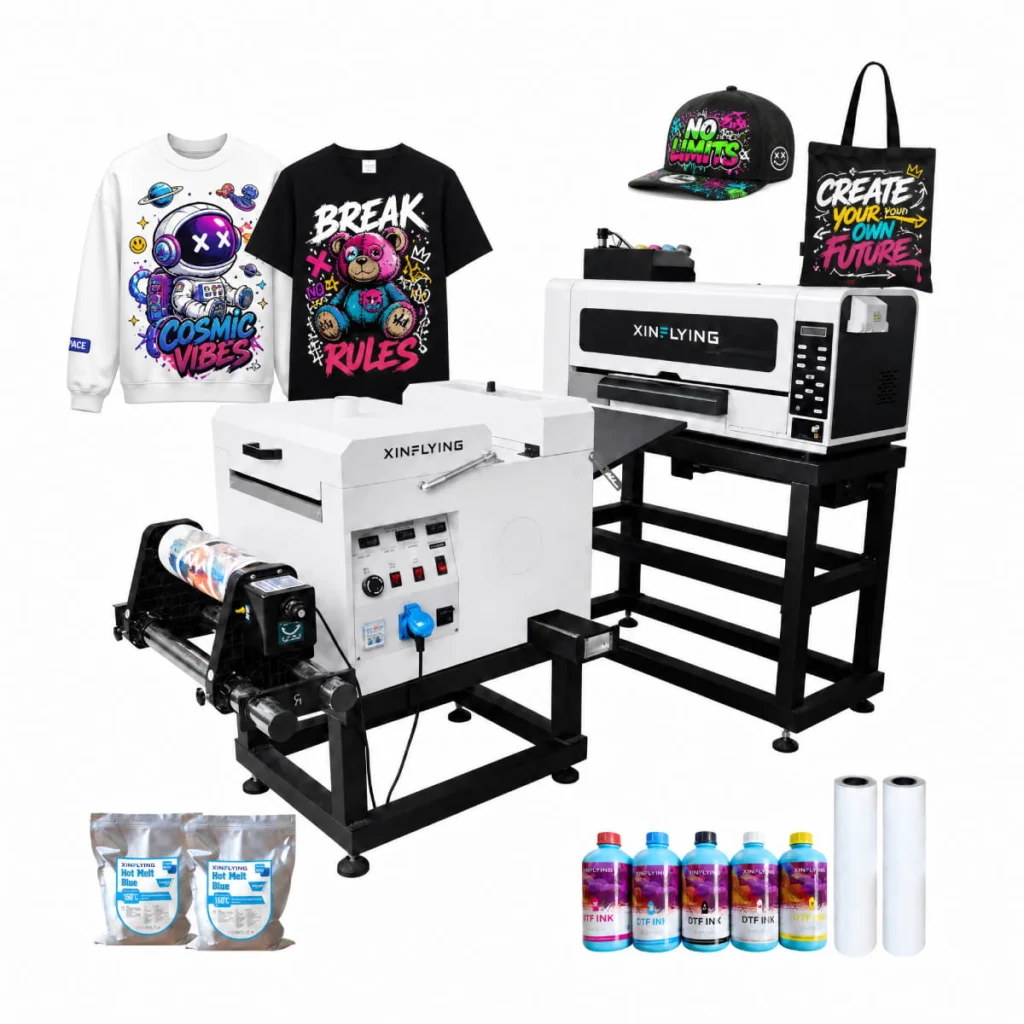
Xinflying DTF Printer Machine-400D
Boost your custom printing business with the Xinflying DTF Printer Machine-400D. Produce high-quality DTF transfers for T-shirts, hoodies, tote bags, and more with consistent results.
When people compare DTF vs DTG printing, DTF usually stands out for:
- Working on almost any fabric: cotton, polyester, blends, nylon, even leather
- No pre-treatment needed, regardless of fabric color
- Transfers can be printed ahead of time and stored, then applied on demand
- More vibrant colors on dark garments, thanks to the built-in white layer
Where DTG still wins:
- Softer feel with zero texture on the surface
- Slightly better color blending for very fine gradients on cotton
DTG vs DTF: Side-by-Side Comparison
| Factor | DTG | DTF |
|---|---|---|
| Fabric compatibility | Cotton/cotton-blend only | Any fabric, any color |
| Feel | Very soft, no texture | Slight texture (thin film layer) |
| Setup/pre-treatment | Required for dark garments | Not required |
| Storage | Must print on demand | Transfers can be pre-printed and stored |
| Startup cost | Higher (specialized printer) | Moderate (printer + press + film/powder) |
| Best for | Cotton-only shops, boutique quality | Multi-fabric shops, dark garments, small batch orders |
What the Market Data Says
The reason this comparison matters so much right now is that the two methods are growing at very different speeds. According to Grand View Research, the global direct-to-film printing market was valued at roughly $2.72 billion in 2024 and is projected to reach $3.92 billion by 2030 — a steady 6.0% annual growth rate driven largely by small businesses and on-demand apparel sellers who need to print across mixed fabric types without holding inventory.
DTG, by contrast, still commands the single largest share of the broader print-on-demand technology mix — an industry analysis citing Mordor Intelligence data put DTG’s share at roughly 44% of all print methods used across on-demand apparel platforms in 2025 (via companieshistory.com). That same data set found DTF is growing faster than any other method in the category, at close to a 28% annual growth rate, in part because DTF workflows use significantly less white ink than DTG per print and require no fabric pre-treatment step — both of which lower per-unit production time for shops running high volumes of small orders.
This mirrors a broader shift happening across other on-demand manufacturing industries — from book publishing’s move to print-on-demand to 3D-printed spare parts — where digital, no-setup production is steadily displacing methods that require upfront preparation, simply because it removes the fixed costs that make small-batch work expensive. Apparel decoration is following the same curve, and DTF’s position in that shift is a big part of why so many shops are choosing it as their default method for anything that isn’t 100% cotton.
Which One Should You Choose?
If your business prints almost exclusively on cotton shirts and prioritizes the softest possible feel, DTG is still an excellent choice — especially for boutique or premium apparel brands.
If you want flexibility across fabric types, need to print on dark garments without pre-treatment hassle, or want the option to pre-print transfers and apply them later, DTF is generally the more practical and scalable option — which is why many shops are running DTF vs DTG printing side by side, or switching to DTF entirely.
Frequently Asked Questions
DTF is more versatile because it works on virtually any fabric and color without pre-treatment. DTG offers a softer feel but is limited mostly to cotton. The “better” choice depends on your fabric mix and order volume.
Both can last 50+ washes with proper curing and care. DTF transfers tend to hold up slightly better on polyester and blended fabrics, while DTG performs excellently on 100% cotton.
Startup costs are comparable, but DTF often has a lower barrier to entry since it doesn’t require specialized pre-treatment equipment for dark garments.
DTG is designed primarily for cotton and cotton blends; it doesn’t perform well on 100% polyester. DTF is the better choice if your garments are polyester or mixed-fiber.
Yes. DTG prints sit within the fabric and feel almost invisible to the touch, while DTF sits slightly on top of the fabric as a thin layer, giving a very slight texture.
Sources
- Direct to Film Printing Market Report — Grand View Research
- Print-On-Demand Market Statistics 2026 — data via Mordor Intelligence
You Might Also Like: