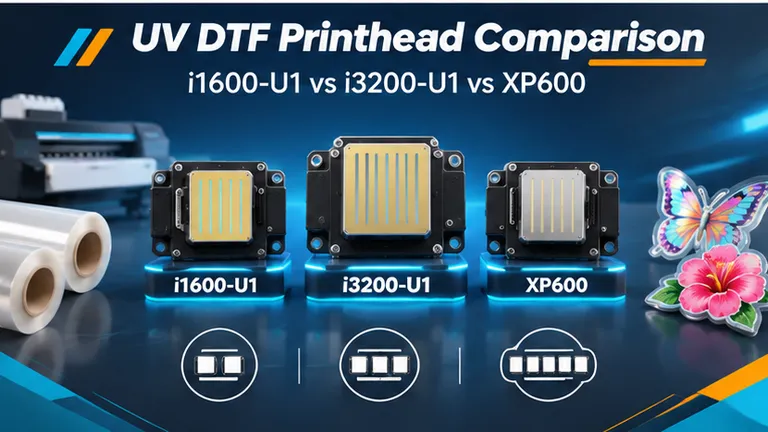
An accurate Comparação entre cabeçotes de impressão UV DTF starts with two hardware checks before comparing prices. First, confirm the quote lists an authentic -U1 UV head rather than an aqueous -A1 textile head. Next, check how many heads handle White + CMYK + Varnish plus foil or glue.
Every crystal sticker stacks white, color, and varnish before B-film lamination, so head family alone never sets speed. Instead, head count, carriage mechanics, pass mode, and inline lamination jointly govern daily output.
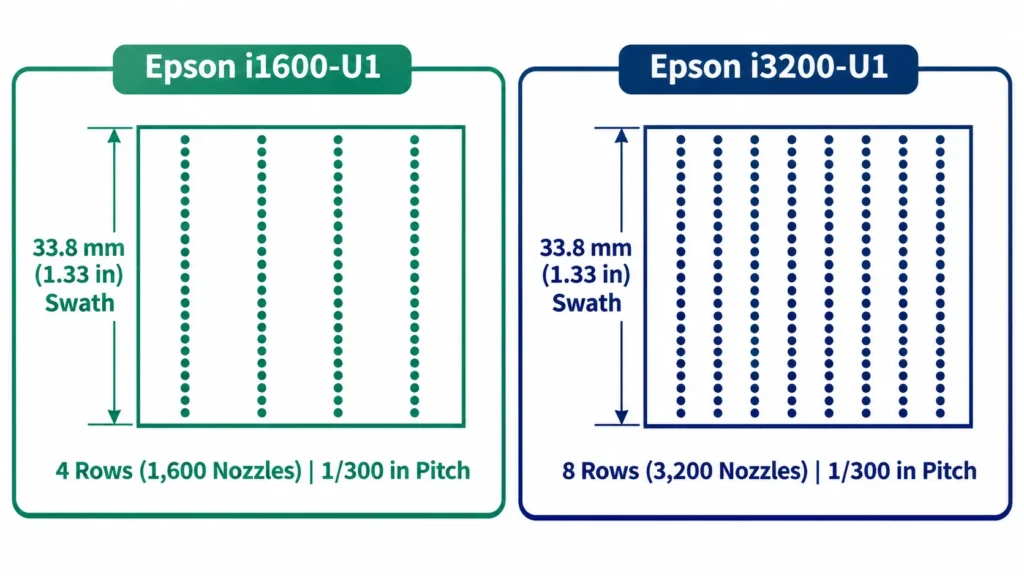
Many buyers assume the Epson i1600-U1 is a lower-resolution downgrade from the Epson i3200-U1. However, Epson’s PrecisionCore MicroTFP sheets show identical 33.8 mm (1.33 in) swath width and 300/600 npi pitch. Both heads also share 3.8, 6.2, and 9.3 pl droplets and a 5–7 mPa·s UV viscosity window.
Only three specs differ: nozzle count (1,600 vs. 3,200), nozzle rows (4 vs. 8), and weight (80 g x 82 g). Thus, i3200-U1 doubles active rows per sweep, while finished speed still depends on the printer. Use the uv dtf printhead comparison chart below to separate factory specs from seller claims.
UV DTF Printhead Comparison Chart: Official Epson Specs vs. Vendor Claims
| Spec | Epson i1600-U1 (Official) | Epson i3200-U1 (Official) | XP600 / F1080 (Vendor Claims) | Buyer Takeaway |
|---|---|---|---|---|
| Ink & Viscosity | UV (5–7 mPa·s) (2021 EN: UV / Eco) | UV (5–7 mPa·s) | Multi-ink piezo (no Epson UV sheet) | Confirm -U1; never run UV in -A1 |
| Nozzles & Rows | 1.600 / 4 fileiras (400/row) | 3.200 / 8 fileiras (400/row) | Mostly 1,080 / 6 ch (180 × 6) | More rows fire more drops per pass |
| Print Swath | 33.8 mm (1.33 in) | 33.8 mm (1.33 in) | Vendor-reported ~25.4–32 mm | Head swath, not 12″–24″ roll width |
| Pitch & Colors | 1/300 in; 300/600 npi (4 colors) | 1/300 in; 300/600 npi (4 colors) | Vendor-reported 180 npi/row | Both U1 heads share native pitch |
| Droplets | 5 pl binary (43.2 kHz); 3.8/6.2/9.3 pl | Same VSDT drops & frequencies | ~3.5 pl min (freq. unverified) | Identical drops with tuned waveforms |
| Size & Weight | 69.1 × 59.4 × 35.6 mm / 80 g | 69.1 × 59.4 × 35.6 mm / 82 g | Smaller footprint | Heads match specific carriages |
| Lab Durability | 106B actuations; 1,500 cleanings (lab) | 106B actuations; 1,500 cleanings (lab) | No Epson lab or field data | White circulation & UV shield set life |
| Spare Price | Request written -U1 citação | Request written -U1 citação (~$1,299 ref.) | $299–$389 (HeyGears / InkSonic) | Verify head warranty exclusions |
Stop Mixing Up Textile DTF (-A1) and UV DTF (-U1) Printheads
Ao comparar i3200-u1 vs i3200-a1, never assume all Epson i3200 or i1600 heads interchange. Copying replacement prices or lifespan estimates from water-based textile DTF blogs also skews a UV DTF budget. In Epson’s I3200-A1/E1/U1 e I1600-A1/E1/U1 brochures, three suffixes target three distinct inks: -U1 for UV-curable, -A1 for aqueous, e -E1 for eco-solvent.
Viscosity, Ink-Path Chemistry, and Cross-Installation Risks
Da Epson official I3200-U1 spec page e official I1600-U1 spec page rate -U1 heads for 5–7 mPa·s UV ink. They also use internal manifolds resistant to UV monomers (the 2021 English I1600 sheet lists UV / Eco-Solvent). In contrast, aqueous i3200-A1 heads target 3–4 mPa·s textile inks with slightly different drop volumes.
Never cross-install heads or flush one chemistry into another. Digiprint USA warns against putting an i3200-U1 in a water-based DTF printer.
Likewise, LONGER warns that mixing UV and aqueous ink inside one head clogs nozzles. Always check the physical I1600-U1 ou I3200-U1 label on the head itself.
Why Epson Heads Do Not Mean an Epson-Built UV DTF Printer
Epson’s printhead pages cover general industrial printing without mentioning “UV DTF.” Likewise, Epson’s SureColor V1070 is a direct desktop UV flatbed rather than an A/B film roll printer.
The UV DTF printers in this guide—from Xinflying, STS Inks, InkSonic, and Procolored—come from third-party builders integrating Epson heads (see O que é a impressão UV DTF). Because listings like the STS Inks S604 omit the suffix, require Epson i1600-U1 ou Epson i3200-U1 on your invoice.
Epson i1600-U1 vs. i3200-U1: What Epson’s Datasheets Confirm—and Where Machine Design Takes Over
Em um i1600-u1 vs i3200-u1 review, Epson’s Chinese pages give both heads the same headline: “1-inch entry-level inkjet printing, 4 colors.” Similarly, Epson’s English sheet notes that “I1600 has also been added to the lineup in order to meet the various customer needs.” Neither sheet calls the i1600-U1 lower-grade.
Swath Width, Nozzle Rows, and VSDT Droplet Potential
Separate what the head datasheet confirms from what depends on the complete printer:
- Swath Width vs. Roll Width: Both U1 heads share a 33,8 mm swath along the carriage axis. Meanwhile, gantry width—not the printhead—decides whether a printer takes 12″, 16.5″, or 24″ A-film.
- 4 Rows (1,600 Nozzles) vs. 8 Rows (3,200 Nozzles): Both heads pack 400 nozzles per row at 1/300-inch pitch (300 npi/row, 600 npi/2 rows) for up to 4 colors. Because i3200-U1 doubles nozzle rows, builders can design faster wide-format carriages. However, lamp wattage, ink cure speed, and RIP profiles still decide whether a job runs 6-pass or 8-pass.
- Shared Droplets vs. Actual Sharpness: Both heads fire 3.8, 6.2, and 9.3 pl VSDT droplets at 21.6 kHz (5 pl at 43.2 kHz binary). Thus, native resolution matches. Real 1–2 pt sharpness depends on waveforms, step accuracy, and bidirectional alignment.
Where XP600 / F1080 Fits—and How to Compare Speed Claims Fairly
Em i1600 printhead vs xp600 ou xp600 vs i3200 uv dtf comparisons, XP600 (often paired with F1080) powers compact 11.8″–13″ entry printers. For example, InkSonic’s VF13 ($4,399 checked October 2026) and Procolored’s VF13 Pro Panda ($6,399 checked September 2026 by Atomm) run dual XP600 heads. That lowers machine cost and spare-head cost ($299–$389) for startups.
Keep two limits clear when reviewing XP600 or F1080 quotes:
- Third-Party Claims Only: Epson publishes no UV DTF datasheet for XP600 or F1080. Most sellers list 6 channels and 1,080 nozzles (180 × 6) with ~3.5 pl drops, though one blog cites “~180 × 2 rows.”
- No Controlled Speed Multipliers: Online speed multipliers for i3200 over XP600 or i1600 vary wildly across dealers. None test the same artwork, pass count, ink stack, and width while changing only the head.
Instead of generic multipliers, ask every seller for m²/h (or linear feet/hour) in your exact 6-pass or 8-pass White + CMYK + Varnish mode.
How 2-Head, 3-Head, and 4-Head UV DTF Machines Are Configured
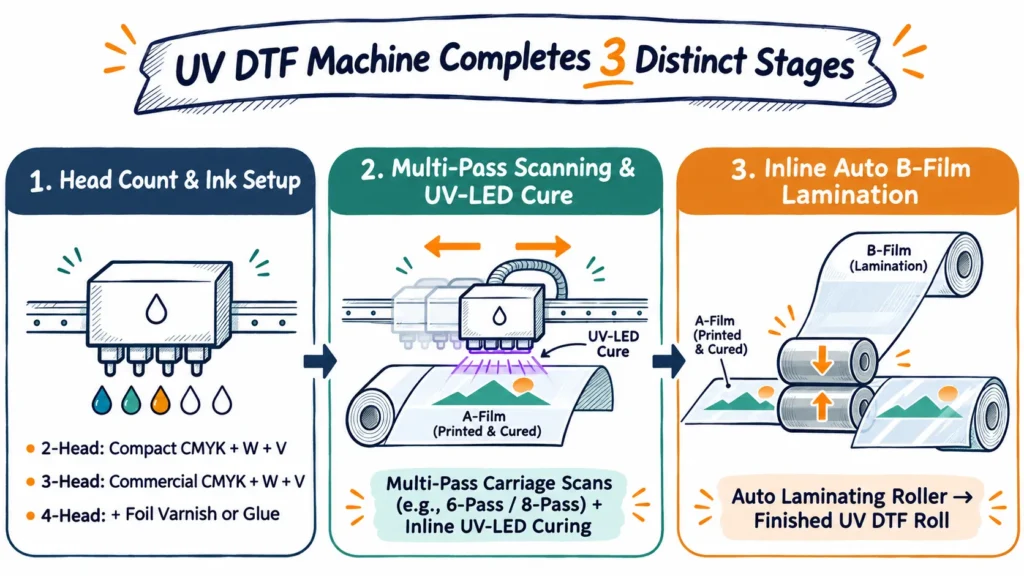
As our best UV DTF printer guide explains, adding printheads only pays off when head count fits your volume and specialty finishes. Unlike textile DTF (CMYK + White), UV DTF builds White, CMYK, and Clear Varnish (V)—plus optional Foil Varnish ou Cola aplicável por jato—across 4-pass, 6-pass, or 8-pass scans.
Matching Head Count to White, Color, Varnish, and Foil Channels
Check both total head count and the stated ink channel string on every model:
- 2-Head Entry A3 Class (2 × XP600): Compact 11.8″–13″ printers like InkSonic VF13 and Procolored VF13 Pro run the full stack across two heads. Entry cost stays low. However, fewer nozzles slow heavy white and gloss varnish runs.
- 3-Head Commercial U1 Class (3 × i1600-U1 or 3 × i3200-U1): For 12″ (30 cm) runs, Xinflying XF-450S-3 uses 3 × Epson i1600-U1 cabeças (CMYK + W + V) rated at 3.5 / 2.75 m²/h (8-pass). For 24″ rolls, Xinflying XF-600-3I32U1 pairs 3 × Epson i3200-U1 heads with an Auto Laminating Device on 600 mm media (6.28 m²/h, 6-pass; verify print width per our UV DTF decal production setup guide). Similarly, the 24.4″ STS Inks S604 runs 3 × i3200 rated at 12 m²/h (4-pass), 8 m²/h (6-pass), and 5 m²/h (8-pass).
- 4-Head Specialty U1 Class (Foil, Glue, or Double-White 3D): Xinflying’s 16.5″ XF-420ST (4 × i1600-U1, 8-pass 3,5 m²/h) and 24″ XF-600ST (4 × i3200-U1, 6-pass 5.5 m²/h) add Foil Varnish for inline metallic stamping. Meanwhile, 4-head STS S604 adds Glue, and 3D builds run CMYK + W + W + V. (Always confirm head count in writing if a brochure conflicts.)
Verified UV DTF Machine Configurations
| Tier & Model | Cabeçotes de impressão | Canais de tinta | Width & Lamination | Published Speed (with Pass Mode) | Best Fit |
|---|---|---|---|---|---|
| Entry A3 Dual-Head (InkSonic VF13 / Procolored VF13 Pro) | 2 × XP600 | CMYK + W + V (or WW + VV) | 11.8″–13″; check if laminator costs $400–$499 extra | Varies by seller (~$4,399–$6,399) | Startups testing short-run wraps on a tight budget |
| 12″ 3-Head Industrial U1 Xinflying XF-450S-3 | 3 × Epson i1600-U1 | CMYK + W + V | 12″ (30 cm) roll/sheet | 8-pass: 3.5 / 2.75 m²/h | Small-to-mid shops running daily 12″ fine-text sheets |
| 16.5″ 4-Head Foil U1 Xinflying XF-420ST | 4 × Epson i1600-U1 | W + CMYK + V + Verniz metalizado | 16.5″ (42 cm) with inline foil/lamination | 8-pass: 3.5 m²/h | Custom label studios making metallic foil decals |
| 24″ 3-Head High-Output U1 Xinflying XF-600-3I32U1 (cf. STS S604) | 3 × Epson i3200-U1 | CMYK + W + V | 24″ (600 mm) + Auto Laminating Device | 6-pass: 6.28 m²/h (STS: 4p 12 / 6p 8 / 8p 5) | Wholesalers running continuous 24″ A/B rolls |
| 24″ 4-Head Specialty U1 Xinflying XF-600ST (cf. STS 4-head Glue) | 4 × Epson i3200-U1 | W + CMYK + V + Verniz metalizado (STS: + Glue) | 24″ (60 cm) roll-to-roll inline finishing | 6-pass: 5.5 m²/h | High-volume shops needing 24″ foil or jettable glue |
Lifespan, White-Ink Maintenance, Replacement Cost, and Warranty Boundaries
Before signing an order based on i1600 printhead price or expected longevity, check four operational realities.
Lab Actuations vs. Real UV DTF Head Failures
Both i1600-U1 and i3200-U1 share the same Epson lab ratings. Each head lists 106 billion piezo actuations e 1,500 cleanings at 40 kPa without leakage. However, Epson explicitly states that “the above are Epson laboratory data and do not serve as a basis for quality assurance.”
Neither Epson nor reviewed builders publish controlled field-life logs in months or years. Moreover, textile DTF lifespan ranges never apply to UV inks.
In real shops, two hazards kill UV heads early. White pigment settles inside manifolds, and stray UV light cures ink on nozzle plates. Therefore, choose printers with white-ink agitation, internal circulation, negative-pressure control, and head heating (as on STS S604 and Xinflying U1 printers).
Spare-Head Pricing, Warranty Exclusions, and Upgrade Limits
Epson sets no retail MSRP for industrial -U1 heads, and textile blogs usually quote aqueous -A1 prices. Published UV spare benchmarks include $389 for an InkSonic XP600 and ~$299 (F1080) or ~$1,299 (i3200) on HeyGears’ desktop UV platform. Always request a written -U1 spare quote covering cables, dampers, and remote calibration.
Also check warranty exclusions before paying. Xinflying’s 12-month limited hardware warranty excludes installed and tested printheads, consumables, and ink-contact wear parts. In contrast, some retail desktop bundles include starter coverage, like InkSonic’s 6-month VF13 policy or HeyGears’ 180-day coverage.
Por fim, do not count on upgrading across printhead families later. Mounting plates, capping stations, cables, waveforms, and boards differ by head model. While HeyGears offers a paid G1-to-G1X flatbed upgrade, most roll UV DTF printers lock into one head family.
Real-Shop Evaluation: Why Inline Lamination and Total Job Time Matter on Short Runs
Comparing 3.5 m²/h against 6.28 m²/h hides the main bottleneck for custom shops: B-film lamination and short-run setup.
Consider a two-person promo shop making 300–500 custom items monthly, from tumblers and keychains to acrylic plaques and metal tags. Nearly every order ran 1–3 pieces per design under 2.5″ × 3.5″ with 1 pt text and gradients. Initially, they eyed the cheapest A3 desktop printer.
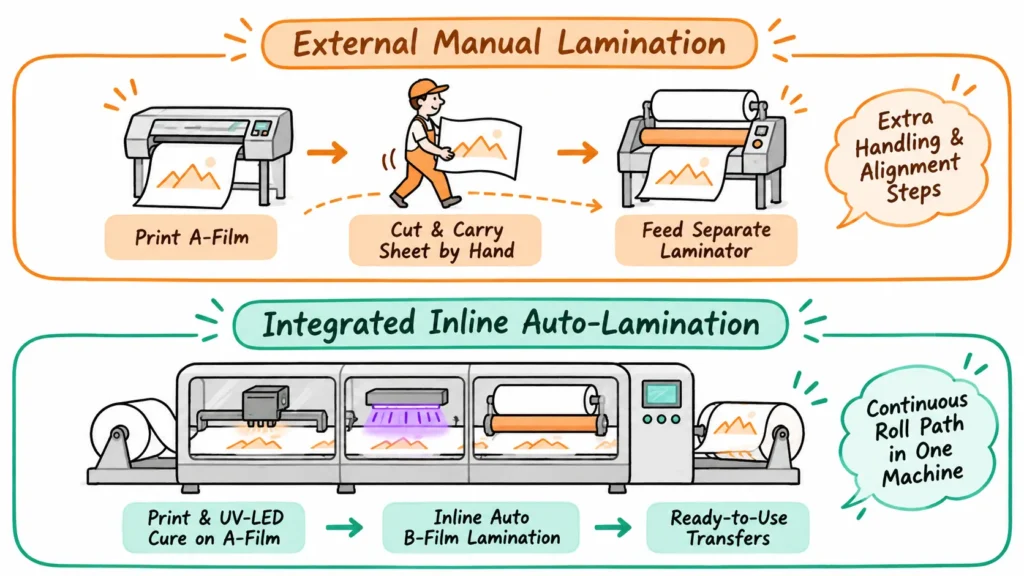
However, quotes revealed two workflow gaps. Standalone laminators added $400–$499 (per Atomm’s September 2026 review). Worse, hand-carrying A-film to an external laminator risked crooked alignment and air bubbles.
Instead of trusting brochure speed, the buyer sent both finalists his hardest 1 pt file for a 10-piece timed video demo:
- External Manual Lamination: Operators hand-fed every A-film sheet into a separate laminator, adding handling time and bubble reprints on tiny batches.
- Integrated Inline Lamination: Once operators set tension on the leader strip, the printer cured ink and laminated B-film automatically in one pass.
Grade every demo by accepted bubble-free decals divided by total elapsed clock time. For 1-to-3-piece orders, inline auto-lamination and steady varnish curing drive daily output more than m²/h ratings. Meanwhile, 24-inch 3 × i3200-U1 speed pays off on long daily gang rolls.
Five-Step Pre-Purchase Verification Checklist
- Lock Head Model and Count: Require the exact suffix (3 × Epson i1600-U1 or 3 × Epson i3200-U1) and verify title and spec table match.
- Confirm Paid-Mode Speed: Ask for m²/h in 6-pass or 8-pass White + CMYK + Varnish mode rather than draft mode.
- Audit Lamination and Inclusions: Confirm inline B-film lamination plus starter film, UV inks, and RIP dongle in writing (see UV DTF printer costs).
- Time a 10-Piece 1 pt Demo: Track total minutes from nozzle check through lamination and count only bubble-free passes.
- Confirm Warranty and Spare Pricing: Check head exclusions, get one authentic -U1 spare price, and verify remote training.
Perguntas frequentes
De acordo com as fichas técnicas da Epson, ambas as cabeças compartilham 33,8 mm largura da faixa de corte, 300 npi/linha tom, 3,8–9,3 pl gotículas, e 5–7 mPa·s viscosidade. Apenas o número de bicos (1.600 / 4 fileiras vs. 3.200 / 8 fileiras) e peso (80 g x 82 g) diferem. Assim, o i3200-U1 dobra o número de fileiras por passagem, enquanto a mecânica e a cura ainda determinam a velocidade.
Não. O -A1 suffix denotes Epson’s aqueous head built for 3–4 mPa·s tinta têxtil. As impressoras DTF UV precisam de -U1 cabeças (i1600-U1 ou i3200-U1) classificado para 5–7 mPa·s Tintas UV.
Uma impressora de 3 cabeçotes como Xinflying XF-450S-3 (3 × i1600-U1) dispõe de 4.800 bicos industriais -U1 distribuídos ao longo de 33,8 mm para impressões contínuas de 12". Em contrapartida, os modelos duplos XP600 (InkSonic VF13, Procolored VF13 Pro) distribuem a tinta por duas cabeças compactas. Isso troca o número de bicos por um custo inicial mais baixo e cabeças de reposição que custam entre US$ 299 e US$ 389.
As impressoras padrão de 3 cabeçotes funcionam CMYK + W + V. Um quarto membro acrescenta Verniz metalizado em linha em XF-420ST (4 × i1600-U1) e XF-600ST (4 × i3200-U1). Outras configurações de 4 cabeçotes funcionam Cola aplicável por jato (STS S604 de 4 cabeçotes) ou tinta 3D dupla branca.
Normalmente, não. As placas de montagem, as estações de encapsulamento, os cabos, as formas de onda e as placas de controle variam de acordo com as famílias de cabeçotes. Só faça a atualização se o fabricante vender um kit modular de fábrica, como a atualização paga da HeyGears para a mesa plana G1 para G1X.
Coverage depends on each seller’s written policy. Standard 12-month hardware warranties—including Xinflying’s—cover core parts but exclude installed printheads, consumables, and ink-contact wear parts. Only a few retail bundles offer 180-day or 6-month head policies, so confirm exclusions and -U1 spare prices in writing.
Match Your Printhead and Head-Count Setup to Your Decal Volume
Start by confirming three shop facts: typical decal size and daily film length, gloss vs. foil needs, and inline B-film lamination.
Next, explore our Impressoras UV DTF, covering the 12″ XF-450S-3, 24″ XF-600-3I32U1, and 4-head foil XF-420ST / XF-600ST models. Send our team your hardest 1 pt file and weekly volume for a written quote, spare-head pricing, and a timed sample demo.