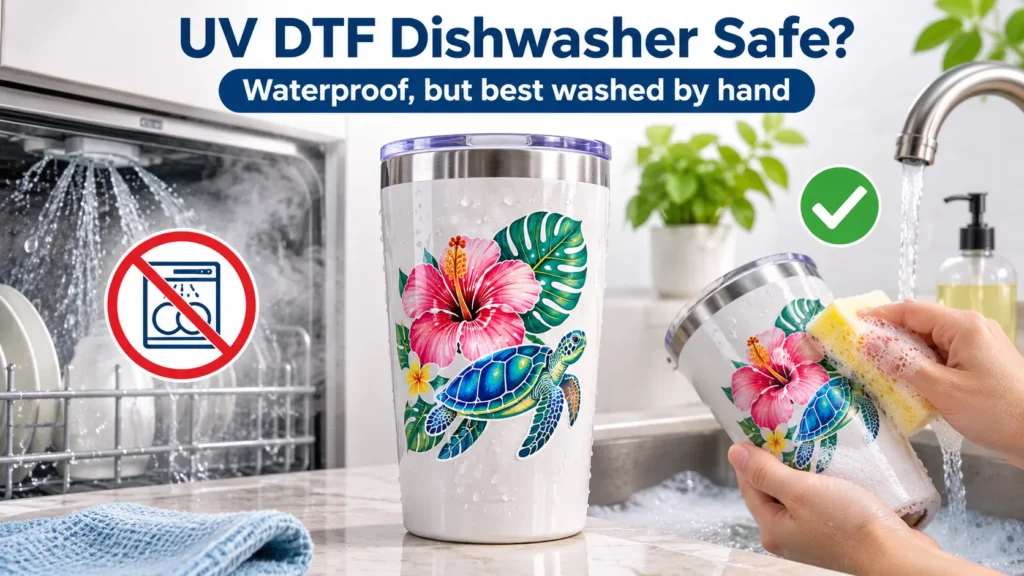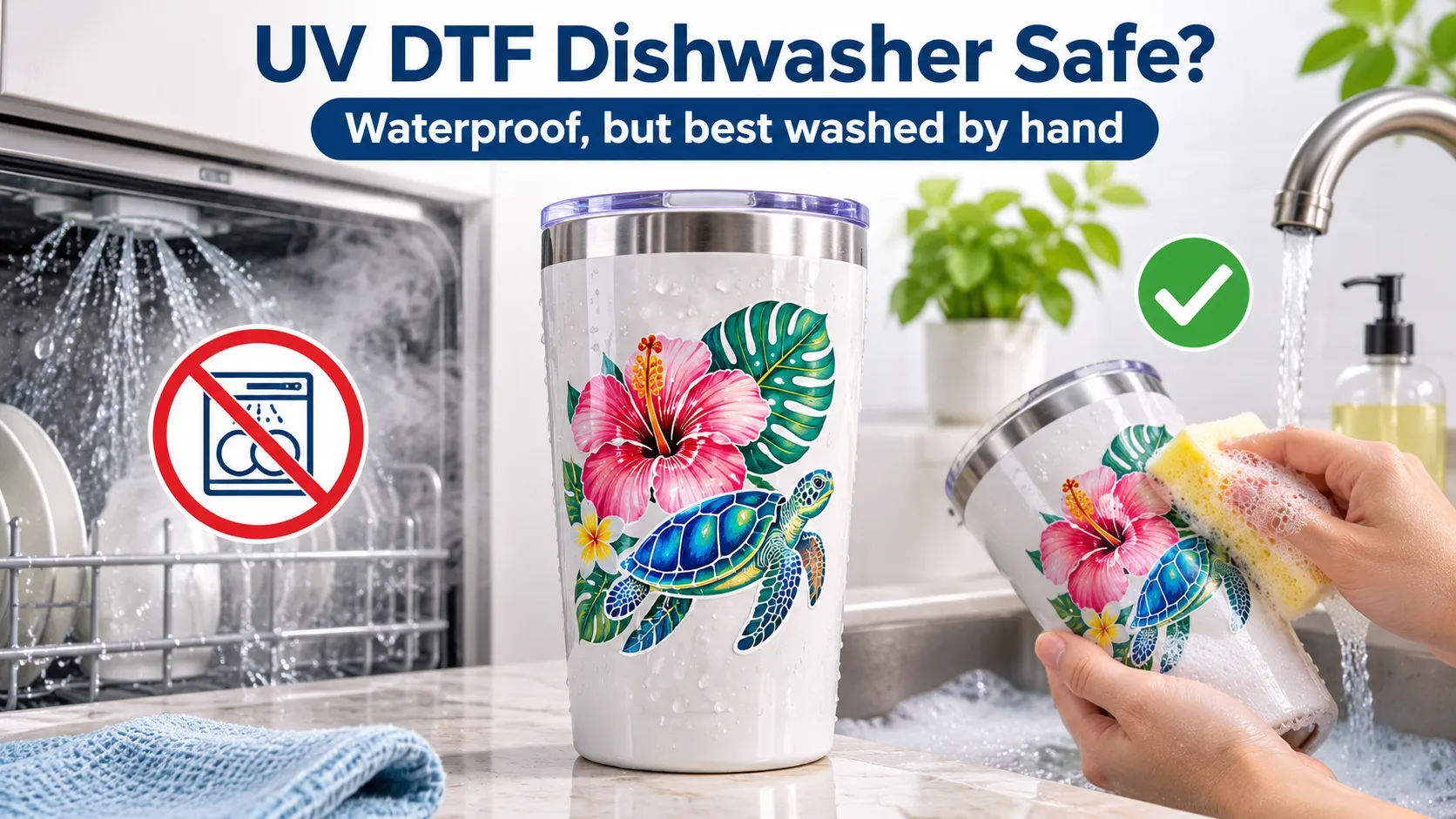
When buyers or print shops ask “is uv dtf dishwasher safe”, the accurate answer is no — not by default. Even major label manufacturer Avery states in its UV DTF help guide that while its UV DTF stickers are waterproof, they are not dishwasher safe, and recommends handwashing cups and tumblers with dish soap. Although a few specialty film makers market films described as “dishwasher resistant,” even those manufacturers note that they cannot qualify every glass or tumbler surface on the market.
If you just bought a UV DTF-decorated cup or tumbler and want to wash it safely right now:
- Wash by hand using mild dish soap, cool or lukewarm water, and a soft cloth or non-abrasive sponge.
- Do not soak the cup in standing water, do not scrub across decal borders with abrasive pads, and never pick at raised edges.
- Wait before the first wash if the decal was newly applied (many transfer suppliers instruct users to wait at least 24 hours after peeling the carrier film), and do not put the cup in the microwave.
If you sell custom UV DTF cups or transfers: you should only mention conditional dishwasher use when you have tested that exact combination of film, adhesive, ink, cup blank, application method, and dishwasher cycle—and confirmed support from both your transfer supplier and blank manufacturer. Without documented testing on that exact setup, label your drinkware “Hand wash only”; when a specific combination passes your in-house test log below, state the exact tested settings rather than making a blanket promise.
Why Supplier Claims Conflict — and What Each Care Position Means
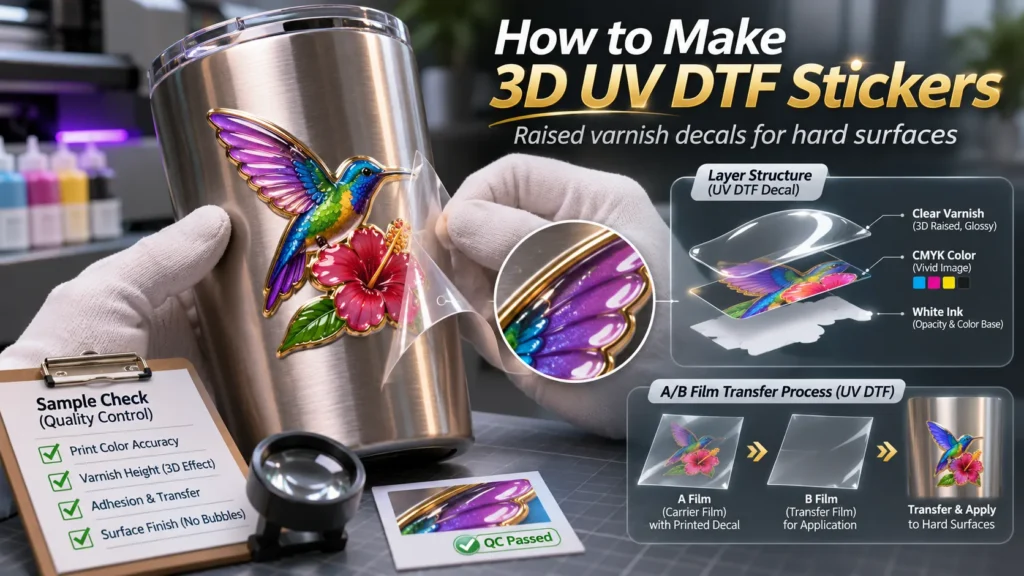
Why do some product pages claim UV DTF decals survive the dishwasher while others warn they will peel? The disagreement happens because “UV DTF” is a transfer process rather than a single standardized product, and the supplier pages cited here do not include a full test protocol specifying sample sizes, dishwasher models, water temperatures, detergents, and pass/fail criteria. As our breakdown of how A/B film transfers work explains, two decals that look identical on the sheet can use very different A-film adhesives, UV ink flexibility profiles, and lamination pressures.
Public guidance from label brands, transfer shops, and film manufacturers falls into four distinct care positions, each with its own condition boundary:
| Supplier Care Position | How Suppliers & Listings Describe It | Public Example or Context | Evidence & Condition Boundary Before Using It on Drinkware |
|---|---|---|---|
| 1. Waterproof / Water-Resistant, Hand Wash Only | Indicates the decal tolerates splashes, cold-drink condensation, rinsing, and hand washing with mild dish soap—no machine dishwashing | Avery UV DTF Stickers Help Guide (“waterproof, but they are not dishwasher safe; recommend handwashing with dish soap”) | Separate moisture resistance from machine washing; always pair “waterproof” o “water-resistant” with visible “Hand wash only — do not soak or machine wash” guidance |
| 2. Hand Wash Default Unless Exact Pair Is Approved | Advises treating UV DTF drinkware as hand-wash only unless both the decal supplier and blank manufacturer approve that exact combination | US transfer supplier care guides (e.g., Legends DTF Prints) | Require written guidance from both blank and transfer suppliers plus your own shop trial on that exact SKU |
| 3. Conditional / Top-Rack Claims | Suggests decals may tolerate light or occasional top-rack gentle cycles after full adhesive set, while still recommending hand washing for longevity | Various transfer shop blogs and small-shop creator videos | Do not copy generic blog or video claims; only state top-rack settings if verified in your own multi-cycle shop log |
| 4. Specialty “Dishwasher Resistant” Film | Markets an aggressive A-film adhesive rated by the vendor at over a 99% success rate across hundreds of cycles on tested items, while noting it cannot qualify all glassware or difficult surfaces | Central Chemical Magic Film DR (first-party vendor claim; cycle temperature and detergent not published) | Even with specialty film, test the exact cup blank, ink set, and cycle settings in-house before writing a conditional care card |

Keeping these four positions distinct prevents two common listing mistakes. When a seller puts “waterproof” o “permanent” in the headline while burying “hand wash only” in fine print, the care limit is simply not visible enough and buyers easily misread it as dishwasher safe. A true contradiction occurs when a product page promises “dishwasher safe” drinkware while the box insert says “hand wash only”—as we emphasize in our guide on Cómo hacer envoltorios para tazas con impresión DTF UV, keep your product title, bullet points, and care card aligned to the exact same rule.
What a Dishwasher Does to a UV DTF Decal
A common misconception is that the A/B transfer film encapsulates the ink on the tumbler and shields it inside the dishwasher. In reality, the clear B-film carrier is peeled away and discarded during application; only the cured ink-and-varnish stack and the pressure-sensitive adhesive layer remain on the cup wall, leaving every outer border and tiny letter edge directly exposed.
While suppliers generally explain dishwasher failure through mechanical and chemical mechanisms rather than controlled lab data, running a decorated cup through a dishwasher subjects those exposed edges to five stresses that gentle hand washing avoids:
- Sustained hot water: Prolonged heat softens pressure-sensitive acrylic adhesives and causes the cup wall and cured UV ink film to expand at different rates.
- Pressurized spray jets: Rotating spray arms strike the cup repeatedly from sharp angles, driving hot water directly against exposed decal edges and isolated graphic details.
- Aggressive dishwasher detergents: Automatic dishwasher pods and powders contain stronger alkaline builders and enzymes than mild liquid dish soap, which suppliers note can dull varnish gloss and weaken adhesive bonds over repeated runs.
- Extended wet dwell and heated drying: A dishwasher cycle keeps the decal hot and wet far longer than a sink rinse, followed by a heated dry or sanitize cycle that bakes softened borders.
- Rack and dish contact: Rattling against metal rack tines or neighboring mugs can nick raised UV varnish textures before the cycle ends.
Two aftermarket workarounds often suggested in online forums also lack verifiable support: flashing an applied sticker with a handheld UV lamp for 10–15 seconds (which confuses already-cured film transfers with direct-to-object UV printing) and brushing a third-party clear sealer over the decal (which does not guarantee dishwasher durability and can leave uneven coatings unsuitable for drinkware). Equally important, check the blank cup’s own care rating first—as Legends DTF reminds decorators, many painted mugs, specialty powder-coated tumblers, and vacuum-insulated stainless steel cups are marked “hand wash only” by their own manufacturers, meaning the blank’s finish or vacuum seal can fail in the dishwasher before the decal does.

Four Production Factors That Help UV DTF Decals Last Longer in Water
While good shop practices do not turn a standard transfer into an unrestricted dishwasher-safe product, controlling four production variables noticeably improves how well your cup wraps withstand everyday condensation and regular hand washing.
1. Film Adhesive, UV Ink Flexibility, and Lamination
In Reddit’s commercial printing community (r/CommercialPrinting), some shops report that ready-to-apply transfers bought from one vendor stayed on through their home dishwasher while decals printed in-house peeled on the first cycle—even when applied to the same glass blanks and washed in the same machine. While those forum posts are unverified user anecdotes rather than controlled trials, they highlight how strongly A-film adhesive formulation and ink-to-film compatibility govern adhesion after washing.
Specialty films such as Central Chemical’s Magic Film DR pair an aggressive adhesive with specific ink flexibility guidance, noting that UV ink that is too brittle can crack around tight curves while overly soft ink can bubble or orange-peel. Remember that printer hardware specifications (such as printhead count or roll width) never make a decal dishwasher safe; the A/B film adhesive, UV ink chemistry, and lamination bond determine water resistance. For a closer look at how the two film layers interact, see our guide to UV DTF Film A vs B and why transfers fail.
2. Cup Material and Factory Surface Finish
UV DTF adhesives bond best to smooth, non-porous, rigid surfaces such as bare glass, glazed ceramic, smooth stainless steel, and smooth hard plastics (the substrates recommended by Avery and other transfer suppliers). Textured plastics, silicone, rubber, and flexible squeeze bottles prevent full adhesive wet-out and lead to early peeling. Because powder-coated and painted tumblers vary in surface roughness and factory release agents across batches, always test one blank from the new box before running a batch order.
3. Wash-Friendly Artwork Design
In decorator forums, operators frequently observe that “tiny detail islands are the first to go in the dishwasher.” Every isolated period, thin script tail, or floating star creates extra exposed perimeter where water jets and washcloths catch an edge. When preparing files for washed drinkware:
- Thicken fine text and thin lines, or connect floating punctuation and small accents with subtle bridges or a solid background badge.
- Leave safe clearance at high-wear zones: Keep the graphic away from the top drinking rim, lid threads, sliding lid tracks, and the bottom base ring that slides into car cup holders.
- Keep small text off full-wrap seams: Measure the actual tumbler circumference rather than relying on generic templates, and keep fine lettering away from the vertical seam line.

4. Clean Application Pressure and Pre-Wash Dwell Time
Even a strong adhesive lifts if microscopic air pockets or finger oils sit beneath the border. Follow the full how to apply UV DTF cup wraps routine: clean the blank with a suitable residue-free cleaner and lint-free cloth, let it dry completely, and avoid touching the cleaned zone with bare skin.
Press and burnish the decal from the center outward, paying extra attention to outer borders and small text before peeling the B-film carrier slowly at a low angle.
After peeling the carrier film, allow the adhesive to wet out and set before the first wash. Many transfer suppliers (including Regalo Creations, Legends DTF, and DTF Transfers Wholesale) instruct users to wait at least 24 hours before washing, while some shops advise 24–48 hours. Follow your film supplier’s stated wait window, noting that extra wait time cannot fix an edge that was pressed over oil or trapped air.
How to Test Your Own Product Before Making a Conditional Dishwasher Claim
Before adopting any conditional dishwasher wording, avoid three common shortcuts that lead to premature failures. Never treat a single wash cycle or a same-day wash as product qualification, and never copy unverified vendor cycle numbers (such as 30–50 cycles or hundreds of cycles) onto your retail guarantee without knowing the test conditions.
Likewise, do not rely on short social media clips that combine pressure washing, sun exposure, and dishwashing without close-up edge inspection. Notably, even creators whose wraps survive a video test cycle still write in their captions: “I still 100% recommend hand washing… for the longevity of the cup, please handwash!”
Instead, follow the structured in-house protocol recommended by suppliers like Legends DTF and Alpha DTF Print, adding a hand-wash control group, pre-wash baseline photos, y pre-set failure criteria to compare how your setup behaves under gentle hand washing versus fixed dishwasher settings:
- Lock in one exact SKU combination: Use the exact cup blank (brand, model, material, color, and finish), the exact A/B film and UV ink lot, and the standard application workflow used for customer orders.
- Use a stress-test graphic: Include a solid block, a gradient, small text, isolated micro-dots/stars, and a full-wrap seam so edge weaknesses appear early.
- Prepare dishwasher test units plus a hand-wash control group: Apply the identical graphic to your dishwasher test cup(s) and at least one hand-wash control cup washed strictly by hand, recording the exact number of cups in each group. Comparing the two groups helps evaluate wash stress: if the hand-wash control also lifts, that points to a baseline material, application, or hand-washing issue to check first, while a passing hand-wash control alongside a failed dishwasher cup shows the dishwasher environment exceeded that setup’s limits (though it cannot by itself isolate whether heat, detergent, or water jets caused the failure).
- Complete the full post-application wait window and take pre-wash baseline photos: Let all test and control cups rest dry at room temperature for the full dwell time specified by your transfer supplier (typically at least 24 hours), then take close-up Cycle 0 baseline photos of every cup before Wash #1.
- Fix and log every dishwasher setting: Place the test cups in the same rack location (e.g., top rack only, away from exposed heating coils) and run the exact same dishwasher model, cycle program, heated-dry/sanitize toggle, and detergent brand for every cycle.
- Inspect and photograph at pre-set checkpoints: Let the cups cool completely to room temperature after Cycle 1 and at fixed checkpoint intervals thereafter, photographing edges, micro-details, gloss, and cup finish under consistent lighting to compare against your Cycle 0 baseline photos and the hand-wash control.
- Stop and mark as failed at the first sign of damage: Grade the trial as failed if you see any edge or corner lifting that catches a fingernail or cloth, any missing letter or detail island, noticeable fading or gloss loss compared with the pre-wash baseline photos and hand-wash control, bubbling/cracking across the wrap, or peeling/seal failure on the blank cup itself.
- Re-test whenever any input changes: A passed trial applies only to the exact cup blank, film lot, ink set, and cycle settings tested—run a fresh log whenever you change blank suppliers, coatings, or consumables.
In-House UV DTF Dishwasher Test Log (Copyable Shop Template)
| Log Field | Example Entry Format (Fill From Your Own Trial) | Why You Need This Recorded |
|---|---|---|
| 1. Blank Cup Details | Brand, model, material (e.g., clear soda-lime glass / powder-coated stainless), color, batch, and manufacturer care rating | Prevents applying clear-glass results to coated tumblers, and flags blanks marked hand-wash only by their maker |
| 2. Transfer / Film & Ink Lot | Transfer supplier or in-house printer model, A/B film brand & lot number, UV ink set, and lamination settings | Tracks which specific adhesive and ink combination was evaluated |
| 3. Sample Count & Wait Time | Dishwasher group count ([X] cups) + Hand-wash control count ([Y] cups); cleaner used, peel timestamp, and hours waited before Wash #1 | Documents group sizes and verifies that early lifting was not caused by skipping the pre-wash dwell period |
| 4. Dishwasher & Cycle Settings | Dishwasher brand/model, rack position (Top / Bottom), cycle name, Heated Dry (ON/OFF), Sanitize (ON/OFF), detergent brand & form | Defines the exact condition limits required on any conditional care card |
| 5. Baseline & Checkpoint Photo Log | Cycle 0 (pre-wash baseline photos) + Cycle numbers inspected (e.g., Cycle 1, Checkpoint A, Checkpoint B…) after cooling to room temperature | Provides a before-and-after visual reference for edge wear or gloss dulling |
| 6. Decal Inspection & Group Tally | Dishwasher group pass/fail count ([X/X passed]); edge/corner hold, micro-detail retention, and gloss vs. Cycle 0 baseline photos and hand-wash control | Separates cosmetic gloss changes from adhesive edge lifting across all tested units |
| 7. Hand-Wash Control Results | Hand-wash control pass/fail count ([Y/Y passed]) and condition over the same number of washes | Helps compare wash-method impact and flags whether material prep or hand washing already caused lifting |
| 8. Final Decision & Allowed Wording | Pass under stated conditions OR Fail at Cycle [X] (reason) → Approved care card template (Default Hand-Wash vs. Conditional) | Keeps public product listings and box inserts tied to documented shop evidence |
A passed test supports only the exact cup, transfer, application method, and dishwasher settings you recorded. Treat it as an internal durability check, not a formal certification.

What to Tell Customers: Care Card Wording That Matches Your Evidence
Clear UV DTF dishwasher safe care instructions protect your shop from avoidable returns and chargebacks. As our partner transfer supplier DTF Dallas notes in its UV DTF FAQ, declining to make a blanket dishwasher-safe promise—and giving buyers straightforward care rules—sets accurate expectations before checkout.
Choose one of the two templates below based on whether you have completed the in-house test log above, and keep the wording identical across your product page, checkout notes, and box inserts.
Option A: Default Care Card (When You Have Not Tested That Exact Combination)
Use this standard template for all UV DTF drinkware, promotional gifts, and custom decals where you have not logged a multi-cycle dishwasher trial:
Care Instructions for Your Custom UV DTF Drinkware – Wait before first wash: If your decal was newly applied, wait at least [insert supplier wait time, e.g., 24 hours] before washing. – Hand wash only: Wash gently by hand using mild dish soap, cool or lukewarm water, and a soft cloth or non-abrasive sponge. – Do not soak or scrub: Do not leave the item soaking in standing water, do not use abrasive scrub pads or steel wool, and avoid scrubbing directly across decal edges. – Dry gently: Rinse with clean water and pat dry with a soft towel or air-dry. – No dishwasher or microwave: Do not place this item in a dishwasher or microwave, and keep it out of extreme heat.
Option B: Conditional Care Card (Only When Documented by Your In-House Test Log)
Use this template only for a specific SKU that passed your in-house test log—filling the bracketed fields strictly from your recorded sheet rather than using an unqualified “dishwasher safe” badge:
Care Instructions for [Exact Cup Model & Decal Line] – Best care for longest life: Hand washing with mild dish soap and a soft cloth is always recommended to keep colors and gloss looking new as long as possible. – Tested dishwasher conditions: In our shop testing on [exact cup blank model], this decal withstood [number] washes under the following settings: [Top rack only / cycle name / heated dry OFF / sanitize OFF / detergent type], after waiting [wait time] prior to the first wash. – What to avoid: High-heat cycles, heated drying, sanitize modes, bottom-rack placement, abrasive pads, and prolonged soaking can lift decal edges or damage the cup finish. Do not microwave.
How to Reply When a Buyer Asks “Can I Put It in the Dishwasher?”
When a customer messages you before ordering, reply with a direct explanation that matches your care card:
“Our UV DTF wraps hold up well to everyday cold drinks and gentle hand washing with mild dish soap, which is what we recommend to keep the design looking sharp. Unless a specific tumbler listing states tested top-rack settings, please treat UV DTF drinkware as hand-wash only—dishwasher heat, spray jets, and harsh detergents can lift fine edges over time.”

Build care card insertion right into your inspection and packing steps so every outgoing package carries the exact same guidance shown online.
Preguntas frecuentes
Are UV DTF stickers dishwasher safe?
No, not by default. For example, Avery states in its official help guide that while its UV DTF stickers are waterproof, they are not dishwasher safe and should be hand washed with dish soap. Other specialty films marketed as dishwasher resistant must be evaluated under their own supplier guidelines and tested on the exact cup blank and dishwasher cycle before making any conditional claim.
Are UV DTF tumblers dishwasher safe?
Check the blank tumbler’s manufacturer care label first—many powder-coated, painted, or vacuum-insulated stainless steel tumblers are rated hand-wash only before any decal is applied. Even on dishwasher-safe blanks, hand washing is the safest default unless your exact wrap and tumbler combination has passed testing.
¿Es resistente al agua la impresión UV DTF?
Some suppliers (such as Avery) describe their UV DTF decals as waterproof, while others use water-resistant to mean they handle splashes, cold-drink condensation, and gentle hand washing with dish soap. In either case, waterproof or water-resistant labeling does not mean the decal is dishwasher safe or meant for prolonged underwater soaking.
How long should I wait before washing a UV DTF cup?
Follow the instructions provided by your transfer or film supplier. Many suppliers (including Regalo Creations, Legends DTF, and DTF Transfers Wholesale) instruct users to wait at least 24 hours after applying the decal and peeling the carrier film before the first wash so the adhesive can set.
Is UV DTF microwave safe?
No—do not put UV DTF-decorated drinkware in the microwave unless your transfer supplier explicitly supports microwave use (and never microwave metal tumblers). Suppliers such as DTF Transfers Now, Regalo Creations, and Southeast Prints explicitly mark UV DTF transfers as not microwave safe.
Can I use UV DTF on coffee mugs and hot-drink tumblers?
Yes, UV DTF wraps are widely applied to the smooth exterior wall of glazed ceramic coffee mugs and insulated travel mugs. Because heat from hot liquids, steam, and frequent washing adds stress to the adhesive, keep the graphic below the drinking lip and test your specific mug blank with hot beverages and hand washing before selling a batch.
Are UV DTF transfers food safe?
UV DTF decals are exterior decorative graphics, not food-contact coatings, and this guide does not provide food-contact safety certification. Always place decals on the outside body of a cup or container—away from the drinking rim, interior walls, or any surface that directly touches food, drinks, or a user’s mouth—and request written compliance documents from your film and ink suppliers if an order requires regulatory documentation.
How long does UV DTF last on tumblers?
There is no single guaranteed lifespan in months or years because durability varies by setup and daily care. How long a wrap stays intact depends on the film and adhesive quality, the cup coating, how thoroughly the edges were burnished on a clean surface, everyday friction against bags or cup holders, and whether the owner washes it gently by hand.
Are UV DTF stickers permanent?
UV DTF stickers use a strong pressure-sensitive adhesive that cannot be cleanly repositioned once pressed onto a smooth surface, which is why sellers call them “permanent decals.” However, non-repositionable does not mean indestructible—dishwasher heat, soaking, or picking at borders can still lift edges.
Build a Repeatable UV DTF Cup-Wrap Workflow
If you print UV DTF cup wraps in-house—or plan to add a roll-to-roll UV DTF printer to your shop—consistent durability starts with pairing reliable printing and lamination hardware with verified film consumables and a clear shop testing routine. While no UV DTF printer hardware on its own makes a decal “dishwasher safe,” controlling white, color, and varnish registration alongside uniform A/B film lamination gives your adhesive the best possible baseline on every sheet.
Explore our Impresoras DTF UV and share the cup types you decorate, your typical wrap dimensions, how the finished cups will be washed, and your monthly batch volume. Our team can recommend a matched printer configuration and outline which film adhesive specifications, compatible surfaces, and care guidelines to confirm with your media supplier so you can run the in-house test log with confidence.