Choosing a Impresora DTF is not simply a matter of selecting the largest format or the lowest purchase price. The right setup should match your order volume, workspace, operator experience, product mix, and plans for growth. A machine that works well for a small custom-print business may not fit a shop producing transfers daily for wholesale customers.
This buyer’s guide explains what to compare before investing in DTF printing equipment. It is designed for print shops, apparel decorators, promotional-product businesses, and entrepreneurs who want to evaluate DTF solutions with more confidence.
If you are comparing production-ready options, explore the XINFLYING DTF Printer Machine 702E and request a configuration recommendation based on your actual production needs.
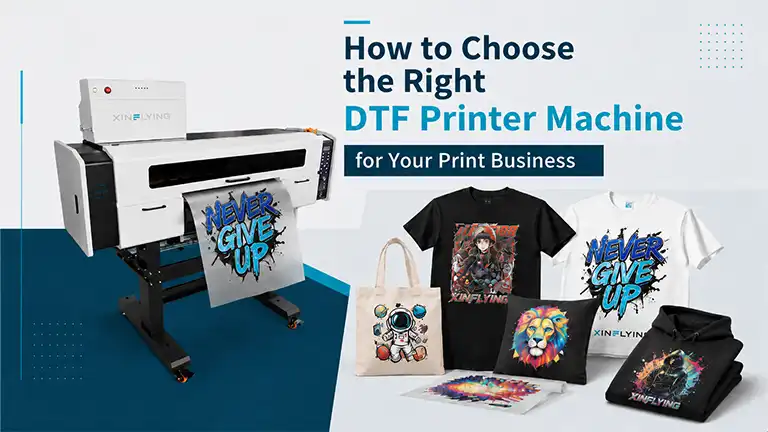
XINFLYING 702E at a Glance
The XINFLYING DTF Printer Machine 702E is a 24-inch production model built around two Epson i3200-A1 printheads. According to the published product specifications, its listed production speeds are 10 m²/h at 6-pass, 8 m²/h at 8-pass, and 5 m²/h at 12-pass. The stated machine dimensions are L1700 × W850 × H1350 mm.
| Published 702E specification | Detail |
|---|---|
| Ancho de impresión | 24 inches |
| Cabezales de impresión | 2 × Epson i3200-A1 |
| Print speed | 10 m²/h at 6-pass; 8 m²/h at 8-pass; 5 m²/h at 12-pass |
| Machine dimensions | L1700 × W850 × H1350 mm |
| Workflow features highlighted by XINFLYING | White ink circulation, ink alarm, and emergency stop button |
These figures make the 702E worth considering for businesses that need a 24-inch DTF workflow and want to balance throughput with footprint. Actual output depends on artwork, pass setting, RIP configuration, consumables, operating conditions, and the full powder-and-curing workflow.
What Is a DTF Printer Machine?
A DTF printer machine is part of a direct-to-film printing workflow. Designs are printed onto transfer film, combined with adhesive powder, cured, and then transferred onto a garment or other compatible textile with a heat press. This workflow can be useful for businesses that need colorful, detailed transfers and flexibility across multiple garment materials.
For many print businesses, the appeal of DTF is operational: transfers can be prepared in advance, production can be organized around orders, and the finished transfers can be applied when needed. However, the best results depend on more than the printer itself. Ink handling, film, powder application, curing, RIP workflow, maintenance, and operator training all affect the final outcome.
Why the Right DTF Printer Machine Matters
The wrong equipment choice can create problems that are expensive to solve later. A setup that cannot keep up with daily order volume can delay fulfillment. A workflow that is too complex for the available staff can create inconsistent transfers. And a supplier relationship that does not provide the level of support your team needs can make routine maintenance harder than it should be.
The right DTF printer machine should help you balance five priorities:
- Production capacity — enough output for current demand, with room to grow.
- Transfer quality — reliable color, detail, white ink performance, and adhesion when the full workflow is managed correctly.
- Operating efficiency — a workflow that fits your staff, workspace, and order process.
- Total cost of ownership — not just the equipment price, but consumables, maintenance, power, training, and downtime.
- Supplier support — access to clear documentation, troubleshooting guidance, parts, and service terms.
8 Factors to Compare Before Buying a DTF Printer Machine
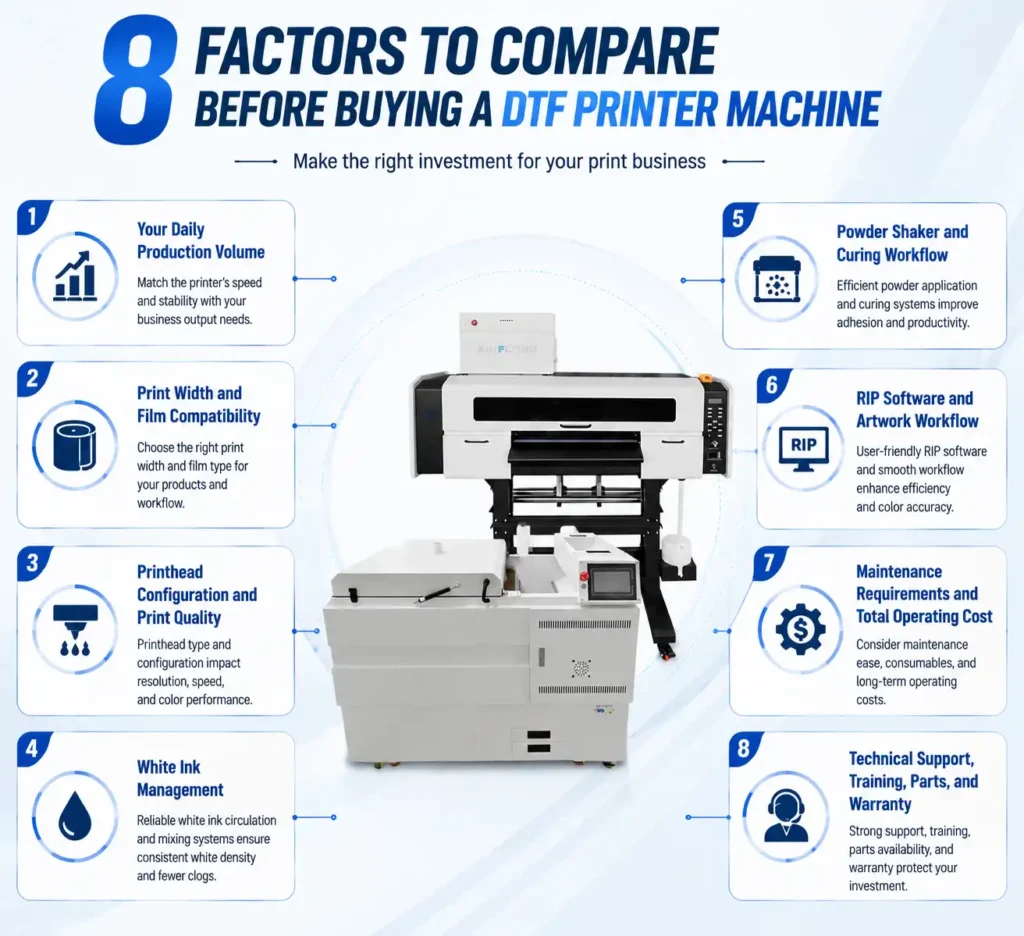
1.Your Daily Production Volume
Start with the number of transfers or garments you expect to produce on a normal day—not only your busiest day. Then consider how quickly your order volume may grow over the next 6 to 12 months.
A lower-volume business may prioritize a compact, manageable workflow. A growing print shop may need equipment that supports longer production runs and a more streamlined powder-and-curing process. Buying solely for today’s volume can create a bottleneck sooner than expected; buying far beyond your operational capacity can make it harder to achieve a practical return on investment.
Ask suppliers how a recommended configuration fits your expected daily output, typical design size, and shift schedule.
2.Print Width and Film Compatibility
Print width affects the size of the designs you can produce and how efficiently you use film. Before choosing a machine, review the types of transfers you sell most often:
- Left-chest logos and small custom graphics
- Full-front or full-back apparel designs
- Gang sheets containing multiple small designs
- Large-format graphics for specialty orders
The goal is not automatically to choose the widest machine. It is to choose a format that reduces waste, supports your product mix, and fits the physical space available in your workshop.
3.Printhead Configuration and Print Quality
Print quality is influenced by multiple variables, including printhead configuration, ink management, RIP settings, artwork preparation, film, powder, curing, and heat-press settings. When evaluating a DTF printer machine, ask to see relevant sample transfers rather than relying only on screen images.
Review samples with the same kinds of artwork and fabrics your customers order. Look at fine lines, gradients, small text, white areas, saturated colors, and the feel of the finished transfer after pressing. A good supplier conversation should focus on your real applications, not only general claims.
4.White Ink Management
White ink is central to many DTF workflows, especially when printing vibrant designs on dark garments. The XINFLYING 702E lists a built-in white ink circulation system designed to keep white ink moving. That can help address pigment settling, but it does not eliminate the need for routine care: XINFLYING still recommends a nozzle check before the first job of the day.
Before purchasing, make sure your team understands:
- Which daily checks are required
- Which weekly maintenance tasks should be scheduled
- How the system should be prepared before and after production
- What consumables and cleaning materials are needed
- What support is available if print quality changes
Consistent maintenance is not an optional extra. It is part of protecting print quality and reducing avoidable downtime.
5.Powder Shaker and Curing Workflow
DTF printing is a complete production workflow, not just a printer purchase. After printing, adhesive powder must be applied and cured correctly. For small operations, a more manual process may be workable. For higher volumes, a more integrated powder-shaker and curing workflow can improve consistency and reduce manual handling.
When comparing options, consider:
- How much operator time is required per production run
- Whether the workflow supports your expected volume
- How powder and curing stages fit within your workspace
- How you will control ventilation, safety, and cleaning
- Whether the process can scale without creating a new bottleneck
6.RIP Software and Artwork Workflow
RIP software translates artwork into production-ready print files. Your team should understand how artwork is prepared, how color settings are managed, and what checks are needed before printing.
Ask the supplier to explain the recommended workflow from customer artwork to finished transfer. A practical setup should fit the design tools your business already uses and give operators a repeatable process for handling common job types.
7.Maintenance Requirements and Total Operating Cost
The equipment price is only one part of the investment. A realistic decision should also consider ongoing costs and operational effort, including:
- Ink, film, powder, and cleaning materials
- Routine maintenance time
- Replacement parts and wear items
- Operator training
- Electricity and workspace requirements
- Expected downtime during cleaning, maintenance, or troubleshooting
Create a simple cost model using your average order size and expected monthly volume. This will give you a clearer picture of how the DTF printer machine could contribute to margin and payback over time.
8.Technical Support, Training, Parts, and Warranty
For a production machine, supplier support matters as much as hardware selection. Before placing an order, confirm what training, remote assistance, documentation, replacement-parts process, and warranty terms apply to your location and configuration.
XINFLYING’s published Warranty & After-Sales Service policy states that, unless different written terms apply, eligible printing equipment receives a 12-month limited warranty from the shipment date. The policy describes coverage for eligible non-consumable core components such as applicable electrical control parts, mainboards, motors, and mechanical components. It also states that consumables, wear items, and printheads after installation and successful testing are generally excluded.
The same policy lists long-term remote technical support, including installation and setup guidance, basic operation training, daily maintenance guidance, printing and software troubleshooting, and workflow support. Remote assistance may be provided by email, WhatsApp, video call, or other available channels. XINFLYING serves customers worldwide; confirm shipping, import requirements, local arrangements, and the exact written warranty terms for your destination before ordering.
Which Type of DTF Printer Machine Fits Your Business?
The most suitable setup usually depends on your production stage.
| Situación empresarial | Typical priority | What to evaluate |
|---|---|---|
| New or small custom-print operation | Manageable investment and simple workflow | Workspace, learning curve, expected order volume, maintenance capacity |
| Growing print shop | Higher throughput and repeatable production | Production bottlenecks, film efficiency, powder-and-curing workflow, staffing; evaluate a 24-inch, dual-head model such as the 702E |
| Wholesale or high-volume transfer business | Consistency, capacity, and serviceability | Workflow integration, operator shifts, parts availability, support response, expansion plans |
Rather than choosing by category alone, ask for a recommendation based on your actual order mix, expected transfer sizes, and desired monthly output. The XINFLYING DTF Printer Machine 702E can be evaluated as part of that discussion.
Questions to Ask a DTF Printer Supplier Before You Buy
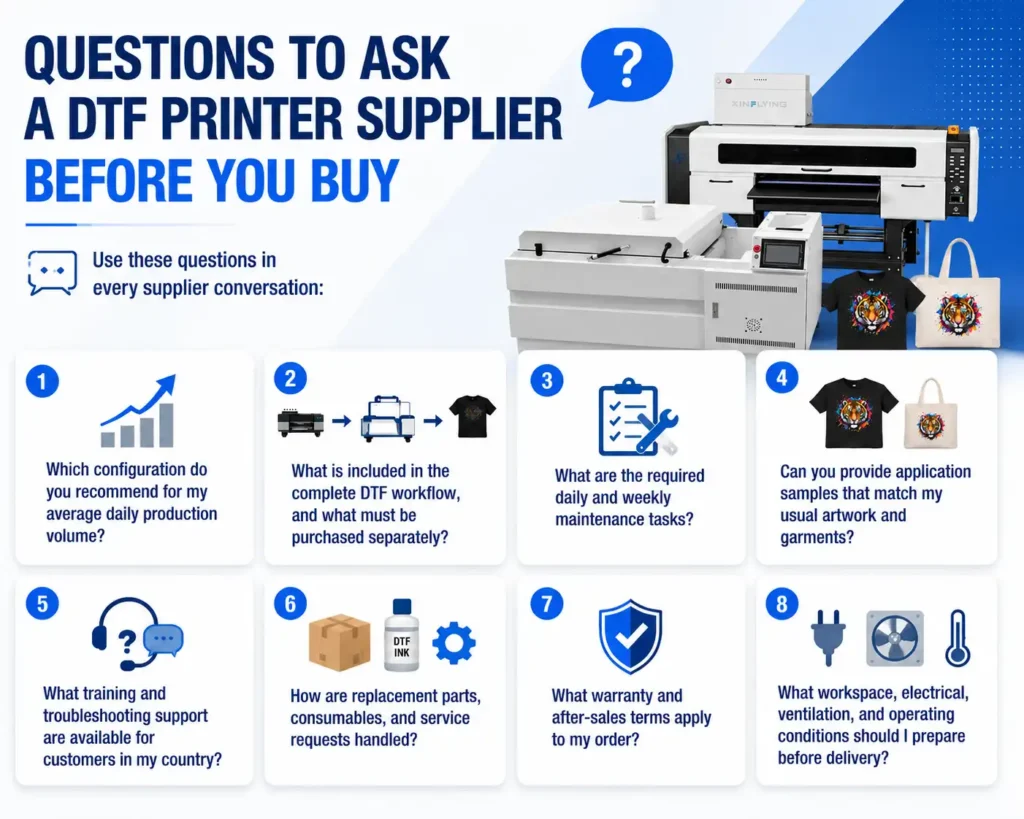
Use these questions in every supplier conversation:
- Which configuration do you recommend for my average daily production volume?
- What is included in a complete DTF workflow, and what do you need to purchase separately?
- What are the required daily and weekly maintenance tasks?
- Can you provide application samples that match my usual artwork and garments?
- What training and troubleshooting support are available for customers in my country?
- How are replacement parts, consumables, and service requests handled?
- What warranty and after-sales terms apply to my order?
- What workspace, electrical, ventilation, and operating conditions should I prepare before delivery?
Clear answers to these questions will help you compare suppliers on more than headline specifications.
Why Consider the XINFLYING DTF Printer Machine 702E?
El XINFLYING DTF Printer Machine 702E offers a specific configuration for print businesses evaluating a 24-inch DTF workflow: two Epson i3200-A1 printheads, listed speeds up to 10 m²/h at 6-pass, and a stated machine footprint of L1700 × W850 × H1350 mm. The product page also highlights white ink circulation, an ink-level alarm, and an accessible emergency stop button.
This combination can be relevant when you need more production capability than a small desktop setup while remaining focused on a manageable 24-inch format. You should still assess it against your design mix, daily transfer volume, finishing workflow, available electrical and ventilation conditions, and operator capacity.
When contacting XINFLYING, provide your target products, typical artwork sizes, expected daily volume, destination country, and any current printing equipment. That information makes it easier to receive a recommendation that is relevant to your business rather than a generic machine quotation.
Ready to compare a DTF printer machine for your production needs? Request a quote for the XINFLYING DTF Printer Machine 702E or chat with XINFLYING on WhatsApp. Confirm the current configuration, delivery options, after-sales process, and warranty terms for your location before placing an order.
Preguntas frecuentes
A: Compare production volume, print width, print quality, white ink management, powder-and-curing workflow, software, maintenance requirements, total operating cost, and supplier support.
A: The published 702E specifications list a 24-inch print width, two Epson i3200-A1 printheads, speeds of 10 m²/h at 6-pass, 8 m²/h at 8-pass, and 5 m²/h at 12-pass, plus machine dimensions of L1700 × W850 × H1350 mm.
A: It can be suitable if the equipment and workflow match your budget, order volume, maintenance capacity, and available space. A supplier should help you evaluate the fit before purchase.
A: Maintenance includes printhead care, white ink management, cleaning, inspection of the film path, and upkeep of the powder-and-curing workflow. The 702E has a listed white ink circulation system, but XINFLYING still recommends a nozzle check before the first job of the day. Follow the supplier’s documented procedures for the specific configuration you buy.
A: Unless different written terms apply, XINFLYING’s published policy provides a 12-month limited warranty from shipment for eligible printing equipment and describes long-term remote technical support. Confirm the exact scope, exclusions, shipping obligations, and terms in your quotation or contract.
A: XINFLYING states that it serves customers worldwide. Confirm shipping, import requirements, local service arrangements, and the applicable warranty and after-sales terms before ordering.