
Dye Sublimation Printer Solutions
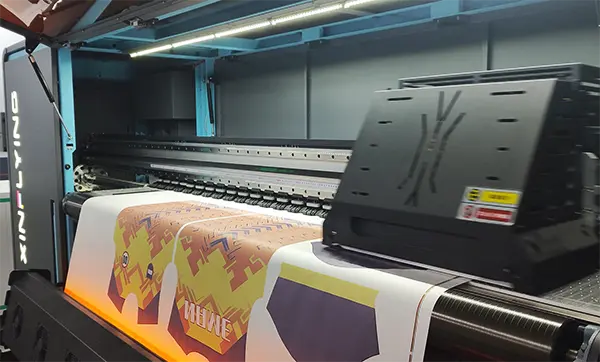
From high-speed sportswear production to wide-format home textile printing, XINFLYING dye sublimation printers deliver vibrant, permanent color for polyester fabric production at industrial scale.
What Is Dye Sublimation Printing?
Dye sublimation is a heat-transfer printing process in which sublimation inks are first printed onto specialised transfer paper, then permanently bonded into polyester fibres using heat and pressure. Unlike surface coatings or screen printing, the ink converts to a gas and diffuses into the fabric structure itself — producing prints that are wash-resistant, fade-resistant, and crack-proof under industrial conditions.
The process is the global standard for polyester textile decoration, used by sportswear factories, home textile manufacturers, and flag producers worldwide. It requires polyester fabric content of 65% or higher for optimal color saturation and durability.
Key requirements
- Polyester content ≥ 65% for best results
- Transfer paper matched to print speed and ink type
- Calibrated heat press at 180–210°C
- RIP software for accurate color management
Output characteristics
- Wash-resistant: no cracking, peeling or fading
- Breathable hand-feel — ink is inside the fibre
- Full-bleed printing with no color limits
- Photo-quality detail up to 3200 dpi
What Is Dye Sublimation Printing?
Dye sublimation transfers ink vapor into polyester fibers under heat and pressure instead of printing on fabric surfaces.
Key requirements
- Polyester content ≥ 65% for best results
- Transfer paper matched to print speed and ink type
- Calibrated heat press at 180–210°C
- RIP software management
Output characteristics
- Wash-resistant: no cracking, peeling or fading
- Breathable hand-feel — ink is inside the fibre
- Full-bleed printing with no color limits
- Photo-quality detail up to 3200 dpi
Dye Sublimation Printing Solutions
Explore dye sublimation printing solutions for two major production markets: custom apparel and large-format home textiles. Each solution includes recommended workflows, equipment configurations and production guidance.
Dye Sublimation Printer for Shirts
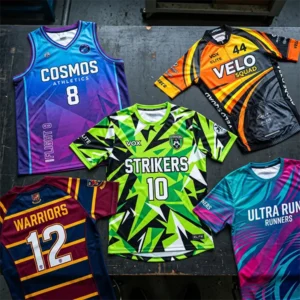
The dominant production technology for polyester sportswear, team uniforms, cycling apparel, performance wear, and promotional shirts. Full-bleed printing with no color restrictions, no minimum order, and wash-resistant output suitable for industrial garment production.
Applications include:
- Sports jerseys and team uniforms
- Cycling and running performance wear
- Promotional and branded apparel
- Fashion T-shirts and casual wear
Dye Sublimation Printer for Home Textiles
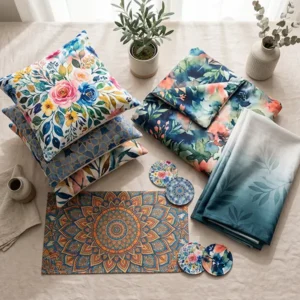
Roll-to-roll wide-format production for curtains, bedding, cushion covers, tablecloths, upholstery fabrics, and decorative panels. Consistent color across long fabric runs, with 1.9 m print width enabling full curtain drops and bed-size panels in a single pass.
Applications include:
- Curtains and window treatments
- Bedding, duvet covers and pillowcases
- Cushion covers and decorative fabrics
- Tablecloths and upholstery fabric
Why Choose a Dye Sublimation Printer?
Dye sublimation has become the preferred technology for polyester textile decoration across apparel, home furnishings, and display markets — because it combines color quality, production speed, and durability in a way no other print process can match.
Photo-quality color output
Permanent, wash-resistant prints
Industrial production throughput
Water-based, low-emission inks
Dye Sublimation Printing Workflow
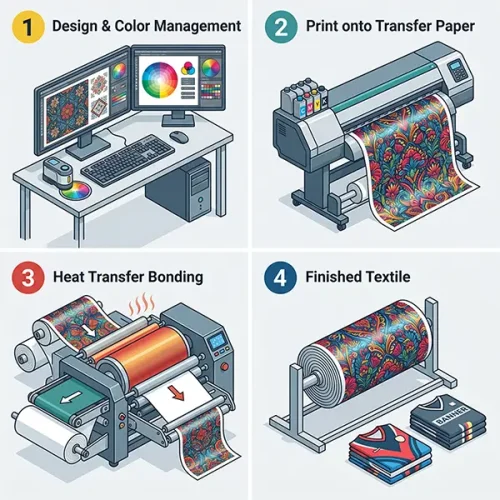
The sublimation process is a four-stage workflow. Understanding each stage helps manufacturers select the right equipment, consumables, and settings for their specific fabric and output requirements.
Artwork is prepared or imported into RIP software (Maintop, PrintFactory, or RIN). Substrate-specific ICC profiles are applied to ensure accurate color reproduction on the target fabric. File formats accepted include JPG, TIFF, PDF, EPS, and AI.
Sublimation inks are printed onto specialised transfer paper at up to 3200 dpi. The printer runs in roll-to-roll mode for continuous fabric production. Xinflying's XF-19E8-PRO and XF-19E15-PRO support print widths of 1.9 m (75") at speeds from 153 to 524 m²/h depending on pass count.
Transfer paper is placed face-down on the polyester fabric and passed through a heat press or calendar press at 180–210°C. At this temperature, the sublimation ink converts to a gas and diffuses permanently into the polyester fibre structure. No pressure film or lamination is required.
The cooled fabric is a finished, production-ready textile. Prints are wash-resistant, breathable, and colourfast — ready for cutting, sewing, and dispatch. No post-curing, drying racks, or additional finishing steps are needed.
Recommended Large Format Sublimation Printers
Both models use Epson i3200-A1 print heads with 1.9 m (75″) print width. Choose based on your required production throughput.
Standard Setup
XF-19E8-PRO
1.9 m · 8-head industrial sublimation printer
Print heads
8× Epson i3200-A1
Max speed
306 m²/h (1 pass)
Recommended speed
210 m²/h (1 pass)
Print width
75″ (190 cm)
Resolution
3200 dpi
Power
10.2 kW / 210–230 V
Best for high-volume production
XF-19E15-PRO
1.9 m · 15-head industrial sublimation printer
Print heads
15× Epson i3200-A1
Max speed
524 m²/h (1 pass)
Recommended speed
394 m²/h (1 pass)
Print width
75″ (190 cm)
Resolution
3200 dpi
Power
14.5 kW / 210–230 V
Both models include: automatic moisturising & cleaning system · intelligent roll feed & tension control · compatible with Maintop, PrintFactory, RIN (Handings board) · Windows 10/11 · 8× overseas warehouses for fast delivery
Dye Sublimation Printer FAQs
Dye sublimation works best on polyester fabrics with a content of 65% or higher. 100% polyester delivers the most vibrant, saturated results. Polyester-cotton blends (65/35 or 80/20) are also widely used, though colours appear slightly less vivid than on pure polyester. Natural fibres such as cotton, linen, and silk are not compatible with sublimation inks.
The XF-19E8-PRO and XF-19E15-PRO both offer a maximum print width of 1.9 m (75"). This accommodates full-width curtain panels, wide bedding fabrics, and large-format sportswear cut pieces in a single pass without seams or joins.
The XF-19E8-PRO reaches a maximum speed of 306 m²/h in 1-pass mode (recommended production speed: 210 m²/h). The XF-19E15-PRO reaches 524 m²/h in 1-pass mode (recommended: 394 m²/h). For reference, at 210 m²/h and 1.9 m width, a single shift of 8 hours produces approximately 884 linear metres of printed fabric.
No. Because the ink diffuses into the polyester fibre rather than coating the surface, sublimation prints are inherently wash-resistant. They do not crack, peel, or fade under normal industrial laundering conditions. Colour vibrancy is maintained across hundreds of wash cycles.
Both the XF-19E8-PRO and XF-19E15-PRO are shipped with Maintop as standard. They are also compatible with PrintFactory, PrintFactory, and RIN (with Handings board). All standard image formats are accepted: JPG, TIFF, PDF, EPS, AI.
Yes. Roll-to-roll sublimation printing is the standard production method for digitally printed home textiles including curtains, bedding, cushion covers, and decorative fabrics. The 1.9 m print width covers full curtain drops and king-size bedding panels. Colour consistency across long runs is maintained by the integrated tension control and ink management systems.
Talk to Our Sublimation Printing Specialists
Tell us your production requirements — fabric type, weekly output volume, and print width — and we will recommend the right machine configuration, ink setup, and consumables for your operation.