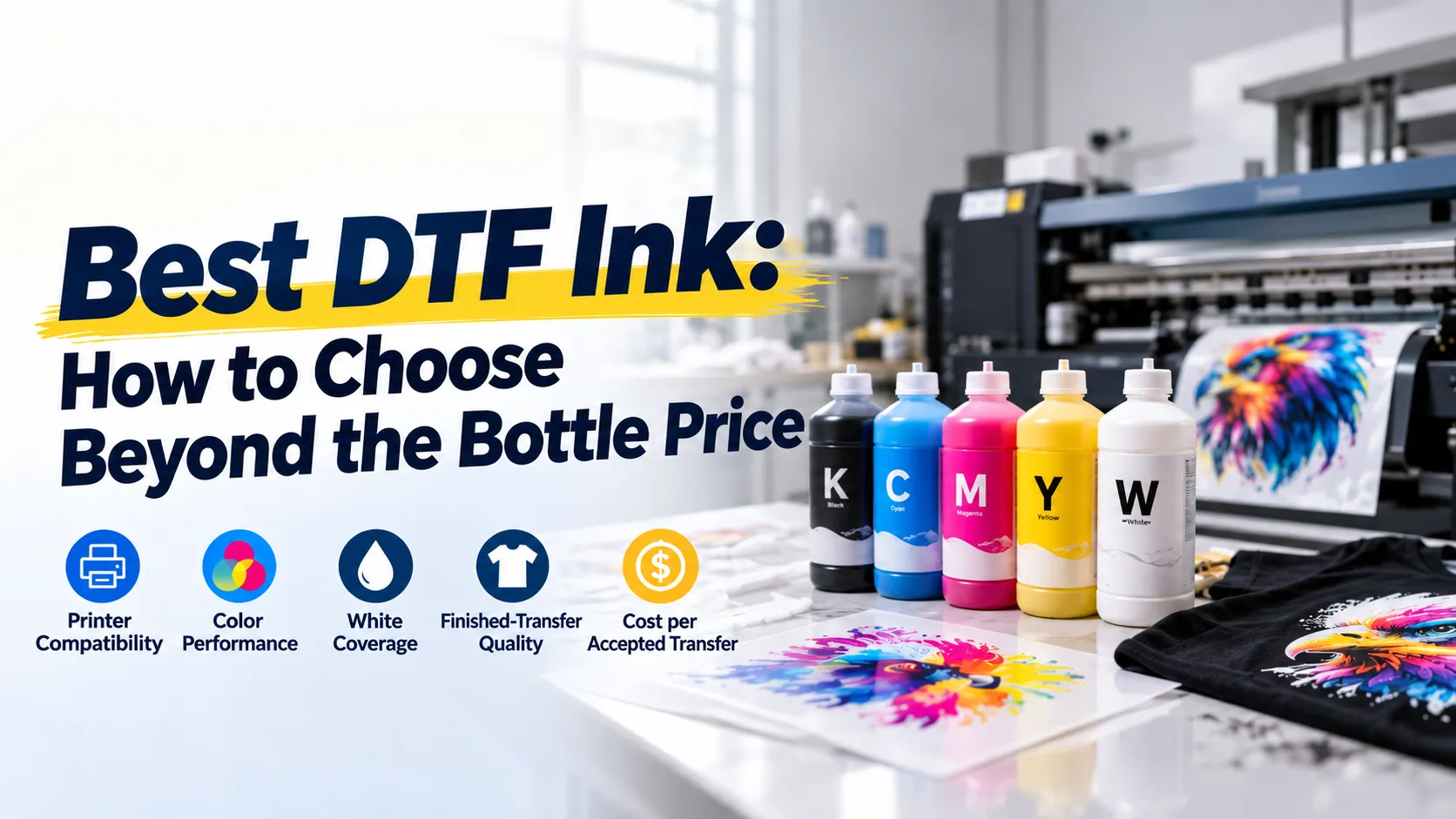
A cheaper bottle isn’t a saving if the next order needs extra cleaning or reprints. The best DTF ink is a supported match for the printer that delivers the required color, white coverage, and finished-transfer quality at a workable production cost.
Start with compatibility, test the finished garment, then compare cost per accepted transfer. A vivid supplier sample is useful, but it doesn’t show how the ink behaves in the equipment and workflow already in use.
Which DTF Ink Should Make the Shortlist?
For a printer with a specified cartridge or ink supply, start with the ink designated for that model. For an open bulk-ink printer, shortlist products that the equipment and ink suppliers support for the exact configuration.
Conventional textile DTF uses purpose-formulated pigment ink with transfer film and adhesive powder. Photo ink, sublimation ink, and UV-curable ink aren’t substitutes simply because the bottle mentions the same printhead brand.
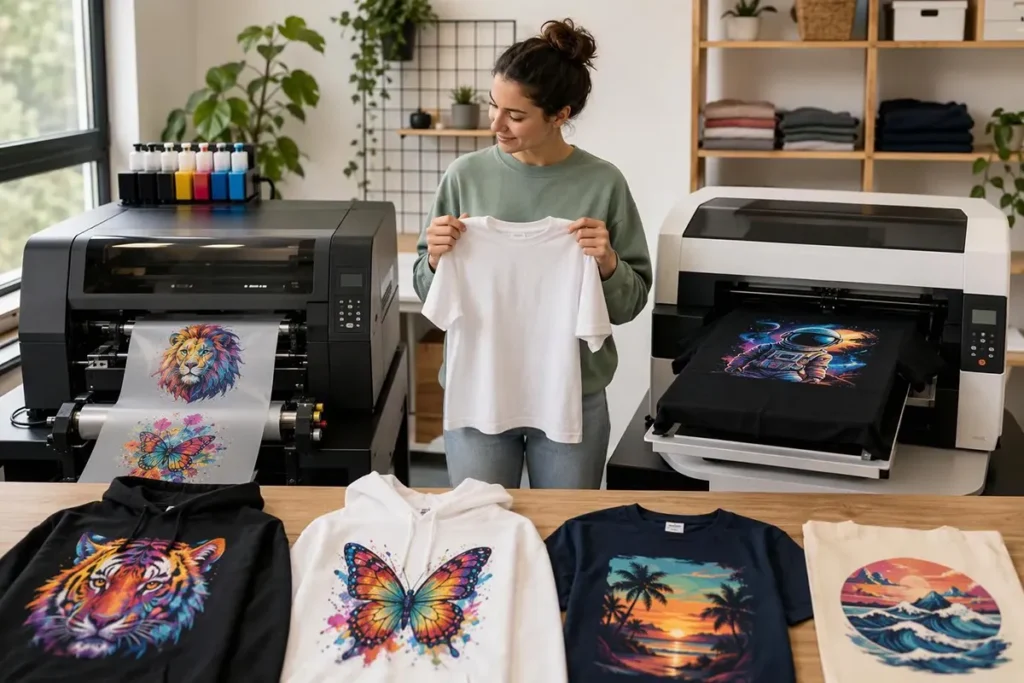
The right choice depends on the work being sold. Dark apparel puts white coverage under close scrutiny; brand merchandise needs repeatable color; stretch garments need the applied transfer checked on the actual fabric. A shop with irregular orders also needs an ink and maintenance routine that fits its idle periods.
When current ink meets those requirements, compare the proposed benefit against the cost of changing it. Switching to fix a supply problem can make sense; switching to cure an unresolved nozzle problem may leave the original fault untouched.
A Printhead Name Is Only the Starting Point
Record the printer model and version, full printhead designation, current ink product, and any ink-path modifications. Include whether the proposed change affects CMYK, white, or both.
An “Epson-compatible” listing doesn’t identify every machine, damper, ink line, or operating setting it covers. Even “i3200” is less specific than the full variant fitted to the printer.
Obtain compatibility information for that configuration, plus the applicable warranty and support terms. Keep the ink product identifier and batch number with the documents so an approved sample can be traced to the stock eventually delivered.
Don’t switch ink to diagnose a printer fault. If the baseline nozzle check is already poor, investigate it first; our guide to a DTF nozzle test that remains bad after cleaning covers that separate task.
Compare Color and White DTF Ink Separately
Color accuracy and white coverage solve different problems. A useful DTF printer ink trial needs samples that reveal both, at the print mode intended for production.
Color: Match the Order, Not the Brightest Sample
Use artwork with a repeat customer’s key colors, a gradient, fine text, and a solid fill. Compare applied samples under the same lighting, using a physical approved color target when matching matters.
Inspect detail, smooth transitions, color consistency between copies, and unwanted spreading at edges. More saturated red isn’t an improvement when the customer’s approved red is more subdued.
A new ink may need a new profile. An ICC profile helps the RIP translate colors for a particular printing condition; reusing the old profile without checking can confuse an ink comparison with a color-management problem.
Record the profile, resolution, pass count, ink limits, and white-layer settings. Our DTF RIP software guide explains the controls that sit between the artwork and printed output.
White: Check Coverage, Detail, and Repeatability
Evaluate white DTF ink on the dark fabrics normally sold, rather than judging it only on clear film. Include a solid white patch, small lettering, and color artwork with a white underbase.
Look for fabric color showing through, patchy coverage, missing detail, and white extending beyond the color edges. That last defect can involve underbase settings or alignment, so it isn’t proof of poor ink by itself.
More white ink isn’t automatically better. Compare the coverage and hand feel needed for the job at supported settings; a heavier layer can change ink consumption and the finished feel.
Follow the ink’s prescribed preparation and the printer’s white-ink routine. Circulation, tank agitation, and printhead capping do different jobs; a low-settling claim doesn’t remove the need for routine DTF printer maintenance.
To assess repeatability, retain the first approved sample and compare later output after normal production and an idle period covered by the operating instructions. Record nozzle condition and maintenance performed; one clean demonstration cannot establish long-term clogging performance.
Judge the Finished Transfer, Not Ink Alone
Ink interacts with the film coating, adhesive powder, curing, pressing, and fabric. A film sample can reveal print defects, but garment feel, stretch behavior, and wash performance need an applied sample.
DuPont’s P1600 application guide describes how film choice and profiling affect that ink’s output. It is a useful example of why the whole material combination matters, rather than a recipe for other inks.
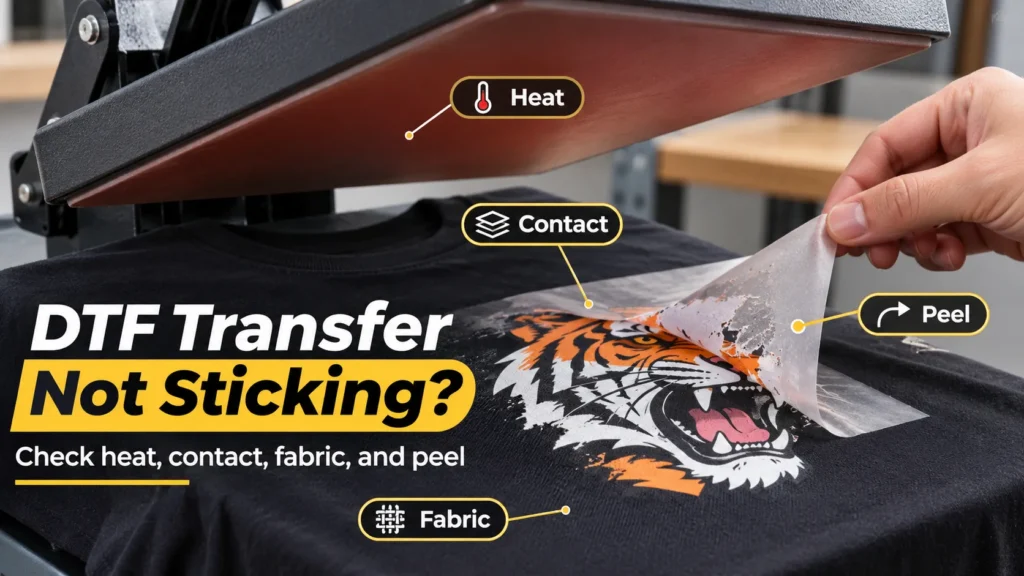
Start with the intended fabric and a supported material pairing. Inspect clean release, adhesion at the edges, surface feel, and stretch appropriate to the garment. Polyester and heat-sensitive fabrics need their own checks; success on a cotton shirt doesn’t establish the same result on every fabric.
Keep one unwashed sample as a reference. Wash the others using a recorded care routine, then compare fading, cracking, edge lifting, and changes in feel after the agreed number of cycles.
A “50 washes” claim is hard to compare without the fabric, ink–film–powder combination, application settings, washing conditions, and acceptance criteria. Use a documented test method when a customer requires one; a shop trial doesn’t become a certification because it includes repeated washing.
Locate the Defect Before Blaming the Bottle
Record the first stage where the problem appears. This prevents an adhesive or application problem from being mistaken for an ink failure.
| Primo problema evidente | What to compare before assigning a cause |
|---|---|
| Missing lines on the nozzle check | Baseline machine condition, ink delivery, and the prescribed maintenance checks |
| Spreading or uneven coverage on printed film | Film identification, profile, ink limits, nozzle condition, and white-layer settings |
| Poor release or lifting after application | Supported film/powder pairing, curing, pressing, peel instructions, and fabric |
| Fading, cracks, or lifting after washing | The retained unwashed sample, application record, care routine, and complete material combination |
The table guides the investigation; it doesn’t diagnose a defect from a photograph alone. Keep the matching samples and settings so a supplier can see when the result changed.
Run a Trial That Supports a Purchase Decision
A sample trial should answer whether the proposed combination can produce the work the business needs to sell. It should also show what changed from the current setup.
Use the same order, with each ink run under its supported conditions. Identical settings are useful only when appropriate for both products; forcing a new ink to use an unsuitable old profile doesn’t create a fair comparison.
- Save the baseline. Keep the current nozzle check, artwork, settings, approved garment, and material identifiers. Resolve known equipment faults before changing ink.
- Agree on acceptance. Set the required color, white coverage, readable detail, application quality, and wash checks before examining the candidate results.
- Complete the supported transition. Use the changeover procedure for the actual printer and inks, then record any new profile, film, powder, or operating settings.
- Run representative work. Print regular artwork and a difficult recurring design. Log accepted transfers, rejects, reprints, cleaning, and active labor through the same completion point.
- Retain the evidence. Label the samples and record the ink batch, test date, nozzle checks, settings, fabric, application details, and wash observations before increasing the order.
If ink, profile, film, and powder all change, the result compares two production combinations. It can justify choosing the better combination, but it cannot prove that the ink alone caused the improvement.
Keep the trial record short enough to use during production. A dated job sheet with labeled samples is more useful than a long checklist nobody completes.
Compare Cost per Accepted Transfer
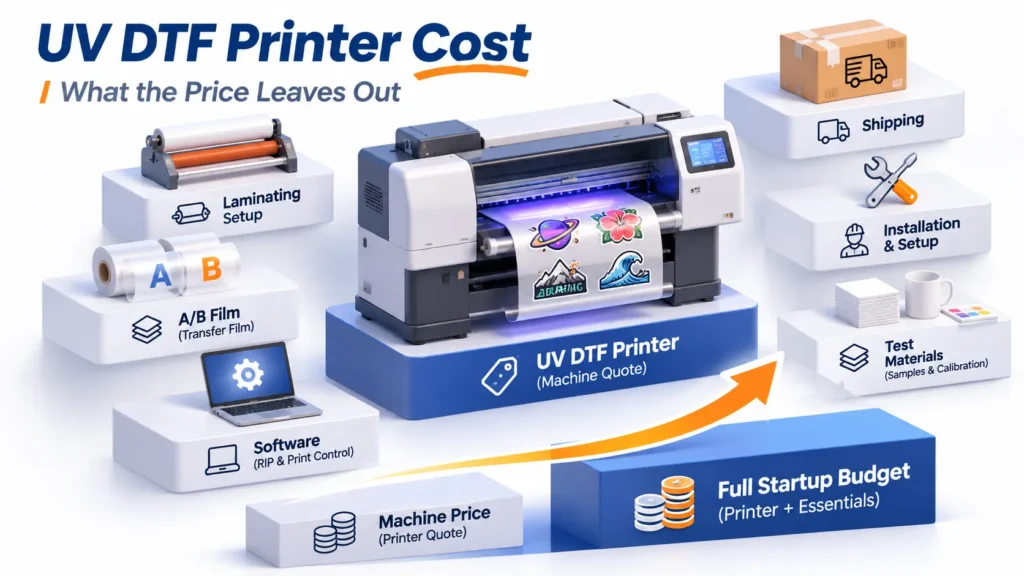
Bottle price matters, but it misses ink used in cleaning, rejected film, reprints, and operator time. Normalize quote units first: a price per kilogram cannot be compared directly with a price per liter without the product’s density information.
Calculate the cost at the output that can be sold. For a transfer business, stop at accepted transfers; for a garment business, add blanks, pressing, and the remaining work through accepted garments.
Trial cost per accepted transfer = relevant production costs ÷ accepted transfers. Include ink consumed in printing and cleaning, film, powder, cleaning supplies, active labor, and other measured costs through the chosen finish point.
Here is an illustrative comparison for two trials that each finish 100 accepted transfers, with reprints included in the costs:
| Voce di costo | Option A | Option B |
|---|---|---|
| Ink used in printing and cleaning | $12 | $16 |
| Film, powder, and other production costs | $28 | $26 |
| Active labor at the same hourly rate | $30 | $20 |
| Total trial production cost | $70 | $62 |
| Cost per accepted transfer | $0.70 | $0.62 |
These are assumed figures, not ink prices or measured product results. The example shows how higher ink spending can coexist with a lower transfer cost when other expenses fall.
Record initial flushing, parts, and profiling separately as changeover costs. Compare those costs with the expected savings over the planned volume before deciding whether a successful trial justifies switching.
Check Supply, Storage, and Product Documents
A supported ink still needs dependable replenishment. Compare delivered price, lead time, minimum order, white-ink availability, and how the supplier handles a suspected batch problem.
Buy enough to support production without exceeding usable storage time. Check manufacture and expiration information, storage requirements, and the separate limits for opened or installed ink. Bulk savings can disappear if stock expires before use.
Keep compatibility information, the technical data sheet, and the safety data sheet separate. Technical instructions address product and operating requirements; the SDS describes the identified chemical’s hazards, handling, and protective measures, as explained in Guida SDS dell’OSHA.
An SDS isn’t a wash-performance report or certification for every finished garment. If a supplier claims certification, check the named products, certificate validity, and scope rather than treating “certified” as approval of the whole workshop or final clothing.
Keep the approved sample and recipe with the reorder record. When a new batch arrives, compare representative output with that reference and record any formulation or product change before treating it as equivalent stock.
Plan the Ink Change Before Opening the Sample
Don’t top up with another brand simply because both labels say DTF. Compatibility with a printhead and compatibility between two ink formulations are separate questions.
DuPont’s P1600 application guide explicitly warns that pigment inks, including different products from one manufacturer, should not be assumed interchangeable. Its detailed changeover instructions apply to that product; the procedure for another ink and machine needs its own support.
Obtain the approved transition method, compatible flushing products, required replacement parts, and restart checks before beginning. Schedule the change with enough time to recover normal output before the next customer deadline.
Keep the last baseline nozzle check and the first checks after the change. If problems appear, stop and use the agreed technical-support route; improvised additives, cleaners, or repeated cleaning cycles can make the comparison harder to diagnose.
Iniziate scegliendo l’inchiostro compatibile con la vostra stampante e con la combinazione di materiali desiderata, accompagnato da istruzioni d’uso chiare. Una guida affidabile, confezioni di dimensioni pratiche e la disponibilità di ricambi sono più utili di un’etichetta non verificata che recita “miglior marca”.
Scegliere un inchiostro bianco compatibile che garantisca la copertura, il livello di dettaglio e la finitura desiderati sul tessuto scuro effettivo. Verificare la costanza dei risultati di stampa e la routine di manutenzione prescritta prima di procedere all’acquisto di grandi quantità.
Solo se le indicazioni dei fornitori confermano l'esatta combinazione e la dotazione. In caso contrario, utilizzare una sostituzione approvata; la presenza di un'etichetta di compatibilità sulla testina di stampa non garantisce che gli inchiostri possano essere miscelati.
No. La stampa DTF convenzionale su tessuto con pellicola e polvere richiede una formulazione DTF specifica; gli inchiostri fotografici, a sublimazione e induribili ai raggi UV sono destinati a processi di stampa diversi.
No. La compatibilità dell’inchiostro, le condizioni della macchina, la gestione, i tempi di inattività e la manutenzione sono tutti fattori importanti; è meglio confrontare i dati di funzionamento registrati piuttosto che prevedere l’affidabilità in base al prezzo.
Check the material combination, application settings, washing method, number of cycles, and pass criteria. A cycle count without those details doesn’t provide a fair comparison.
Choose the Ink Around the Work It Must Deliver
Keep the supported ink that meets the order requirements at the lowest verified total cost. Switch when a controlled trial shows a useful improvement or resolves a supply constraint, and the benefit covers the transition cost.
For Xinflying equipment, browse our DTF ink and consumables range, quindi request an ink recommendation and quote with the printer version, full head designation, current ink, film, powder, fabrics, and the problem being addressed.
Include the intended purchase quantity. That information helps narrow the product choice and purchase scope before a larger order is placed.